Picture the Moon not as a cold rock but as the largest power station in the solar system.
A company that has been building things since 1804 drew up a plan to do exactly that.
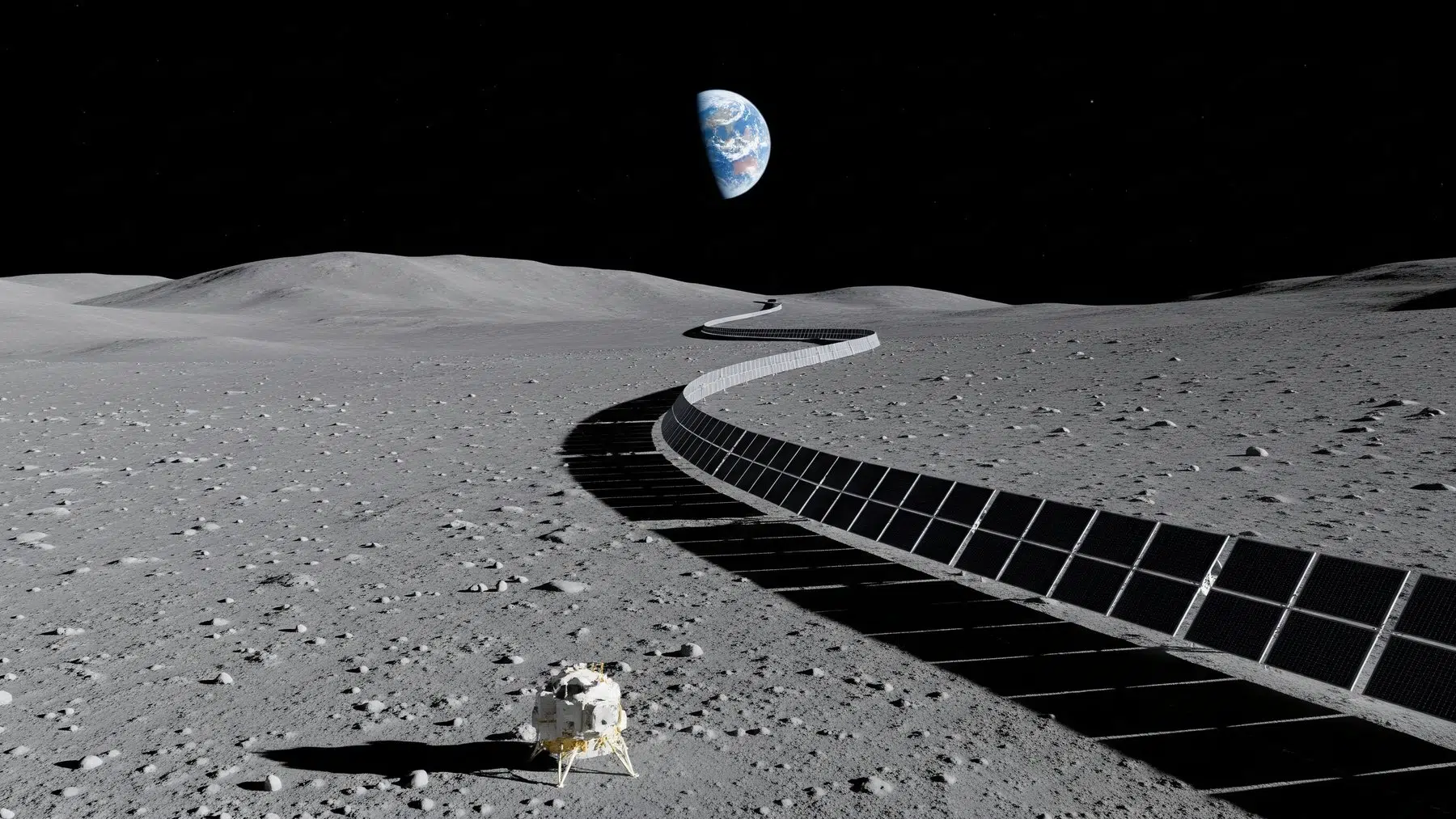
The idea involves wrapping the entire lunar equator in solar panels, converting sunlight into beams of energy, and firing those beams across 238,000 miles of space to your city’s power grid.
Most people who hear it assume it belongs in a science fiction novel.
Engineers who read the blueprints say the physics actually checks out, and that every major ingredient already exists on Earth today.
The disaster that made the Moon feel like an answer
In March 2011, a tsunami struck the coast of Japan and triggered a nuclear meltdown at Fukushima Daiichi.
A large share of Japan’s reactors went offline in the months that followed, and the country suddenly had a much sharper interest in alternative energy sources.
Shimizu Corporation had been developing the concept even before Fukushima, but the disaster gave it a sudden, urgent audience.
The firm is not a fringe startup.
Shimizu is a 222-year-old construction company with deep experience in large-scale engineering, and its Luna Ring proposal arrived at exactly the moment Japan needed bold answers.
The proposal was not a sketch on a napkin but a detailed concept, complete with materials sourcing strategies rooted in lunar geology and a hoped-for construction start of 2035.
Why the Moon beats every rooftop on Earth
Your home solar panels have a fundamental weakness: they go dark every single night.
Terrestrial solar farms also lose efficiency during overcast weather, and clouds can cut output by more than half on a bad day.
The Moon has none of those problems.
Free from clouds and atmosphere, a lunar solar belt could generate power continuously.
Shimizu estimates that space-based panels produce roughly twenty times the energy an equivalent array yields on Earth.
Because the ring surrounds the entire Moon, at least half of it is always lit by the sun, resulting in constant production around the clock, every day of the year.
No battery storage required, no backup gas turbine idling on standby, no weather forecast to check.
How you build the largest structure in human history
The engineering plan is strange, bold, and surprisingly detailed.
Shimizu’s proposal includes self-propelled production plants that would move along the lunar equator, manufacturing solar cells from local materials and installing them as they go.
Moon soil could be turned into concrete, ceramics, glass fibers, and even the solar cells themselves.
Robots tele-operated from Earth would handle ground leveling, excavation, and assembly around the clock.
The belt would vary in width, from a few kilometers up to 400 kilometers at its widest, stretching across a territory with no atmosphere to corrode it and no permit board to answer to.
That is the largest structure ever attempted by human civilization, built on another world by machines working alone.
The lunar surface never rusts, never floods, and never needs a permit from a local planning board.
The Luna Ring’s power and the stunning number inside it
Here is where the scale becomes genuinely hard to hold in your head.
Shimizu claimed the system could generate up to 13,000 terawatts of power, roughly 500 times the world’s current electricity consumption.
The energy would not sit on the Moon.
It would be converted into microwave and laser beams, then transmitted to ground-based receiving stations on Earth known as rectennas.
Shimizu also proposes using excess energy to produce hydrogen fuel, positioning the Luna Ring as part of a shift toward what the company calls a “hydrogen-based society.”
You can read about other bold solar experiments already running, like solar panels covering desert canals in Arizona, generating power while shielding precious water from the sun.
The honest catch, and why the idea keeps coming back
Skeptics have real ammunition.
An economist at Japan’s Institute of Energy Economics argued that lunar solar energy sounds good in theory but costs too much, pointing to geothermal power as a more practical path for Japan specifically.
Shimizu had secured no funding and no official endorsement from JAXA or NASA as of its last published update, and the Luna Ring remains part of the company’s “Dream” series, illustrated thought experiments rather than fully costed engineering blueprints.
Yet smaller pieces of the puzzle are moving forward.
Caltech’s Space Solar Power Demonstrator confirmed wireless power transmission in space using MAPLE, an array of flexible lightweight microwave transmitters, and that same mission beamed detectable power all the way down to a rooftop receiver on Earth.
That is a long way from 11,000 kilometers of lunar infrastructure, but it proves the physics holds.
For a sense of what visionary wind turbines in extreme environments can already accomplish, look no further than three spinning on a frozen hill in Antarctica, powering two research bases off a single wire.
The Luna Ring endures because it targets a real frustration: intermittency and land use.
A solar plant that runs every hour of every day, untouched by weather, remains a powerful engineering target even if the path stretches decades long.
The Moon has been sitting up there for 4.5 billion years, doing nothing useful for the power grid.
One firm from Tokyo decided that was long enough.
Read the whole thing?
Get the week's signal, not the noise
Our sharpest reporting on energy, climate and nature — free, once a week.