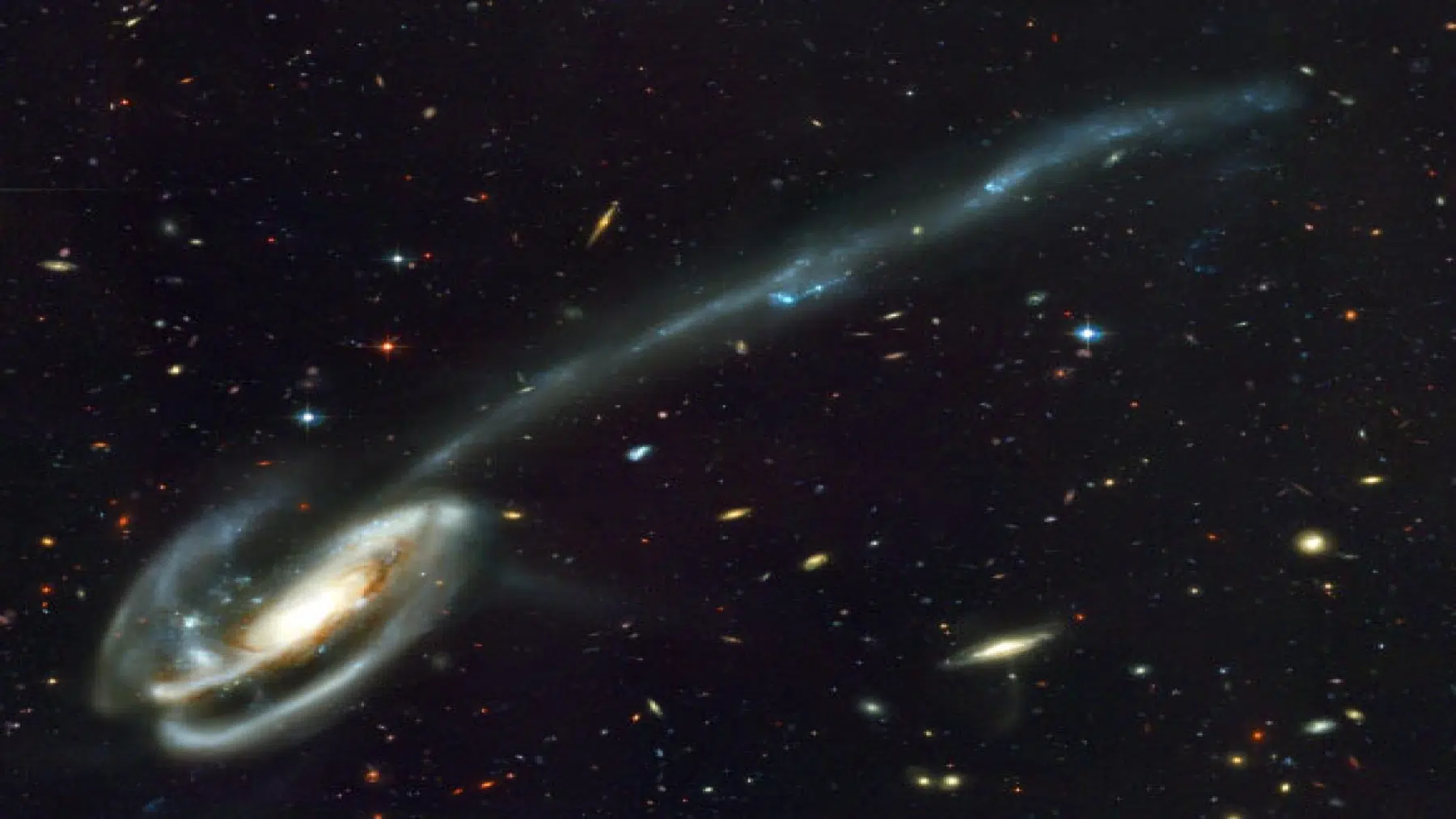
There’s a patch of sky that has astronomers at NASA intrigued. It doesn’t behave the way anyone expected. It consists of more than thirty galaxies, scattered across millions of light-years. All of these galaxies would appear to be pointing their jets and bright cores toward our side of the universe.
30 galaxies pointed at us: This patch of sky sparks curiosity at NASA
This bit of sky has galaxies in it. They aren’t in a neat ring, and it all looks rather messy. All of these are facing us, almost as if they all turned to face our part of the universe at the same time. Coincidence is not something that’s favored by experts. So, these findings have been exchanged between astronomers to figure out how this alignment could be.
Nobody’s panicking, nobody’s pushing any wild theory, but the pattern is just weird enough to keep everyone looking twice. Radio and X-ray observations rendered the first analysis of this. A few telescopes have picked up on this as well. What should be visible is a sight that’s more random and less uniform than this appears.
Why this cluster of galaxies has astronomers at NASA so interested in it
The jets these galaxies have are massive. NASA scientists don’t think the galaxies are circling Earth in any literal sense. The alignment does give off that unsettling impression, like we’re at the center of something. This alignment feels out of place.
Galaxies don’t coordinate. There’s no set and shared choreography about them. So, when more than 30 are doing the same thing, interest is piqued. Now, there are many reasons why this might be, and experts are slowly diving into every possible explanation they can find as to why these galaxies are behaving in this manner.
Why would these 30 galaxies be behaving in the way that they are?
The first thought is simple chance. Space is huge, and patterns sometimes appear just because numbers are big enough. But that feels like a bit of a stretch. When alignment calculations were run by researchers, the probability was not something they were comfortable with.
Another idea is that the galaxies may have formed along the same ancient filament of cosmic structure. If they were born out of material that stretched in a certain way, their spins could have lined up long before stars even lit up inside them. Rotation can shape those jets over billions of years. But this still doesn’t account for how neat this all appears to be and why these 30 galaxies are all facing us.
Earth is not the center of anything, but the alignment of these galaxies does play tricks on the mind
NASA would echo these sentiments. Earth is very seldom at the center of anything when it comes to space. Because the jets are angled toward us, the galaxies look like they’re arranged around us, even though they’re scattered across deep space with no real connection. They aren’t circling us.
The reason the pattern feels eerie is that the jets pointed at us appear brighter. They are a piercing sight, and because of this, they stand out as much as they do. We tend to notice what shines brightly and perhaps ignore what doesn’t. What NASA plans to do next about these 30 galaxies will be of interest to all avid followers of developments in space.
Multi-wavelength observations will be the focus for the time being. NASA wants to know if the jets really are aligned or if some measurement bias is sneaking into the data. Other telescopes will be used as well. If the alignment turns out to be the way it’s being viewed at present, researchers will have to rethink what they know about how these galaxies formed. How they are locked into this uniform position will also have to be looked at.
Read the whole thing?
Get the week's signal, not the noise
Our sharpest reporting on energy, climate and nature — free, once a week.