Thousands of inactive objects remain in orbit around Earth long after their useful lives have ended. Many were never designed to be removed.
Britain is taking steps to do something with two of them.
The British government supports an unmanned spacecraft project backed by approximately $80 million that aims to find and remove two satellites that were never built to be captured.
Operations are currently targeted to begin in 2029.
If successful, it will be the first time this is done to clean up several satellites at once.
Britain wants to remove two inactive satellites
This project is called the UK Active Debris Removal Mission.
The primary goal of this mission is clear. Find two British registered satellites that are not functioning and take them out of orbit.
The British government chose ClearSpace UK as its lead contractor to deliver the mission. Under the contract, ClearSpace UK will design, develop and deliver the spacecraft through an agreement valued at approximately $81 million.
Currently, the proposed timeline for the start of operations is 2029.
Success would mark the first time multiple satellites have been removed during the same debris-removal mission.
Robotic claws are expected to do the difficult work
Removing a “dead” satellite may seem like a simple task. However, locating, reaching, and catching objects in space that were never designed to be serviced, docked with, or taken back to Earth after launch is much harder.
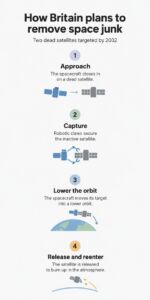
That is why the robotic arms exist. The spacecraft will utilize robotic capture systems to hold onto the satellites before lowering them into Earth’s atmosphere, where they will burn up.
The UK Space Agency says the mission is intended to demonstrate technologies for rendezvous, capture, and removal that could support future orbital service activities.
Dead satellites have become a growing challenge in orbit
Spacecraft do not cease to exist when their missions have concluded. Many remain in orbit because removing them is difficult and expensive.
As more satellites are launched, the number of inactive objects continues to grow. ClearSpace describes the mission as an effort to address that problem.
Instead of launching another satellite, the main goal of this mission is to remove existing hardware that no longer performs any function.
Although this mission is limited to only two satellites, it represents a very practical example of attempting to show if inactive spacecraft can be reliably identified, captured, and removed on an ongoing basis.
Capturing two satellites would be a first
This project is deliberately being approached from a minimalist perspective. Just two satellites.
Both are non-functioning British registered satellites in low Earth orbit.
Capturing even one would be challenging enough. Capturing two during the same debris removal mission would represent something entirely new.
No previous spacecraft has successfully removed more than one satellite during the same debris removal mission.
These two satellites provide more than just a test case. They will help demonstrate whether the technology can perform as intended in orbit under real-world conditions.
The technology could be used beyond debris removal
Removing two satellites is not the only thing this mission hopes to achieve. A greater aim exists above and beyond debris removal.
Technologies that are being developed for this program could also support future orbital servicing, assembly, and manufacturing activities. This greatly expands the implications of this mission.
The same capabilities could help maintain satellites or assemble structures in space. They could also support future commercial activities in orbit.
For now, though, the focus remains on two satellites that are currently not operating.
If Britain is able to capture and remove both, this mission will demonstrate a capability that has mostly existed as theoretical until now.
Read the whole thing?
Get the week's signal, not the noise
Our sharpest reporting on energy, climate and nature — free, once a week.