Coral does not grow back onto something that moves.
That is the problem at one stretch of seafloor off the southwest corner of Oahu, in about 40 feet of water outside a working harbor entrance.
The reef there is not gone.
It is broken into pieces the size of fists and dinner plates, and they shift every time a swell comes through, which they have done for fifteen winters.
Divers keep going back down.
They have hauled it off by the ton and glued living fragments back onto solid rock, and then found the field looking much the way it looked before.
Why the pieces never settle
A reef is a skeleton wearing a thin living skin.
Under the tissue is limestone laid down across centuries and cemented solid, which is what lets the structure stand against open ocean swell.
Break that frame and the physics invert.
Loose fragments have no anchor, so every wave nudges them, and the pieces on top grind the pieces underneath in an abrasive shuffle that never fully stops.
Coral larvae need to land and stay put.
One that settles on a rolling fragment gets crushed or buried within weeks, which is how a rubble field sits inside an otherwise healthy reef for decades and recruits almost nothing at all.
Nature does have a repair for this.
Coralline algae slowly bind loose pieces into a crust, but that binding needs relative stillness, and an exposed island slope in the trade winds offers none.
The morning the ship came in
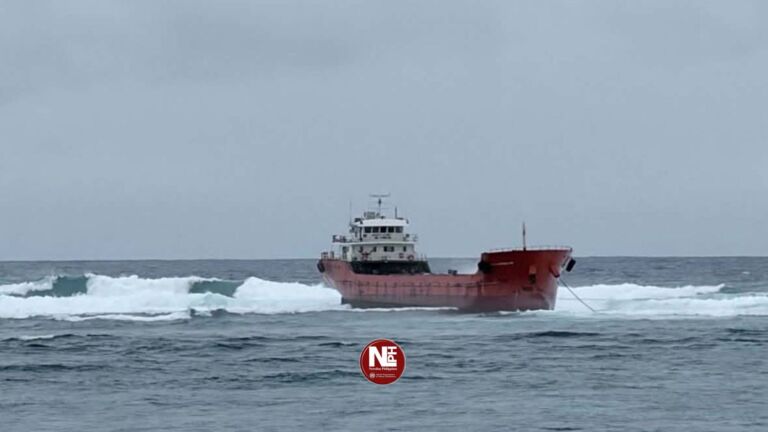
It was a routine inbound approach on a February morning.
A bulk carrier 734 feet long, Liberian flagged, riding low under a full load of coal out of Gladstone in Queensland, with a licensed pilot aboard.
At twenty five past seven it stopped.
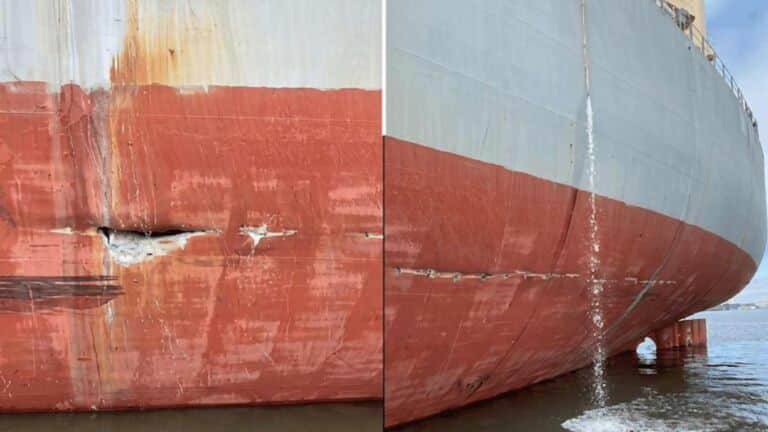
The hull came down on the forereef outside the harbor mouth, cracked, and took water into a fuel tank, though no fuel escaped into the channel.
Getting it off again took most of the day.
Crews flooded ballast on the port side to lift the starboard bilge clear, tugs pulled the ship free by mid afternoon, and the pilot’s tests came back all negative.
The owner said nothing had failed mechanically.
What the survey measured
The injury was mapped at 4,160 square yards.
That is less than a single acre, and inside it surveyors counted more than 100,000 broken, sheared and overturned coral colonies.
The framework underneath was gouged as well.
Emergency work in 2013 reattached 643 colonies of assorted species and sizes and carried close to 700 tons of rubble off the site.
Then everybody waited and watched.
In November of 2022 divers from the federal agency and the state found long sections of the pulverized reef still under loose rubble, with 45 percent of the replanted corals alive.
What the money bought
The bill for all of this was settled at a flat $700,000.
Two companies, the ship’s manager and its owner, paid that figure four years after the grounding, and it covers a hundred thousand destroyed animals at roughly seven dollars each.
The harder number came later.
A peer reviewed study of twelve years of monitoring set the zones that got active work against the zones left alone, and the outplants showed no advantage in density or size.
Recovery tracked how badly a spot was hit and how good the habitat under it was, not how much intervention it received.
The published paper says the outplanting design was probably at fault rather than the idea itself, but the impact zones still carried far more rubble than the reference reefs.
Florida hit the same wall from the other direction, where a restoration promise outran the budget until the funding ran out.
What is being tried on the rubble
The new idea is to stop the movement first.
Rubble stabilization pins the loose material down so a larva landing on it has a chance of still being there in a year, and coastal Hawaii had never tried it.
The gear list is unromantic.
Scuba tanks, painters’ buckets, PVC coated mesh, stainless steel rods, sacks of cement and sand, and a mud mixer bolted to a deck.
Divers took the wet mix down in lift bags.
Three weeks of work produced thirty plots, ten covered in pinned mesh, ten built as cemented boulder piles in layers, and ten controls left untouched.
The precedent is Caribbean.
Stabilized rubble in Puerto Rico went from no live coral to 14 percent cover, and the ruggedness of the surface more than doubled.
The plots were checked after the first winter swells and will be checked every six months from here.
Corals that eventually go on top may arrive the way they did on the Gulf floor, lowered to waiting agency divers and fixed onto concrete domes.
None of that answers the original question.
Whether a reef that took centuries to cement itself can be talked into doing it again in a decade, on a slope that never stops moving, with coral colonies arriving one bucket at a time.
Read the whole thing?
Get the week's signal, not the noise
Our sharpest reporting on energy, climate and nature — free, once a week.