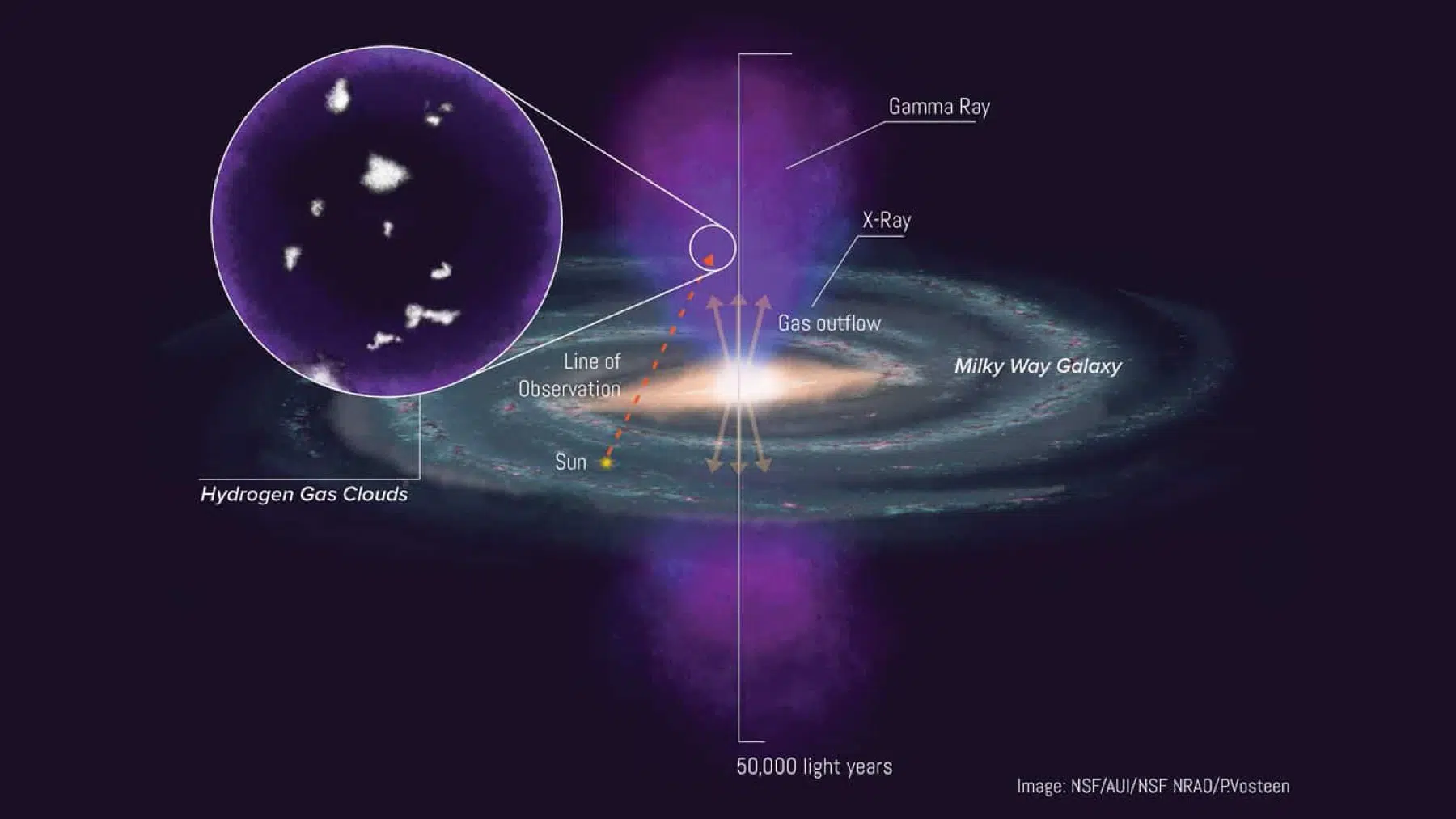
One of the most mysterious formations in the universe has revealed something new. Scientists do not know why there are cold hydrogen clouds inside a very hot area, 50,000 light-years in size, but the explanation could be hidden in the way elements behave in the cosmos. Unlike the public conception that there is no water outside of Earth, researchers have confirmed that there is indeed water on other planets, but it is inside an icy formation – which means there is no liquid water. However, now they still do not know what cold hydrogen gas is doing inside the Fermi Bubbles.
Fermi Bubbles have something inside that shouldn’t be there
In cosmology, Fermi balls are hypothetical structures that may have emerged in the early universe as a result of spontaneous symmetry breaking. They are often described as “charged SLAC-ball type structures” and are considered a form of non-topological soliton—quantum objects that remain stable and self-contained without having a solid outer boundary.
The name “Fermi ball” pays tribute to physicist Enrico Fermi, since these objects would be composed of fermions, the fundamental particles tied to his work. While these balls are associated with how black holes are formed in another theoretical field, the fact that there are cold hydrogen clouds inside the Fermi Bubbles is making scientists wonder what else this means. So far, they could only come to one conclusion.
The cold clouds inside the bubbles: What is going on?
Ballooning above and below the Milky Way’s center like a giant hourglass, the Fermi bubbles are some of the galaxy’s strangest features. These two enormous lobes of plasma have been spilling out of the galactic core for millions of years, stretching today across almost 50,000 light-years — about half the width of the Milky Way.
New observations from the U.S. National Science Foundation’s Green Bank Telescope in West Virginia have uncovered something unexpected inside the bubbles: enormous clouds of cold hydrogen gas that somehow remain intact despite being surrounded by scorching plasma. Researchers believe these “ice cubes” are the leftovers of much larger formations that emerged from the galaxy’s center a few million years ago.
Rongmon Bordoloi, an associate professor at North Carolina State University and lead author of the study, compared the process to dropping ice into boiling water — larger chunks survive longer, even while they slowly dissolve. His team argues that the survival of the cold clouds may point to a more recent outburst from the Milky Way’s central black hole than scientists previously assumed.
Nothing can come close: It’s too hot
The Fermi bubbles were first identified in 2010 by NASA’s Fermi Gamma-ray Space Telescope. Although they rival the galaxy in scale, they are only visible in gamma rays and overlap with another puzzling structure, the eROSITA bubbles, seen in X-rays. The plasma inside the Fermi bubbles reaches more than a million kelvins — close to two million degrees Fahrenheit.
Scientists think that the bubbles are the aftermath of a violent eruption from the galaxy’s black hole, which blasted twin jets of matter above and below the galactic plane, sweeping up gas and dust on the way out. The cold clouds revealed by the Green Bank Telescope may be what remains of that event.
Theory about the Fermi Balls’ role in the formation of black holes
At the Center for Theoretical Physics in Seoul, researchers Ke-Pan Xie and Kiyoharu Kawana have put forward a fresh idea about the early universe. They argue that in the first second after the Big Bang, clusters of so-called Fermi Balls may have collapsed into tiny black holes. These black holes, scattered across the cosmos, could be a key piece in solving the mystery of dark matter — the invisible substance thought to shape galaxies and large-scale cosmic structures.
Read the whole thing?
Get the week's signal, not the noise
Our sharpest reporting on energy, climate and nature — free, once a week.