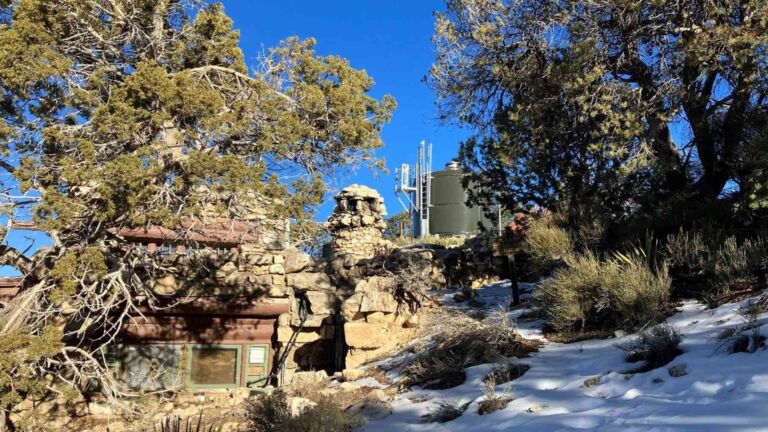
Free climbers scaling a restricted section of Monte Cònero, on Italy’s Adriatic coast, spotted something unusual embedded in the limestone: more than 1,000 impressions, some etched into a cliff face more than 100 metres above the sea.
When scientists began investigating, the markings didn’t match anything previously catalogued at the site. What they found — or think they found — may be a frozen record of a mass event from 83 million years ago that no one had anticipated.
Strange marks on a forbidden cliff face
The impressions appear in two separate locations. One cluster sits on a ledge more than 100 metres above the ocean; another was found on a fallen shelf that now rests at La Vela beach. Together, they number over 1,000 individual marks pressed into Cretaceous-era limestone — rock formed from fine sediment deposited on a shallow seabed roughly 83 million years ago.
The climbers were in an area off-limits to the public. Their photos eventually reached Alessandro Montanari at the Geological Observatory of Coldigioco, who recognized that something worth investigating was embedded in that cliff face. With permission from the managers of the Cònero Regional Park, Montanari and his colleagues conducted formal surveys both on foot and with drones.
Ruling out suspects: from fish to sea turtles
Identifying the source of the impressions meant working through a short list. At 83 million years ago, only two groups of vertebrates lived in the oceans: fish and marine reptiles. The research team moved through the candidates methodically — ruling out fish, plesiosaurs, and mosasaurs based on anatomy and locomotion before arriving at sea turtles as the most plausible explanation.
Anthony Romilio at the University of Queensland notes that if the markings are confirmed as sea turtle traces, they would “easily be the most numerous in the world” — a record-breaking collection by a significant margin. Romilio, however, hasn’t visited the site or examined high-quality images firsthand, a caveat that shapes his assessment considerably.
An earthquake that froze a moment in time
Preserving any impression in a soft, active seafloor is extraordinarily difficult. Sediment shifts, currents disturb the surface, and biological activity erases fine detail fast. For more than 1,000 prints to survive intact across 83 million years, they’d have needed burial almost immediately after being made.
The team’s leading hypothesis centers on an earthquake. Montanari describes a scenario in which a strong seismic event simultaneously panicked a large group of turtles resting in a shallow, nutrient-rich environment and triggered rapid sediment deposition over their tracks. The animals fled toward open water, their paddle strokes pressing into the soft seafloor — and the earthquake’s aftermath sealed those traces almost instantly.
Burial would need to have been near-simultaneous with the movement, not minutes or hours later. That specificity is part of what makes the scenario compelling to some researchers and genuinely difficult to verify for others.
Not everyone is convinced
Romilio’s skepticism is direct. Without having examined the site in person or reviewed detailed imagery, he argues the surface marks don’t display the spacing, rhythm, or anatomical characteristics expected from sea turtle flipper strokes. His conclusion: the impressions may not be biological at all — they could be abiotic structures, geological formations rather than traces left by living animals.
This isn’t a minor objection. Distinguishing true trace fossils from natural rock formations is a specialized discipline, and misidentification has occurred before in paleontology. Montanari’s team acknowledges they can’t be certain about the origin of the marks, and the turtle-stampede scenario remains exactly that — a hypothesis, not a confirmed finding.
To move the research forward, the team is now recruiting specialist ichnologists, scientists who study trace fossils and ancient trackways. Their involvement will be essential for evaluating whether the impressions carry anatomical signatures of biological origin and whether the overall pattern is consistent with coordinated animal movement.
What comes next for Monte Cònero
The next phase of research will likely determine whether this site earns a place in the paleontological record or gets reclassified as an unusual geological feature. Ichnologists bring specific tools and frameworks for this kind of analysis, comparing spacing, depth, and shape against known trackway databases from sites around the world.
If the sea turtle interpretation holds up, the implications extend well beyond record-keeping. A mass trackway from the Cretaceous, potentially triggered by a seismic event, would offer a rare window into animal behavior from a period when the world looked very different. For now, the cliff face at Monte Cònero holds its answer, waiting for the right specialists to ask the right questions.
Read the whole thing?
Get the week's signal, not the noise
Our sharpest reporting on energy, climate and nature — free, once a week.