Miles below the surface, where sunlight gives out completely, pressure builds to crushing extremes, and temperatures hover just above freezing, life has found a way — and it looks nothing like what we know up here.
The creatures thriving in that darkness don’t require a telescope or a space mission to qualify as alien. They live on Earth, in our own oceans. Scientists estimate that roughly one million deep-sea species remain undiscovered, and the ones we have already found — transparent skulls, projectile jaws, bodies made almost entirely of water — already strain the imagination.
A world without sunlight — and the creatures built for it
The deep ocean is not simply dark. Pressure can exceed 1,000 times what we experience at sea level, temperatures hover just above freezing, and no ray of sunlight has ever touched the seafloor. For most of human history, we assumed little could survive there.
We were wrong — spectacularly so.
Scientists estimate that roughly one million deep-sea species remain undiscovered, and even the ones we have found are poorly understood. Many have been observed only a handful of times, because their habitat is so vast and so difficult to reach. Sending equipment to those depths is expensive, technically demanding, and often unreliable. In many ways, we know more about the surface of the Moon than we do about the bottom of our own oceans — not a metaphor, but a genuine scientific reality.

Masters of light in total darkness
In a place where sunlight never arrives, some animals have learned to make their own.
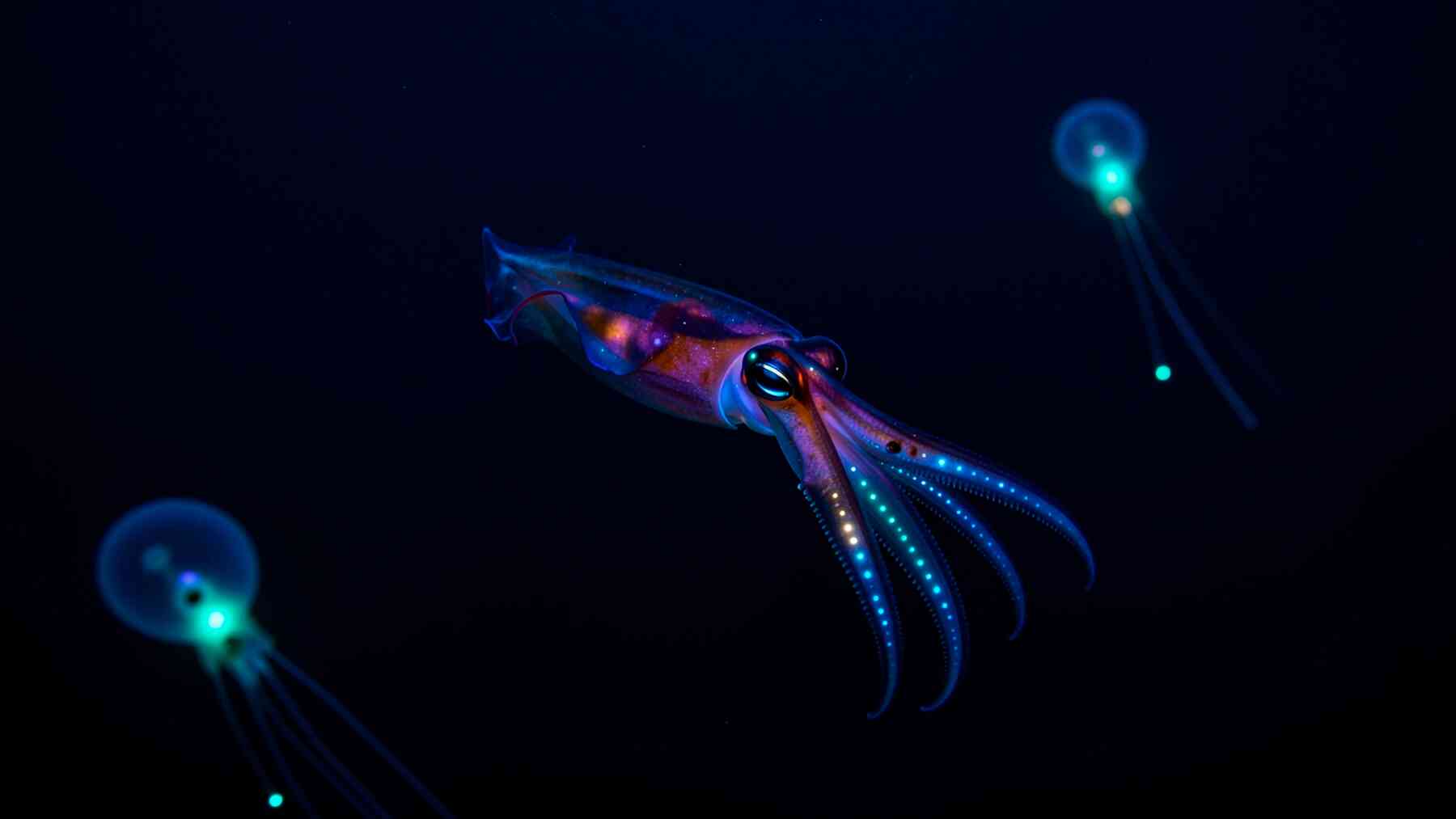
The vampire squid drifts through the deep, suspended in the water column, using long filament-like appendages to collect “marine snow” — tiny particles of organic matter drifting down from above. When threatened, light-producing organs called photophores near the tips of its arms generate bursts of light that may confuse predators long enough for the squid to escape. Its dark, cloak-like webbing and glowing eyes complete an unmistakable silhouette.
The anglerfish takes bioluminescence somewhere else entirely. Rather than using light defensively, it dangles a glowing lure from its head to draw fish and crustaceans into striking range — powered by a natural chemical reaction, not electricity or fire. Only females carry it. Males of the species live very differently, and far more briefly. What connects these two animals is a shared solution to the same impossible problem: in total darkness, producing light can mean the difference between eating and starving.
Bodies that defy expectation
Some deep-sea creatures do not just behave strangely. They look like something a biology textbook would reject outright.
The barreleye fish has a transparent, fluid-filled head. Through it, you can watch its bright green eyes rotate inside its skull — pointing upward to detect prey silhouetted against faint light from above, then swiveling forward when it is time to feed. Researchers at the Monterey Bay Aquarium Research Institute had to observe a live specimen before the full picture came into focus; collected specimens had lost their transparent tissue during retrieval, leaving scientists with an incomplete picture for decades.
The goblin shark is stranger still — semi-translucent skin, blood vessels visible beneath the surface, a long flattened snout, and jaws that shoot forward to snatch prey before snapping back into place. Encounters are so rare that scientists still have very little data on the species. Both animals illustrate how thoroughly the deep sea can overturn biological intuition.

Survivors from another era
Not every unusual creature down there is a recent evolutionary experiment. Some have barely changed in hundreds of millions of years.
The giant isopod looks like a roly-poly insect scaled up to the size of a housecat. These crustaceans live as deep as 7,000 feet below the surface, grow more than a foot long, and carry a fossil record stretching back over 300 million years. Food is scarce at those depths, so they have adapted to survive for years between meals by scavenging organic matter that drifts to the ocean floor.
Sea jellies are older still — some date back 500 million years or more. Composed of at least 95 percent water, they lack blood, a heart, and a brain. Their bodies are gelatinous, sometimes nearly transparent, occasionally pulsing with neon color, trailing tentacles that can stretch extraordinary lengths. Far from passive drifters, they are active participants in deep-ocean ecosystems — proof that extreme conditions do not always demand constant reinvention.
The dumbo octopus and what ‘otherworldly’ really means
Not every deep-sea creature looks threatening. The dumbo octopus, named after the Disney elephant, is genuinely charming — small, round, equipped with ear-like fins it flaps gently to move through the water. It measures just 8 to 12 inches on average and lives between 1,000 and 13,000 feet below the surface, making it one of the deepest-known octopus species.
It also has no ink sac. At those depths, predators are rare enough that the defense became unnecessary over evolutionary time. Something does not need needle-like teeth or a projectile jaw to qualify as profoundly strange. An octopus gliding silently through absolute darkness, thousands of feet underwater, having quietly shed a defense mechanism its cousins still rely on — that is extraordinary in its own right.
Why the unknown depths matter
The deep ocean is not just a cabinet of curiosities. It regulates global climate, stores carbon at a massive scale, and supports biodiversity that scientists are only beginning to map. What happens down there affects what happens up here in ways we do not yet fully understand.
Most of the deep sea remains unexplored. The ecosystems already being affected by warming, pollution, and deep-sea mining may contain species we have never seen and relationships we cannot yet describe. Protecting something you do not fully understand requires humility — accepting that the most significant discoveries may still be ahead, waiting in waters we have never reached. Earth’s strangest life forms are not in science fiction. They are real, they are here, and they raise a question worth sitting with: if life can look this alien on our own planet, what assumptions about life itself might we need to rethink?
The full work to recover and summarize data on these species, along with other newly discovered ones, is available on the Ocean Conservancy website.
Read the whole thing?
Get the week's signal, not the noise
Our sharpest reporting on energy, climate and nature — free, once a week.