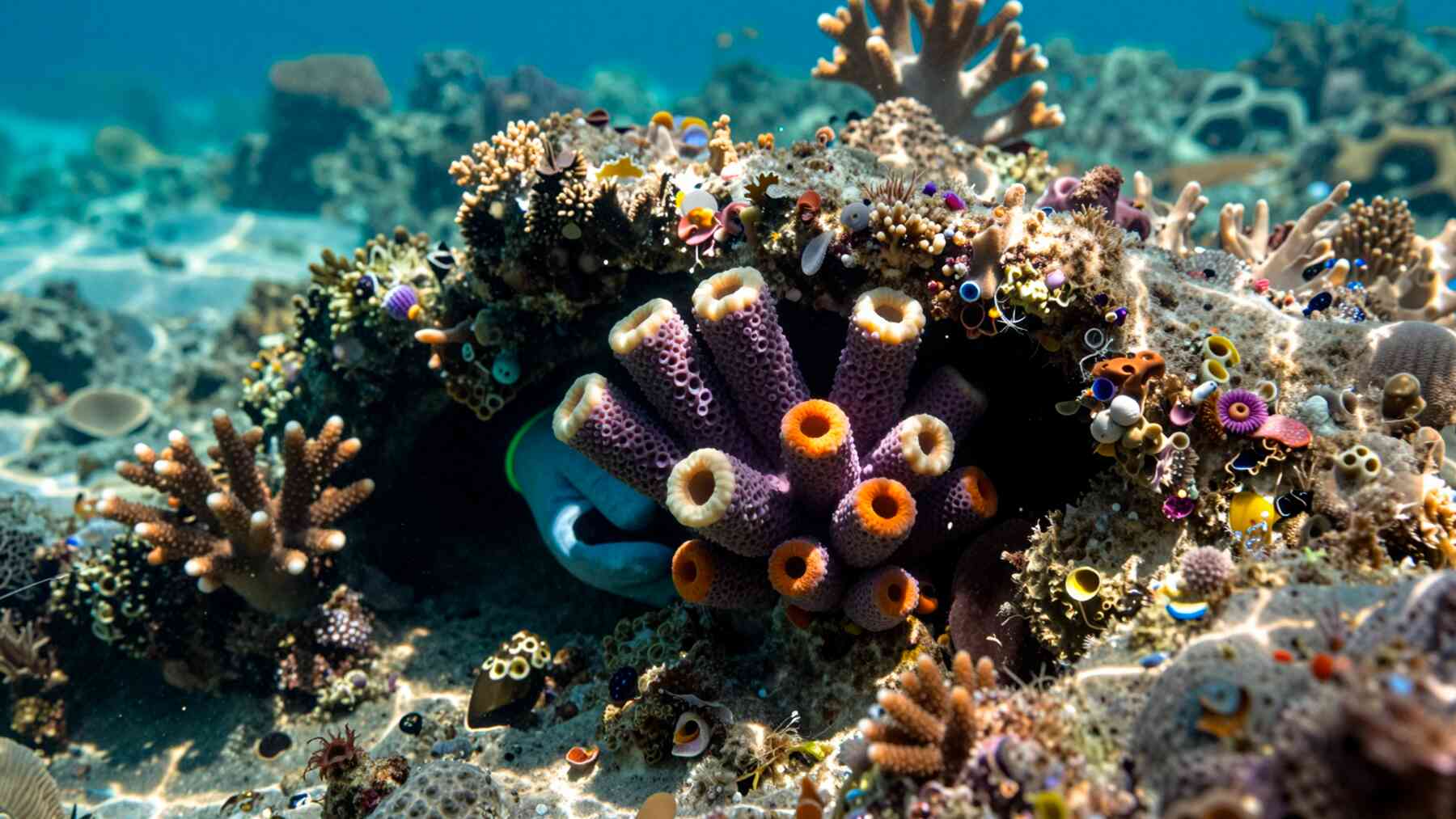
Kāne’ohe Bay, on the windward coast of O’ahu, has been one of the most studied coral reef systems in the Pacific for decades. Yet tucked inside the nooks and crannies of its small, isolated patch reefs, life has been hiding in plain sight.
Researchers at the Hawai’i Institute of Marine Biology recently identified 10 previously unknown sponge species from those reefs — results published across two journals in rapid succession. The scale of the find caught even the scientists off guard. Sponges are among Earth’s oldest animal lineages and play a central role in reef nutrient cycles, yet science has barely begun to map how many species actually exist.
A reef studied for decades, still full of secrets
Moku o Lo’e is a small patch reef in Kāne’ohe Bay — and home to the Hawai’i Institute of Marine Biology. Researchers have worked there for decades, yet species counts kept coming up short.
Previous surveys had catalogued only around 30 sponge species in the bay. The explanation was simple enough: earlier studies weren’t looking in the right places. The tight, shadowed crevices where sponges actually live were largely ignored. Once researchers started targeting those hidden spaces, the numbers changed fast.
How do you find a species no one knew existed?
The team used autonomous reef monitoring structures, or ARMS — devices that mimic the reef’s cryptic environment, the same dark, sheltered spaces sponges prefer, allowing collection without damaging the surrounding structure.
After gathering specimens, researchers ran DNA analysis first. That narrowed down what they were working with. Then came the deep dive into scientific literature: lead author Rachel Nunley built a database and compared physical characteristics against known relatives worldwide. This integrative taxonomic approach — combining genetic data with detailed morphological comparisons — confirmed what the DNA had hinted at.
Why sponges are so hard to study — and so easy to overlook
Sponges present a frustrating combination of obstacles. They’re tiny and fragile, with very few visible features that distinguish one species from another. Without specialized tools, identification is nearly impossible.
Their habitat compounds the problem. Collecting from reef crevices risks damaging the structure around them — the very thing researchers are trying to protect. Sponge lifespans can also be as short as two months, meaning a population present one month may be gone the next. As Vicente notes, taxonomy is equally unforgiving: missing a single morphological detail can mean misidentifying an entire species.
Ancient animals with a critical job in the reef
Sponges are among the oldest multicellular lifeforms on Earth. That alone makes them scientifically significant, but their ecological role matters just as much.
Nutrients are scarce in remote island reef systems like Hawai’i. Sponges help cycle those nutrients, supporting the broader reef community in ways scientists are still working to understand. As coral reefs face escalating climate-related threats, knowing which species are present — and what each one actually does — becomes harder to ignore.
The 10 new species reflect that complexity. Some appear to be native to Hawai’i; others may have been introduced from the Caribbean or the Western Indo-Pacific, raising questions about how non-native sponges interact with local ecosystems.
Named in Hawaiian — and just the beginning
When it came time to name the new species, the team turned to Native Hawaiian stories and the Hawaiian language. Each name was chosen to honor either the mo’olelo of Moku o Lo’e or to reflect a diagnostic physical trait of the species using ʻŌlelo Hawaiʻi.
One example: “Lo’e” references the sister of three brothers, a figure from Hawaiian legend associated with keeping honesty within the family. It’s a deliberate choice — connecting scientific discovery with the place and culture it came from, rather than treating naming as a formality.
The work is far from finished. The team has already collected over 1,000 specimens from Kāne’ohe Bay’s cryptic reef fauna, and ARMS have been recovered from five Pacific ecoregions. Future research aims to determine which species are endemic to Hawai’i, which are native but more widely distributed, and which have been introduced. Mapping those distinctions across the broader Hawaiian Archipelago and Oceania could reshape what scientists know about sponge biodiversity in the Pacific — and how much of it is still waiting to be found.
Read the whole thing?
Get the week's signal, not the noise
Our sharpest reporting on energy, climate and nature — free, once a week.