In the spring of 2005, a crack appeared in the Ethiopian desert almost overnight.
It stretched for 35 miles in just a few days, splitting the ground so fast that local herders watched it happen.
Scientists who flew in to measure it had never seen anything like it at the surface.
Cracks like it are usually the work of ages, not a single week.
That crack was not a freak event.
It was a glimpse of something that has been building for 30 million years.
A continent pulling itself apart
The East African Rift runs for roughly 3,700 miles, from Ethiopia south toward Mozambique.
Along its length, two huge sections of the African continent are being pulled in opposite directions.
The slow churn of hot rock deep in the mantle is driving them apart.
The movement is only about one inch per year.
You could not feel it shift if you stood right on top of it.
That sounds trivial until you learn it has been happening since before our earliest ancestors walked upright.
In the stretch crossing Kenya and Ethiopia, the ground has already dropped in places.
It has formed a long sunken valley flanked by steep walls hundreds of feet high.
That valley is not just scenery, it is the first chapter of something enormous.
What a new ocean looks like at the start
Most people picture an ocean forming as water rushes in from somewhere else.
The real process is the opposite, the land tears apart first.
It drops lower and lower, and only much later does the sea find the gap.
Geologists compare East Africa now to the Atlantic about 200 million years ago.
Back then there was no Atlantic, only a widening crack in a single supercontinent.
That crack became a rift, the rift became a shallow sea, and the sea became an ocean.
East Africa sits at the earliest stage of that same story.
In time its rift floor could fill with water and become a brand new ocean that reshapes the whole map.
The record buried in the valley floor
Because the rift has been slowly sinking for millions of years, it acted as a natural trap.
Sediment, ash, and the remains of animals settled into it and were sealed away.
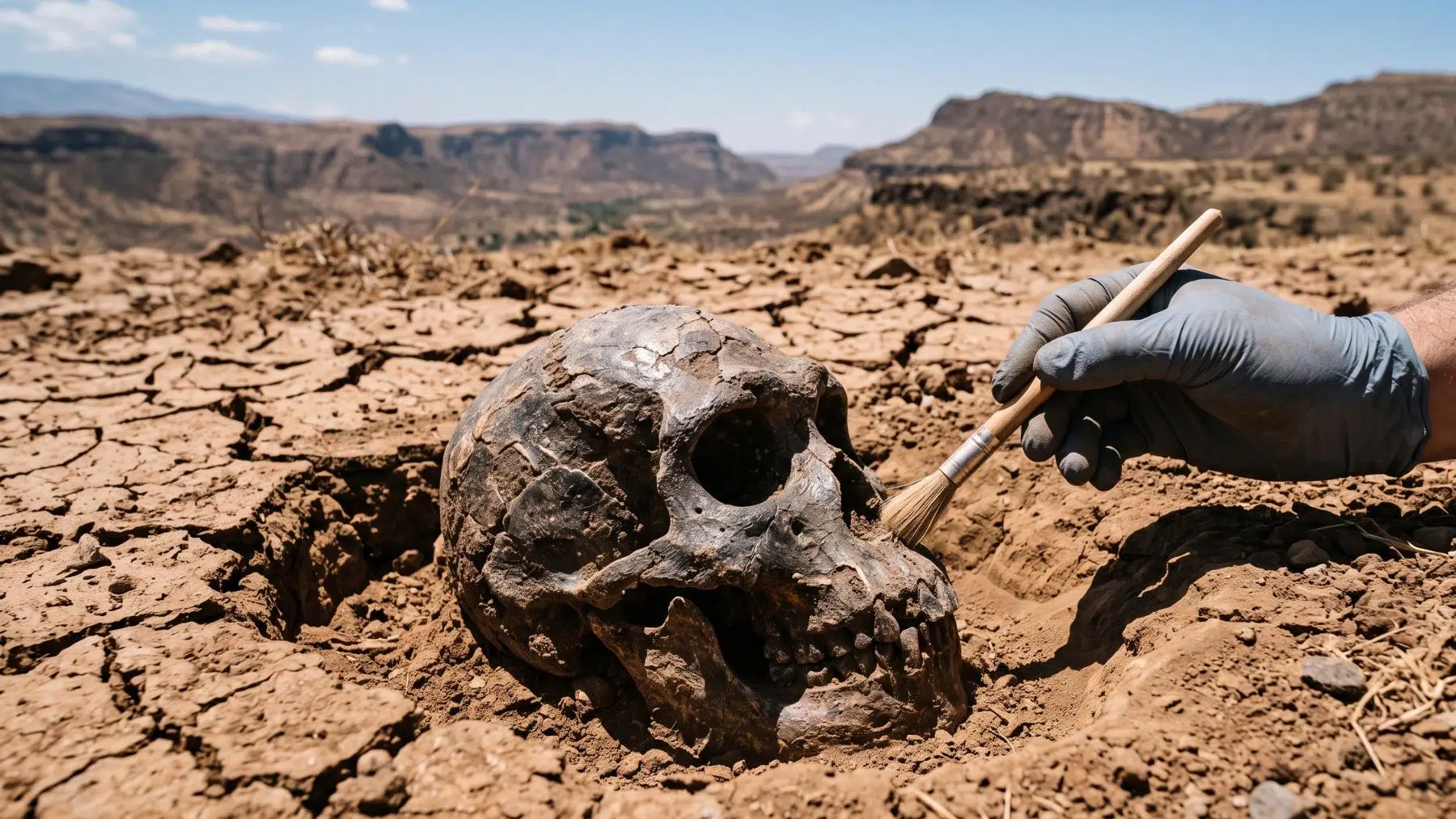
That is why this valley holds one of the richest fossil records on Earth.
Few places pack so much of our own deep story into one stretch of ground.
According to one review, the Turkana Rift alone has yielded more than 1,200 fossils of human ancestors.
That is roughly a third of all such fossils ever found across Africa.
Lucy, the famous 3.2 million year old skeleton, came from a rift site in Ethiopia.
Turkana Boy, one of the most complete early skeletons, came from the shores of Lake Turkana.
The same forces splitting Africa apart also preserved our ancestors below the surface.
The hidden force doing the splitting
Beneath the rift, a massive plume of hot rock is pressing upward against the base of the crust.
It domes the land upward before pulling it apart from below.
This is the same process that built Iceland in the middle of the Atlantic.
In East Africa the plume is so large that it has spawned two separate rifts.
The Eastern Rift runs through Ethiopia and Kenya, and the Western Rift curves through Uganda and Tanzania.
Where the two arms meet in the south, the continent will one day fully separate.
The Horn of Africa, and everything east of the rift, will drift off as its own landmass.
That new continent would carry its own coastline and its own weather.
It would become a brand new continent, riding a fresh ocean between itself and the rest of Africa.
A landscape still cracking open
The 2005 rupture in Ethiopia was not a one time moment.
Since then, geologists have recorded hundreds of smaller earthquakes along the rift each year.
Erta Ale, a nearby lava lake, has stayed active for more than a century.
The ground in parts of the region has dropped by as much as 20 feet in intense events.
According to one account, villages near the rift have had to move as fissures opened beneath them.
For the people living along this fault, the geology is not abstract at all.
It shakes their homes and reshapes their land within a single lifetime.
Yet the bigger picture is one of remarkable creation, echoed in other hidden worlds like an ice core and a NASA find.
A new ocean arrives one inch a year, one crack at a time, on a planet still reinventing itself.
Read the whole thing?
Get the week's signal, not the noise
Our sharpest reporting on energy, climate and nature — free, once a week.