Ling Li’s lab was chasing a mechanical puzzle. His team at Virginia Tech wanted to understand how sea stars build skeletons riddled with pores yet somehow stay strong — a trick that had already earned their earlier work a journal cover.
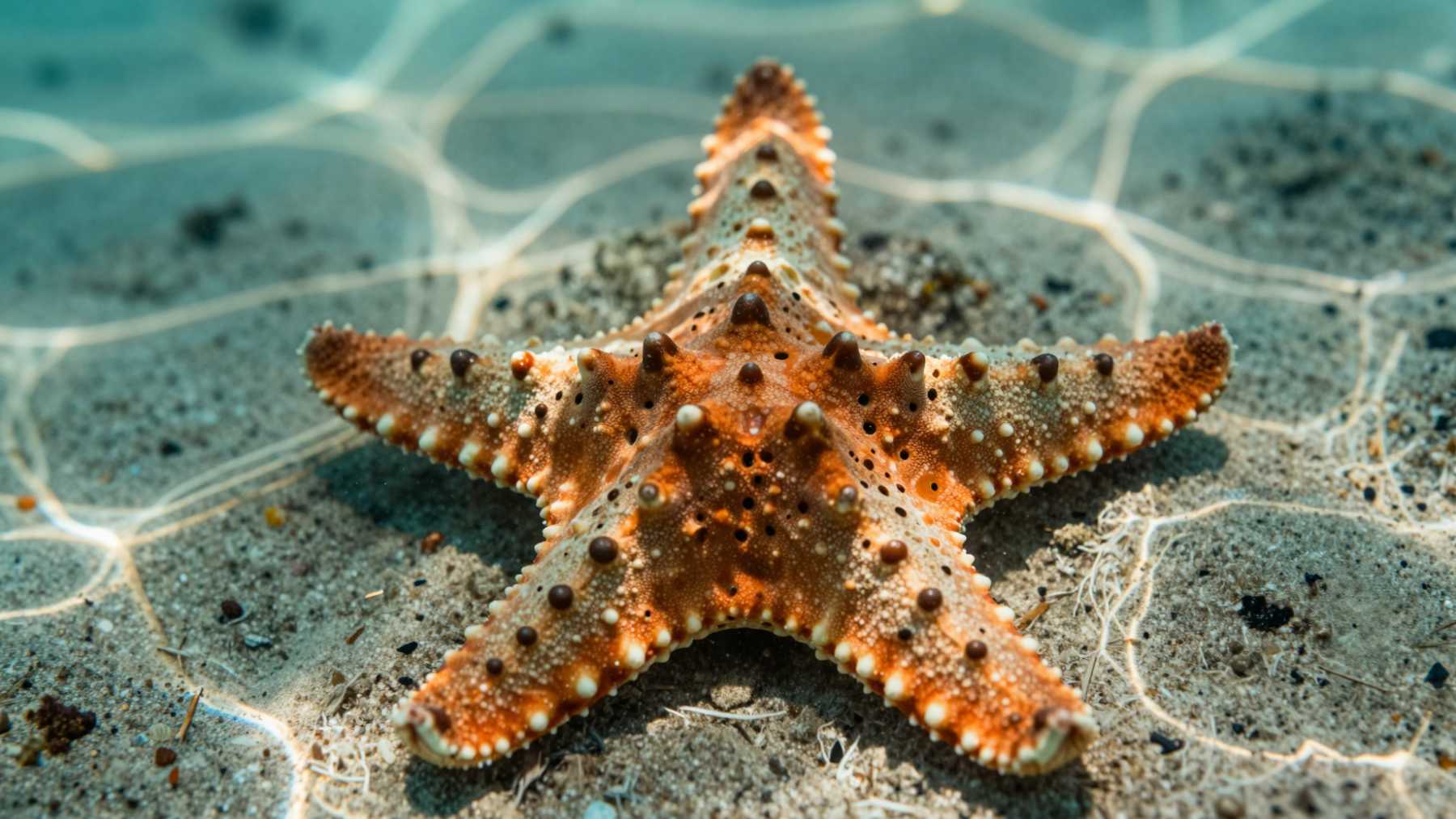
Then, while examining the arm tips of Protoreaster nodosus, a knobby tropical sea star, researchers noticed something that had nothing to do with strength. Dozens of smooth, lens-like structures sat embedded deep inside the mineral — not surface details, but shapes that reached inward like tiny cones. Nobody had put them there on purpose. Nobody had been looking for them at all.
A structural mystery that started with pores
Li’s team didn’t stumble onto this entirely by accident. They had spent years studying why sea star skeletons defy the usual rules of calcium carbonate. Engineers know the mineral well: cheap, lightweight, but brittle. Punch holes in it and it usually falls apart. Sea stars do the opposite — their skeletons are riddled with pores yet hold together through the rough tumble of ocean life.
That earlier work on the skeleton’s dual-scale lattice had earned a cover story in Science, establishing Protoreaster nodosus — a knobby, chocolate-chip-dotted tropical species — as a serious model for lightweight architecture.
What drew the team to the arm tips was geometry. Under the microscope, the transitions between pores are extraordinarily smooth, and that smoothness isn’t decorative. It spreads mechanical stress evenly across the structure. Previous work showed it can even trap cracks, stopping a small fracture before it travels through the whole skeleton. That structural trick was the original puzzle Li’s group came to decode.
Tiny cones hiding inside the mineral
While imaging those arm tips in high resolution, researchers noticed something that didn’t belong in a mechanics study. Dozens of smooth, cone-shaped structures sat embedded inside the mineral — not bumps on the surface, but forms reaching deep inward, like tiny funnels carved into the skeleton itself.
Optical testing revealed what those cones actually do. Each one catches incoming light and guides roughly 70 percent of it into a small cavity at its base — a striking efficiency for a passive mineral structure. As a group, they gather light from a wide angle and produce a signal several times stronger than any single cone could manage.
Similar lens-like features had been spotted in brittle stars decades earlier, but their function had never been systematically explored. “When we found similar features in sea stars, we were able to connect the dots and investigate them systematically,” Li said. The new study didn’t just describe the cones — it placed them inside a broader pattern emerging across echinoderms.
What light sensing could mean for a sea star
A skeleton that guides light is more than a curiosity. For an animal without conventional eyes, detecting light could offer real survival advantages: spotting the shadow of an approaching predator, finding shelter, or navigating a complex reef environment.
The exact biological role of the cones remains an open question. But the skeleton’s demonstrated ability to concentrate and channel light makes clear it does far more than hold the animal together. That possibility extends beyond Protoreaster nodosus — sea urchins and brittle stars also build their skeletons from calcium carbonate, and if the light-guiding architecture appears across the group, it may reflect something deeper about how these animals sense their world.
The discovery also illustrates a broader evolutionary principle. Building biological structures costs energy, so evolution tends to squeeze multiple functions out of the same material rather than dedicate separate systems to each job. The sea star skeleton may be one of the cleaner examples of that logic.
One material, two jobs — the engineering challenge
For materials scientists, multifunctionality is genuinely difficult to engineer. Adding sensors to a protective structure typically means trade-offs: more weight, reduced strength, shorter service life. The sea star sidesteps all three by embedding optical function directly into the calcium carbonate framework that already handles mechanical loads.
Computer simulations added a surprising detail. The lens cones don’t weaken the mineral around them — they actually stiffen it, so the optical and mechanical roles reinforce each other rather than competing. That’s unusual, and it’s what makes the skeleton a compelling blueprint rather than just an interesting observation.
“In nature, one structure often serves many purposes because materials are expensive for organisms to make,” Li explained. “Evolution tends to use the same material system for multiple functions, so adopting that approach in material manufacturing and design would only help our engineered structures perform better and cost less.” That framing — multifunctionality by design — is the principle the team wants to carry into the lab.
From ocean floor to aerospace panel
The applications Li’s team envisions are concrete: lightweight, impact-resistant structures, self-monitoring materials that detect damage in real time, protective panels for aerospace, transportation, and defense — panels that don’t just absorb a blow but register what caused it.
“Imagine a protective panel that not only absorbs impacts but also monitors environmental conditions, detects damage or provides feedback about its surroundings,” Li said. No current foam or panel does that. Most protective materials have one job, and they do it passively.
The team is now studying biomineralization — how the cones actually form as the animal grows and repairs itself. That process builds intricate mineral structures at ambient temperatures and pressures, using far less energy than industrial manufacturing requires. Understanding it could open pathways to producing advanced materials more efficiently than current methods allow.
The study was published in the Proceedings of the National Academy of Sciences, with PhD student Liuni Chen as first author, and involved researchers from MIT, Penn Engineering, Virginia Tech, Bowdoin College, the University of South Carolina, and the Zuse Institute Berlin. What started as a question about pores has become a roadmap — one pointing from the ocean floor toward the next generation of materials that don’t just hold things together, but pay attention to the world around them.
Read the whole thing?
Get the week's signal, not the noise
Our sharpest reporting on energy, climate and nature — free, once a week.