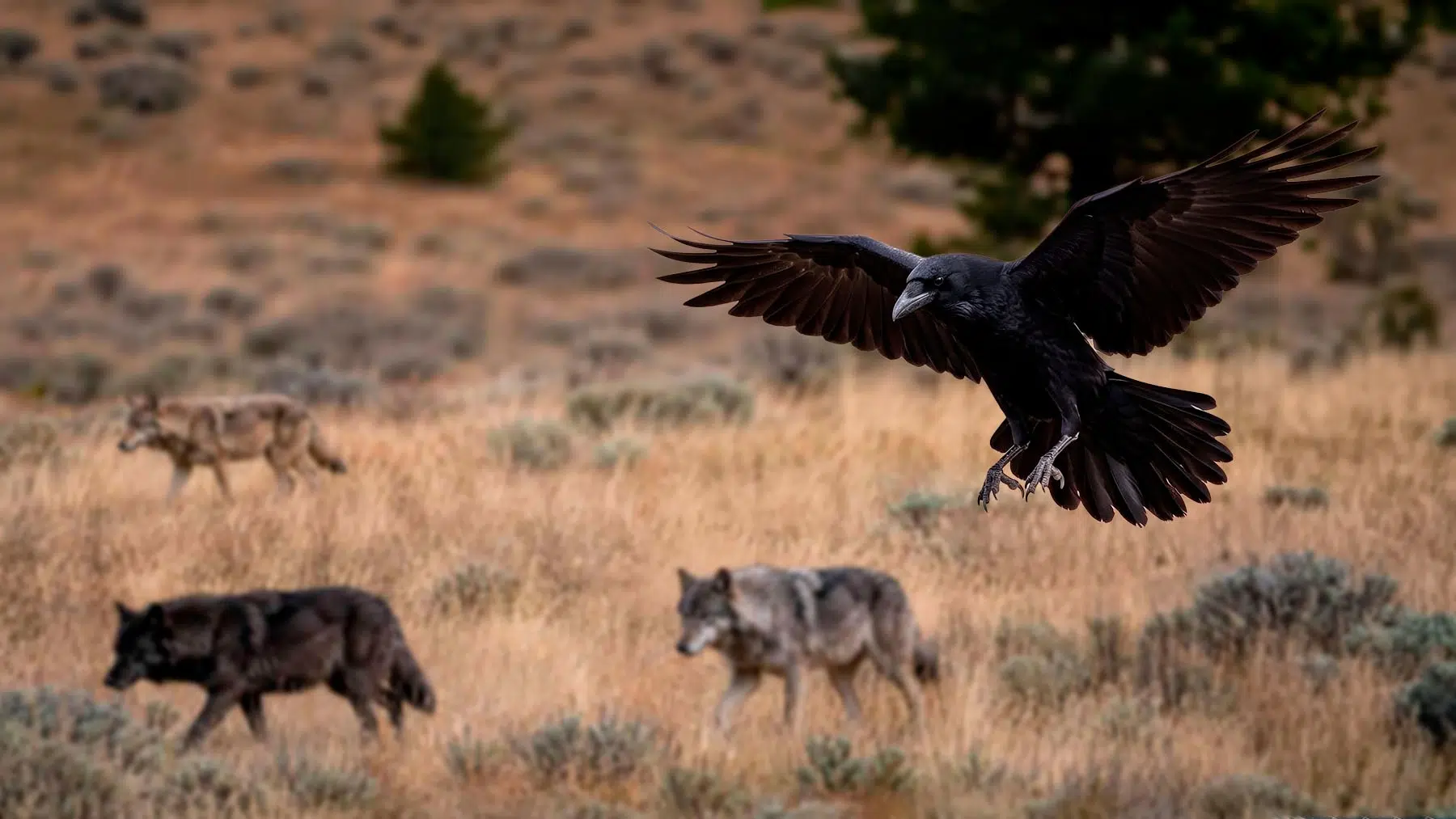
A raven is flying over Yellowstone. It is drifting toward an elk herd.
The wolf pack is still miles away. Yet the raven already seems to know where to go.
For years, scientists assumed the raven followed wolves to find kills.
A new study, published in 2024, indicates otherwise. Researchers wanted to know: were ravens actually following wolves?
The answer was far more unexpected than anyone anticipated.
Why ravens and wolves puzzled scientists
There has been a long history of interest among researchers into the relationship between wolves and ravens.
When wolves kill large animals, there is usually evidence of raven activity very soon afterward. As a result, some scientists suggested a simple explanation.
The timing of the raven’s arrival at a kill site seemed to follow the timing of the wolf hunt itself.
It appeared as though the raven could tell when the wolf was going to find its next meal.
The raven was observing what the wolf did.
But no one had ever tracked both species at the same time — until now.
The team wanted to determine whether the raven followed the wolf around the park. An international group studied 69 individual ravens and 20 individual wolves.
The study took place in Yellowstone National Park. It lasted 2.5 years.
The researchers tracked both groups through GPS units. In addition, they examined each group’s travel patterns within Yellowstone.
They wanted to better understand which species were moving around more and why.
Tracking ravens revealed an unexpected pattern
For many years, the old assumptions worked well.
But this study showed that those assumptions were completely incorrect.
Yes, ravens do hang around with wolf packs. Just nowhere near as much as most people thought.
And yes, the ravens at wolf kills didn’t follow the wolf packs across the park.
Instead, the GPS data showed the ravens returning to the same general locations over and over again. Locations where wolves had made kills before.
Researchers from the University of Washington led the GPS tracking effort.
Their study, “Ravens anticipate wolf kill sites across broad scales,” published in Science changed how scientists view the relationship between these two species.
The data pointed researchers in a very different direction.
Something other than the wolves themselves appeared to be guiding the birds.
Ravens will travel up to 155 km to get to kill sites. No wolf pack moves that far in a single day.
The raven is not following.
It is out ahead.
The data pointed to another explanation that the team had not fully considered.
The discovery behind the raven’s advantage
The answer was the birds’ remarkable spatial memory, developed through repeated experience.
Ravens don’t follow wolves. They remember where wolves hunt.
Tracking wolves is not required.
This was not instinct. This was memory, built over years.
Memory, not wolves, guides the search
What we now know for certain is that ravens have learned to memorize areas where wolves make kills and return to those areas.
The birds have created mental maps of areas where food is most likely to exist. These maps are based on their own experiences.
Because of this, ravens are able to locate food without continuously following predators.
In addition, this finding demonstrates just how well-developed raven cognition can be when operating in natural environments.
For several years, scientists have known that ravens possess intelligence.
The current research shows that ravens use spatial memory across surprisingly wide geographic ranges. It also shows that ravens remember where wolves hunt and return to those spots later.
If a bird can map a national park from memory, what else is it remembering that we haven’t learned to ask about?
Read the whole thing?
Get the week's signal, not the noise
Our sharpest reporting on energy, climate and nature — free, once a week.