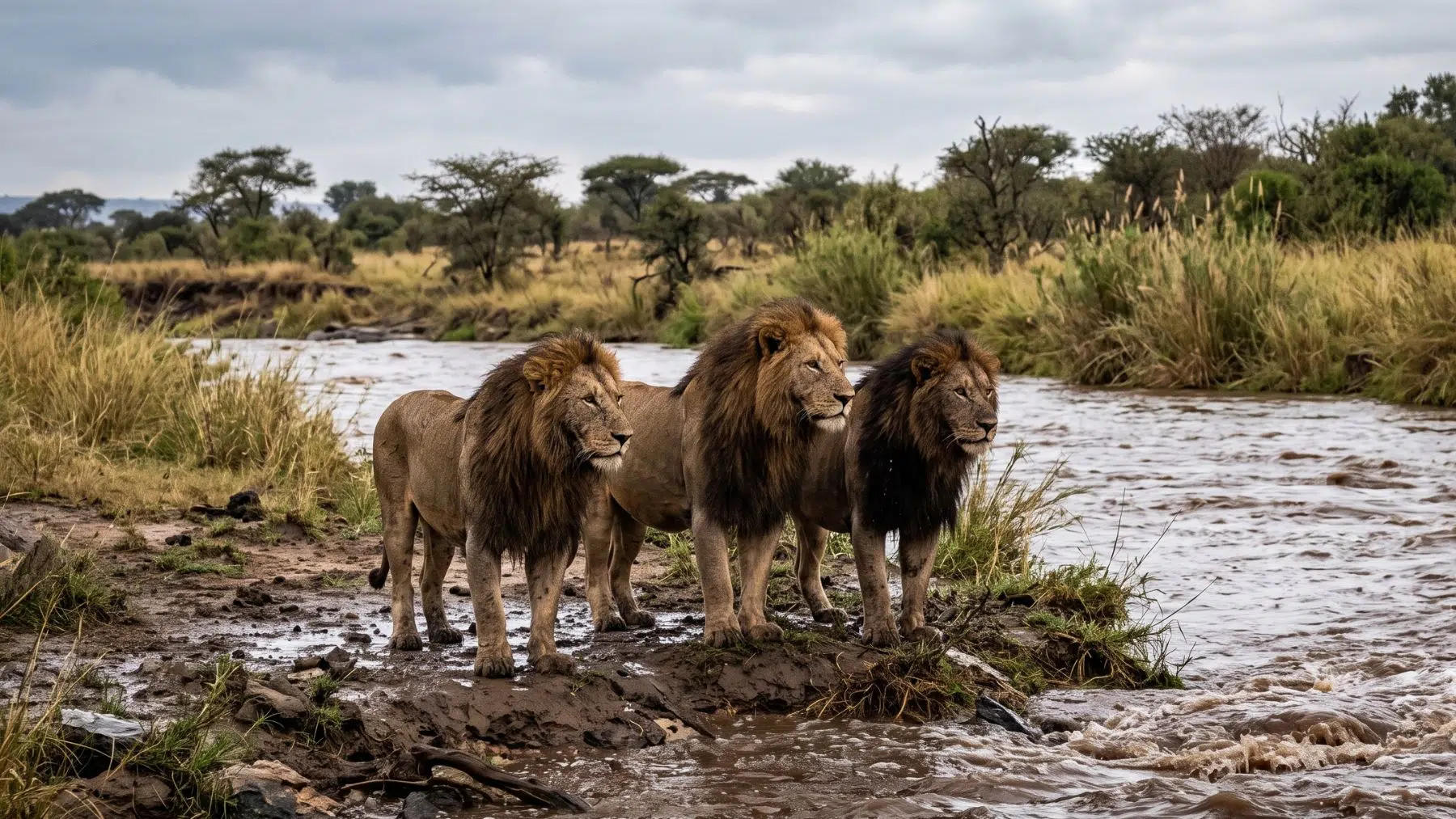
The rains had fallen hard for days, and the Rongai River was running high and fast.
On the far bank stood three male lions from the Sonkai Pride, cut off from where they needed to be.
The current between them and the other side was moving with muscle.
A game ranger lifted his camera and began to film.
What happened next turned on one simple fact about a big cat.
It is the fact that decides which lions cross a flooded river alive.
The morning the Rongai became a wall
The scene played out in Kenya’s Masai Mara, one of Africa’s most famous reserves.
Seasonal rains had swollen the Rongai River far past its calm dry season flow.
Ranger Richard Mututua was there to record the three lions weighing the crossing.
Each of these males can weigh well over 400 pounds.
They paced the bank, testing the water and reading a current that was clearly dangerous.
Few people ever watch a full pride weigh a flooded crossing in real time.
A river in the Mara can hide crocodiles and sudden drop offs.
For a heavy cat, the water itself is the first threat.
And these lions seemed to know it well.
Why lions and rivers rarely mix
Lions are among the most powerful animals alive, but they are not built to swim.
Most big cats avoid deep water whenever they possibly can.
Their bodies are packed with dense muscle, which gives them very little natural buoyancy.
A tiger will happily swim to cool down, yet lions rarely take to water by choice.
A heavy male rides low, and his large head pulls forward as he paddles.
Every stroke costs him energy that a lighter animal would never spend.
Water strips away the very thing that makes a lion so fearsome on land.
On dry ground he is all power and speed, but the river erases both.
That reluctance is written into their anatomy, and not merely into their mood.
Add a fast current, and the math turns sharply against him.
So a flooded river is one of the hardest tests a pride can face.
What the current does to a swimming lion
Once a lion pushes off the bank, physics takes over completely.
Moving water does not simply carry him downstream, it pulls at his whole body.
The current drags hardest on his broad chest and his heavy shoulders.
He has to swim across the flow and fight that push at the same time.
His head stays barely above the surface, and his mane grows heavy and soaked.
A soaked mane adds weight in exactly the place he can least afford it.
He also cannot read the depth or the speed before he commits.
By the time trouble arrives, turning back can be as risky as pressing on.
Tire in the middle, and the river simply takes control.
That is why so many crossings end with an animal swept far downstream.
The two brothers who proved what a lion can survive
The most striking proof of what a lion can endure came from Uganda.
In February 2024, two brothers named Jacob and Tibu did something never recorded before.
According to one report, they swam about 1.5 kilometers across the Kazinga Channel.
That water holds crocodiles and hippos, and one crocodile trailed them the whole way.
Jacob had already lost part of a leg to a poacher’s trap, and still he made it.
The pair failed twice before finally reaching the far shore on the third attempt.
The swim took them roughly forty five minutes of hard, steady effort.
Researchers believe a shortage of females on their side pushed them to risk it.
The old recorded distance for a lion swim was under 700 feet.
Jacob and Tibu beat it by a huge margin.
The scientists who track them called the feat almost unthinkable.
Two crossed, and one stayed behind
Back at the Rongai, the Sonkai males finally committed to the water.
Two of the three powered across the flooded river and hauled out on the far bank.
The third lion hesitated, turned back, and stayed on the near side alone.
Nothing forced him into the current against his own judgment.
A pride is strong, but it does not override an animal’s instinct for danger.
The two who crossed had judged the current and their own strength correctly.
The one who stayed likely read the same water and chose not to risk it.
The same drama plays out wherever wildlife shares water with people, from clever octopuses to the seals near an offshore wind farm.
According to one account, moments like this are rarely caught on film.
For these male lions, the flooded Rongai was a line drawn in water.
Read the whole thing?
Get the week's signal, not the noise
Our sharpest reporting on energy, climate and nature — free, once a week.