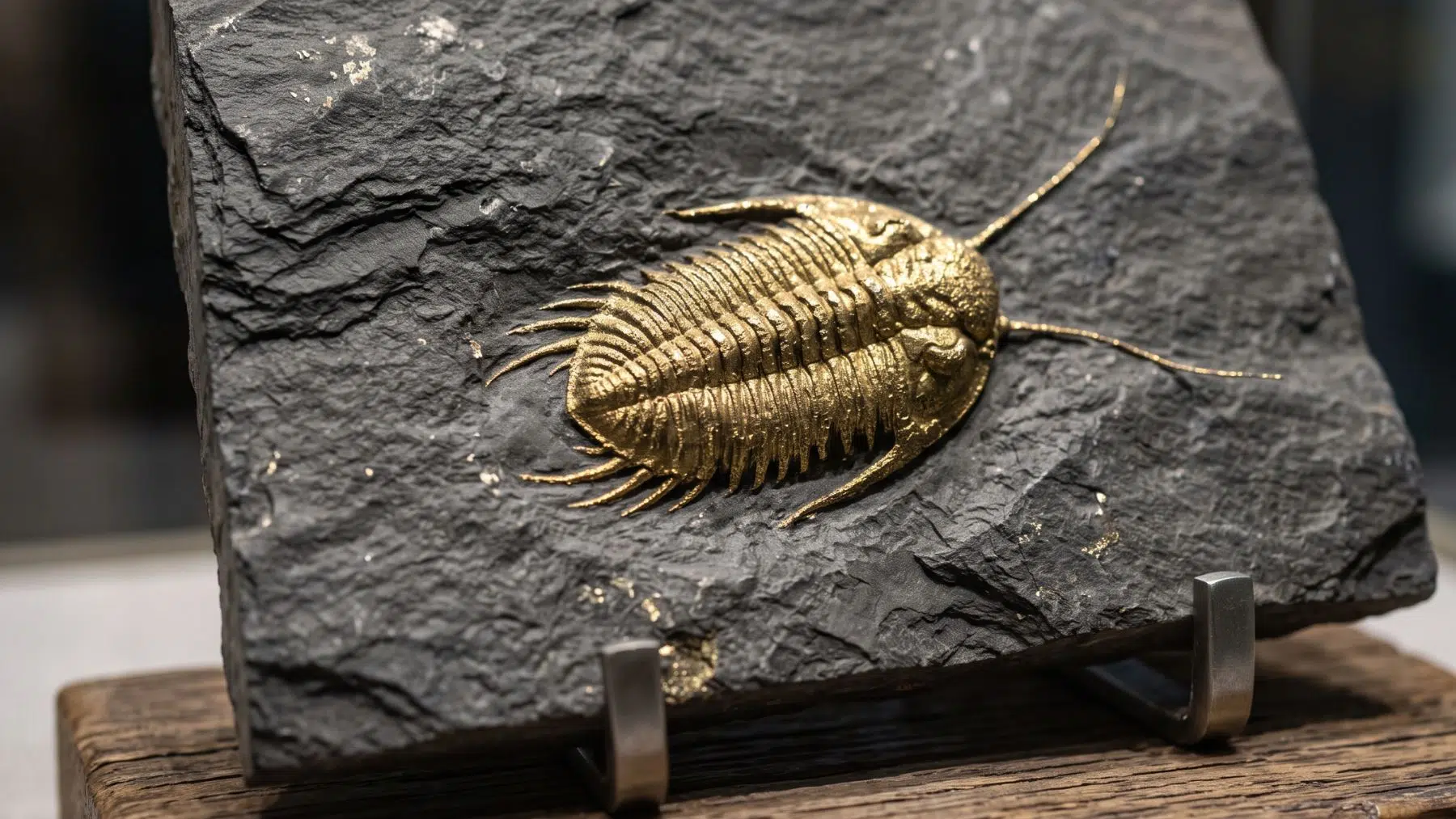
Near the small city of Rome in central New York, there is a layer of ancient rock that paleontologists call Beecher’s Bed.
It looks like ordinary stone.
But crack it open, and sometimes the inside shines gold.
Embedded in that rock are creatures that lived 450 million years ago, their bodies slowly replaced by iron pyrite, the mineral everybody knows as fool’s gold, turning them into glittering three-dimensional sculptures.
They have waited in the dark ever since.
A rock that was not supposed to be interesting
The animals preserved at Beecher’s Trilobite Bed lived in a hostile, low-oxygen environment that allowed pyrite to replace parts of their bodies after they were buried in sediment.
The result is spectacular golden three-dimensional fossils, each one a tiny time capsule from the ocean floor.
Most of what turns up there are trilobites, the iconic armored animals that fill natural history museums.
Other kinds of organisms are much less common at this site, which makes any other find genuinely rare.
So when a collector cracked open a chunk of fool’s gold and found something that was not a trilobite, it was immediately clear that something unusual had surfaced.
Nobody yet knew it would rewrite a chapter of animal history.
The creature inside looked like it could walk away
A shimmering ancient fossil unearthed in New York state looks like a piece of finely crafted jewelry, but it is also a portal into the natural world 450 million years ago.
The striking fossil is a newly identified species of arthropod, a distant relative of modern-day horseshoe crabs, scorpions and spiders.
Arthropods are the most species-rich group of animals on Earth today, and this creature was one of their deep relatives.
It lived on the ocean floor during the Ordovician Period, a time when life had only a tentative foothold on land.
Preservation in pyrite of this kind is extremely rare.
Soft tissue usually decays before it can be captured in stone, but this specimen gives scientists an almost complete look at the animal’s anatomy, right down to individual limb segments.
Scientists ran it through an X-ray machine, and the image stopped them cold
Pyrite is a very dense mineral, and fossils from this layer can be CT scanned to reveal hidden details of their anatomy.
The technique involves rotating the specimen while taking thousands of X-ray images, then reconstructing everything in three dimensions on a screen.
The scans showed every segment of the body in crisp detail.
They showed the mouth plate.
They showed the legs.
And then they showed the thing on the creature’s head, which turned out to be the real story.
The team essentially hit a geological jackpot.
The sediments that contain the fossils are low in oxygen but high in iron, so the carcasses of the animals were like small islands where the conditions for pyrite to form were just right.
A megacheiran that gave up its claws and grew sensory whips instead
The creature, named Lomankus edgecombei, is a remarkably bright golden color because it is preserved in three dimensions by iron pyrite, which is a highly unusual way for a fossil to form.
The fossils reveal that the grabby arms seen on other members of its group, known as “great appendages,” shrank and changed shape in Lomankus.
The claw used for grabbing in other species is much smaller here, while three long, whip-like structures called flagella are dramatically longer.
Since Lomankus had no eyes, this change suggests the creature used its great appendages for sensing the world rather than snatching prey.
The arrangement of features on the species’ head closely mirrors that of living arthropods, meaning its appendages are the ancient equivalent of insect antennae or the chelicerae (mouthparts) of scorpions and spiders.
The researchers suggested that Lomankus lost its eyes because it lived in a dark environment where vision offered no advantage.
That shift mirrors what happened more recently in eyeless cave fish, which sharpened their other senses to compensate.
You can also see a parallel in the way creatures in deep ocean environments rewire their senses when light disappears entirely.
What one golden fossil from New York tells us about every spider alive today
The discovery offers important new clues toward solving the long-standing riddle of how arthropods evolved the appendages on their heads.
That includes the antennae of insects and crustaceans, and the pincers and fangs of spiders and scorpions.
Rather than representing a dead end, Lomankus shows that megacheirans kept diversifying and evolving long after the Cambrian, with the formerly fearsome great appendage now performing a completely different function.
The spider building its web on your porch this summer carries, somewhere deep in its biology, the legacy of that shift.
And the creature that made it possible spent 450 million years waiting inside a chunk of fool’s gold in a quarry near Rome, New York, for someone patient enough to look.
Read the whole thing?
Get the week's signal, not the noise
Our sharpest reporting on energy, climate and nature — free, once a week.