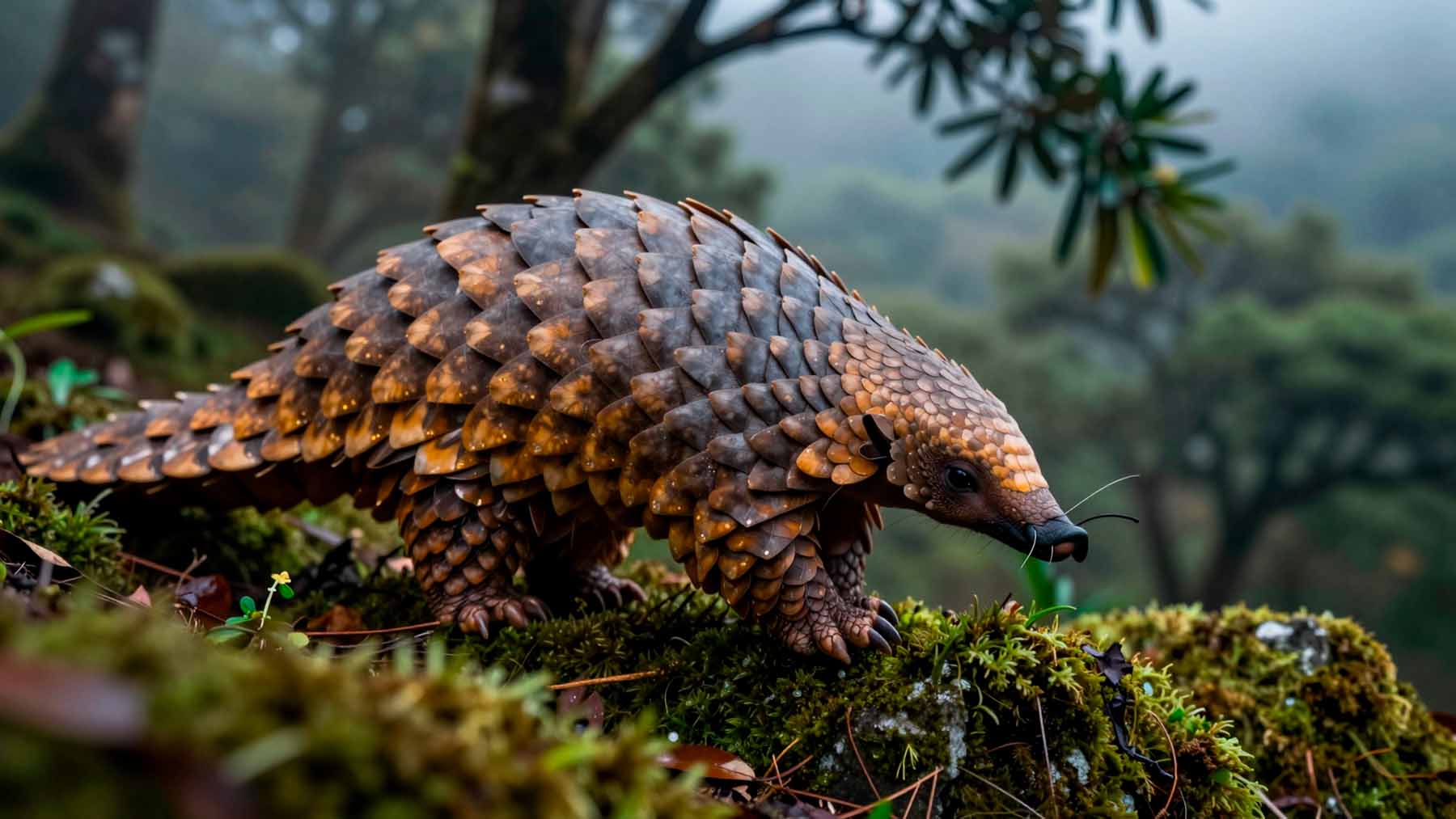
For nearly two centuries, a pangolin quietly roamed the forested slopes of Nepal and northern India — catalogued, forgotten, and folded into the wrong species. Researchers long assumed it was simply a regional variety of the Chinese pangolin. It wasn’t.
A team of scientists spent more than five years gathering the evidence to prove it. All eight pangolin species are already imperiled, and the family tree, it turns out, was missing a branch.
A species lost in a label
Manis aurita was first described by British zoologist Edward Blyth in 1836. Over the following decades, taxonomists folded it into the Chinese pangolin (Manis pentadactyla), reclassifying it as a subspecies rather than a species in its own right. That single decision had consequences lasting nearly two centuries.
The distinction between a species and a subspecies isn’t just academic. Under most wildlife protection frameworks, conservation resources, legal protections, and enforcement tools are organized around species-level classifications — and a subspecies often falls through the gaps. For the Himalayan pangolin, that meant no dedicated conservation planning, no species-specific forensic tools for trafficking cases, no formal recognition of its unique evolutionary identity. Nearly 200 years of invisibility.
Five years of evidence, from Nepal to the museum archive
The path to correcting that oversight began in Nepal. Narayan Koju, a researcher at Nepal Engineering College at Pokhara University and the study’s lead author, first documented field evidence suggesting pangolins in the Himalayan region represented a distinct evolutionary lineage — not simply a geographic variant of their Chinese relatives.
What followed was more than five years of painstaking research. The team drew on international collaboration and museum specimen collections, cross-referencing historical samples with modern data. That kind of archival work is easy to underestimate. Museum collections preserve biological records that no living field study can replicate, capturing snapshots of populations long before modern monitoring existed.
Confirmation came through integrative analysis — combining genomic data with detailed morphological measurements. Genetics alongside physical anatomy gave the team the evidence needed to formally resurrect Manis aurita as a valid species. The study was co-led by Anderson Feijó, the Negaunee assistant curator of mammals at the Field Museum, and published on July 1 in Communications Biology.
Small ears, big difference
On the surface, the Himalayan pangolin and the Chinese pangolin look strikingly similar. The differences, while subtle, are consistent and measurable: compared to its Chinese relative, the Himalayan pangolin has a longer tail, a larger body, and noticeably smaller ears.
That last feature is encoded in the species name itself. Aurita derives from the Latin auris, meaning ear — a direct nod to the trait that most visibly sets this pangolin apart. The same root appears across the animal kingdom, from the brown long-eared bat (Plecotus aurita) to the moon jellyfish (Aurelia aurita).
Subtle physical differences can still define a valid species boundary, particularly when they align with genetic divergence. Integrative evidence — anatomy combined with DNA — has become the gold standard in modern taxonomy for exactly this reason. Either line of evidence alone can be ambiguous. Here, both pointed clearly in the same direction.
Why naming a species can save it
All eight pangolin species are currently threatened. Two are classified as vulnerable, three as endangered, and two as critically endangered. Every taxonomic clarification in a group this imperiled carries real-world weight.
Pangolins are the world’s most trafficked mammals, targeted for their meat and for their scales, which are falsely believed to hold medicinal value despite no scientific evidence supporting that claim. Poaching pressure is relentless. It doesn’t slow down for animals that lack formal recognition.
“We can’t protect what we do not know,” Feijó said in a press statement accompanying the study. Formal species status unlocks a specific set of tools: targeted conservation planning, species-specific legal protections, wildlife forensics capable of identifying trafficked animals by origin. When pangolin parts are seized at borders or markets, forensic identification can help determine which species — and which population — was targeted. Without a confirmed species designation for Manis aurita, those tools couldn’t be applied to Himalayan pangolins at all.
As Koju noted, the confirmation of Manis aurita “provides a strong scientific basis for conservation planning, wildlife forensics, and efforts to protect one of the world’s most-trafficked mammals from extinction.”
What recognition makes possible
The scientific work of confirming this species is done. What comes next is harder: translating that recognition into action on the ground.
Researchers and conservation organizations now have a foundation to build from. The Himalayan pangolin’s range — the forested slopes of Nepal and northern India — can be mapped and monitored with this species specifically in mind, and habitat protection efforts directed accordingly. Wildlife law enforcement agencies gain a clearer target when prosecuting trafficking cases involving animals from this region.
The study also serves as a reminder that the taxonomic record is far from complete. Species hidden within misclassified groups may still be waiting for the right combination of fieldwork, archive access, and analytical tools to bring them into focus. For the Himalayan pangolin, that moment finally arrived — nearly 200 years late, but not too late to matter.
Read the whole thing?
Get the week's signal, not the noise
Our sharpest reporting on energy, climate and nature — free, once a week.