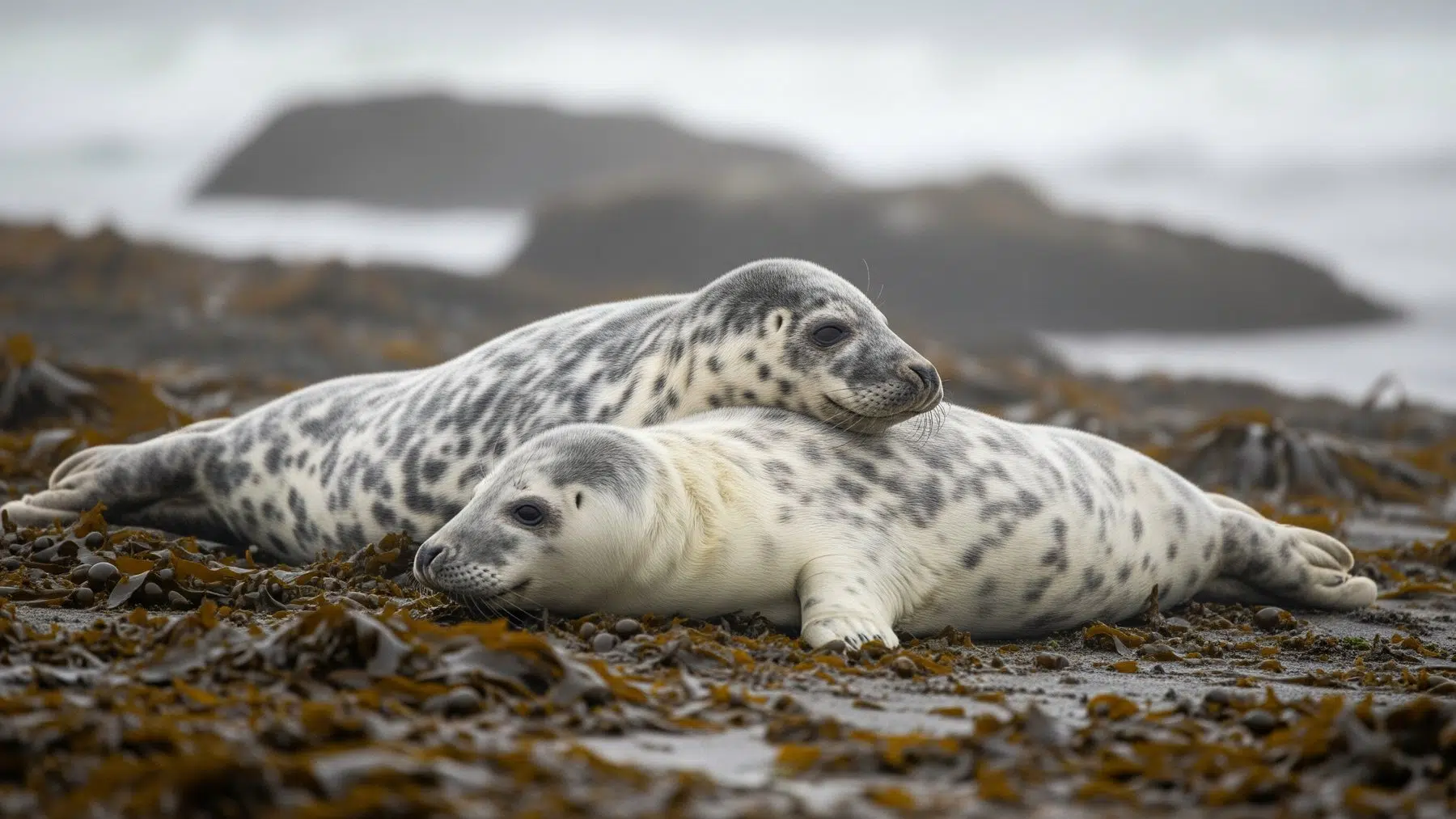
On a rescue center’s floor in Ireland, dozens of orphaned seal pups squirm and cry.
Each one arrived alone, plucked from a cold Atlantic beach.
Almost every seal ever born comes into the world as a single pup.
A mother nursing two at once is one of the rarest sights in the sea.
It is so rare that most rescuers never see it.
And the reason why hides in a hard piece of math.
Built for one, not two
Seals may gather by the hundreds on a beach, but each one keeps to itself.
A mother seal cares for one pup and one pup only.
She gives birth on shore, nurses fast, and soon returns to the sea.
Her whole strategy is built around raising a single young at a time.
On a crowded beach they bark and shove, but form no real families.
Each mother knows her own pup by its call and its scent.
Everything about her body is tuned to that one bond.
Twins would mean splitting everything she has in two.
In the ocean, that split can be the difference between life and death.
So evolution has pushed seals hard toward the single pup.
Two at once is not just uncommon, it is almost unheard of.
And when it does happen, it rarely ends well.
The brutal math of milk
The reason comes down to one thing, milk.
Seal milk is among the richest of any mammal on Earth.
It can be more than half pure fat, like drinking heavy cream.
A pup can double or triple its weight in a matter of weeks.
All of that fat comes straight from the mother’s own body.
She barely eats while nursing and burns through her reserves.
A gray seal can wean its pup in under three weeks.
In that short window the mother may lose a third of her weight.
It is one of the most intense nursing runs in all of nature.
Feeding one pup already pushes her to the edge.
Feeding two would drain her past the limit.
Nature does the grim math and lands on one.
What the rescuers see
Places like Seal Rescue Ireland watch this rule play out every winter.
Storms and separation wash orphaned pups onto the shore.
In 2024 alone, the center took in 169 sick, injured, or lost pups.
Almost every one arrived on its own, with no sibling in sight.
The pups are fed, warmed, and slowly nursed back to strength.
Many strand after being swept from their mothers in rough surf.
Others are simply too weak to survive their first days alone.
The staff bottle feed them around the clock for weeks.
It is slow, costly, and delicate work every single time.
Over the years, rescuers handle hundreds of young seals.
Yet a confirmed set of twins is something most of them never meet.
The very idea sits at the far edge of what nature allows.
To see how far, scientists finally ran the numbers.
A birth close to one in a thousand
Here is just how rare a seal twin really is.
According to one study, twin seal pregnancies turn up in only about 0.1 to 0.4 percent of births.
At the low end, that is close to one in a thousand.
And a pregnancy is only the very start of the odds.
The figure holds across several different seal species.
Scientists piece it together from decades of birth records.
Even when twins are conceived, both rarely survive to weaning.
The mother simply cannot make enough milk for two hungry pups.
So most seal twins never make it off the beach at all.
For a species that bets everything on one pup, twins break the rule.
A surviving pair is one of the ocean’s true long shots.
The rarest bond in the water
This is why two pups found side by side spark such wonder.
A bonded pair hints at that rarest of births.
But even then, the truth is hard to pin down.
Rescued pups often bond in care without being related at all.
Only close study, or a bit of luck, can tell a real twin from a friend.
A genetic test could settle it, but that is rarely ever done.
So most suspected pairs stay a lovely maybe.
According to one account, the Irish center returns its recovered pups to the wild each year.
The same small dramas play out across the marine world, from clever octopuses to the seals near an offshore wind farm.
Nearly every seal will always be born a lone pup.
And that is exactly what makes a real pair of twins so hard to forget.
Read the whole thing?
Get the week's signal, not the noise
Our sharpest reporting on energy, climate and nature — free, once a week.