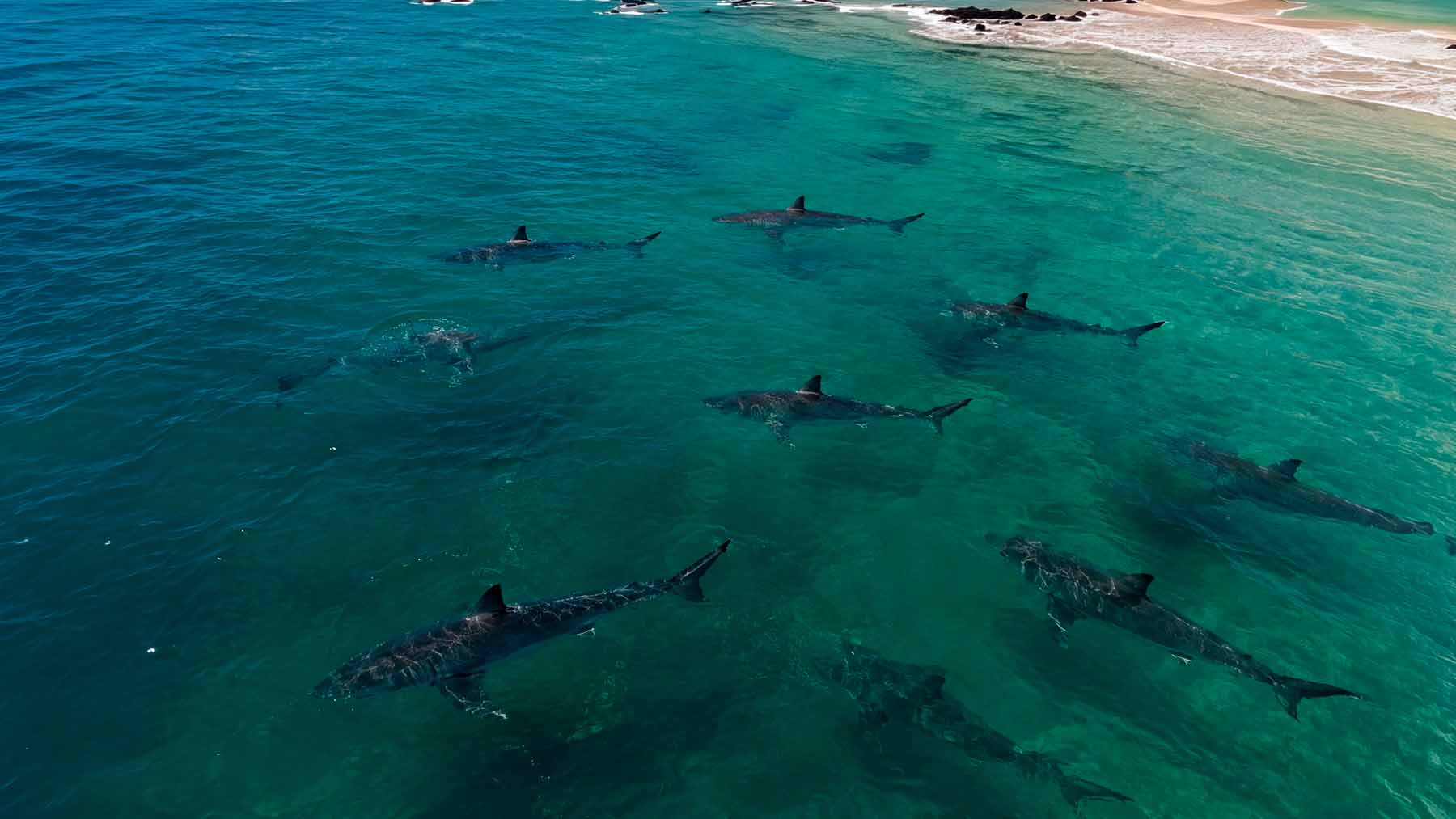
Pine Point Beach in Scarborough, Maine, is the kind of coastline most people picture with lobster boats and lighthouses — not apex predators circling offshore. But this past August, nine great white sharks were confirmed in the waters just beyond the sand, prompting one photographer on the scene to describe them simply as “everywhere.”
What pulled so many sharks to this one stretch of coast at the same time is the question scientists are now working to answer.
A rare gathering at Pine Point Beach
The first confirmed sightings came on August 4. Two juvenile great white sharks — each estimated between six and eight feet long — appeared near the southern tip of Prouts Neck, the mouth of the Scarborough River, and the waters just offshore of Pine Point Beach. Authorities from the Scarborough Police Department confirmed the reports.
What followed made the story considerably larger. Officials reported up to seven additional sharks swimming and feeding near Pine Point Jetty over the next two days. Photographer Karl Ramsdell, who captured the sharks on camera, offered a description that needed no elaboration: “they were everywhere.”
By any reasonable measure, this was an extraordinary event. Researchers and local officials have described it as one of the largest documented concentrations of great white sharks near a Maine beach in recent history — a distinction that carries real weight along a coastline not typically associated with apex predators.
What drew so many sharks to one spot
The answer, according to scientists, comes down to food and temperature. The Gulf of Maine was offering both in abundance, according to A-Z Animals.
Large schools of baitfish and growing harbor seal populations had created a reliable, concentrated food source along that stretch of coastline. Favorable summer water temperatures added to the appeal, making the area genuinely attractive for sharks that follow prey rather than territory.
Timing played a role too. Great white sightings in Maine typically run from May through December, peaking between July and September. Early August sits squarely in that window, so the presence of sharks wasn’t, by itself, surprising. What was surprising was the number. Individual great whites appear in Maine waters most summers. Observing five to seven of them in one relatively small area over two consecutive days crosses into genuinely uncommon territory, even against the backdrop of a season when sightings are expected.
Maine’s surprisingly short — but significant — shark attack history
Maine’s recorded history of unprovoked shark attacks is brief. Since 1837, only two confirmed incidents appear on the books — a number smaller than most coastal states, and one that contributed, for a long time, to a general sense that serious encounters were a distant concern.
The 2020 death of swimmer Julie Dimperio Holowach near Bailey Island changed that perception. Her death, caused by a great white shark, became the first recorded fatal shark attack in Maine’s history and forced coastal communities to reckon with a risk that had previously felt theoretical.
The response was practical rather than reactive. Improved public notification systems were developed in the years that followed, and beachgoers are now actively encouraged to report sightings so authorities can issue rapid alerts and give swimmers time to clear the water. The infrastructure for managing these encounters has grown more sophisticated, even as the underlying risk remains statistically low.
No aggression reported — but caution still advised
Despite the dramatic footage circulating from Pine Point Beach, no aggressive behavior toward swimmers, surfers, or boaters was reported during the August sightings. The sharks were feeding and moving — behaving, in other words, like sharks.
That distinction matters. Presence isn’t the same as threat. Authorities were still clear that proximity to the sighting area called for sensible precautions: staying close to shore, avoiding swimming alone, exiting the water immediately if a shark is spotted, and steering clear of areas near baitfish schools or seal colonies — both of which, as the August cluster illustrated, can draw sharks in numbers.
Experts consistently make the same point: responsible behavior, not panic, is the appropriate response. The sharks near Pine Point Jetty weren’t hunting people. Acting as though they were serves no one.
Great whites belong here — the Gulf of Maine is their habitat
There’s a framing problem that tends to follow great white sightings, and it’s worth naming directly. News coverage often implies that sharks have arrived somewhere they don’t belong — that the coastline has been invaded. That framing gets the ecology backwards.
The Gulf of Maine has always been within the natural range of great white sharks. These are their waters. The August sightings near Pine Point Beach don’t indicate that the coast has become more dangerous in some new or unprecedented way; they indicate that sharks are doing what sharks do, in waters where they’ve always lived.
When you enter the ocean, you enter a space that belongs to other species. That’s not a reason to stay on shore — it’s a reason to hold the experience with a little more humility. A cluster of great whites feeding off a Maine beach isn’t an anomaly to be alarmed by. It’s a reminder of what the ocean actually contains. The beach has a name. The sharks were there first.
Read the whole thing?
Get the week's signal, not the noise
Our sharpest reporting on energy, climate and nature — free, once a week.