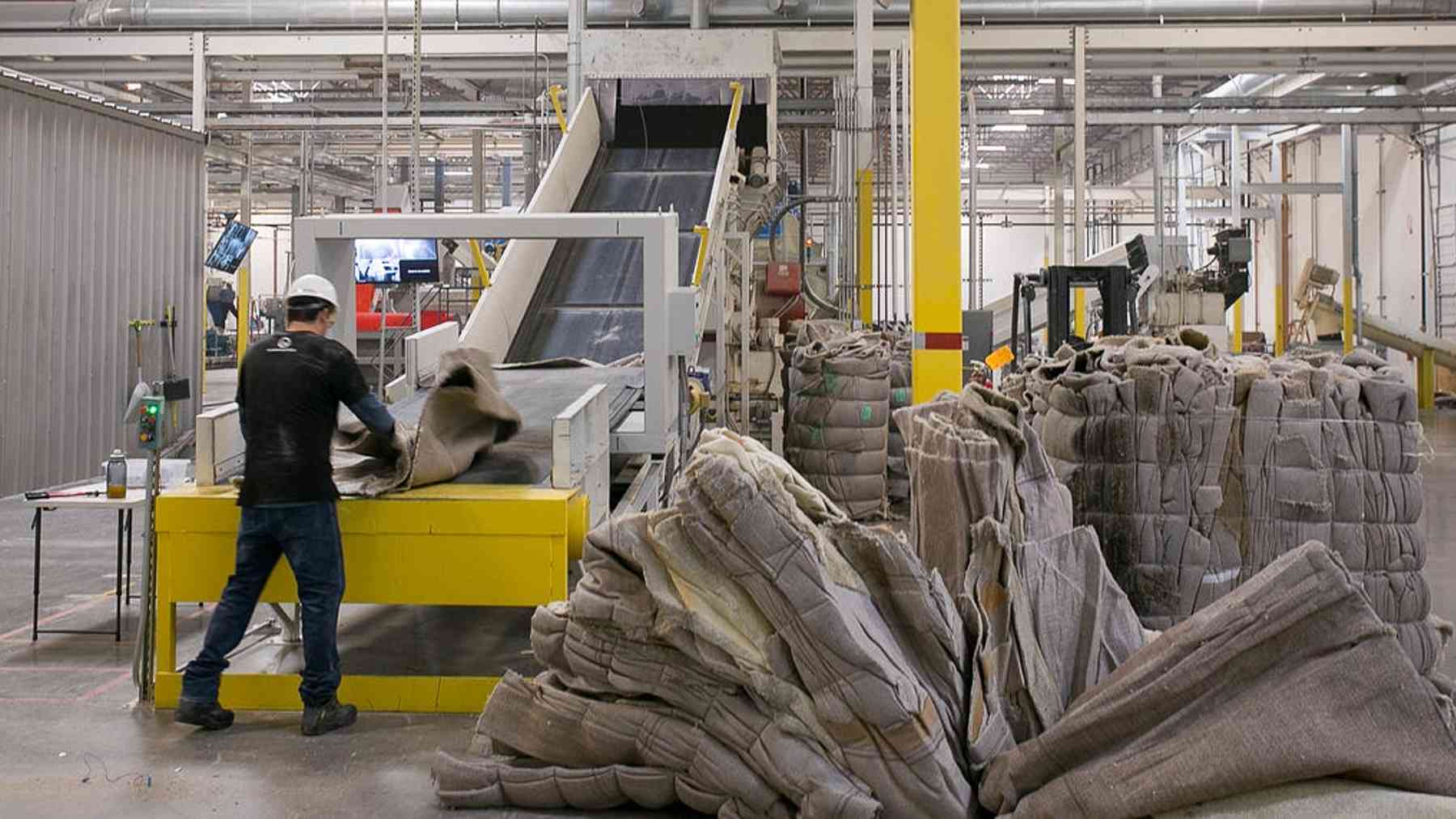
Three chutes come off the end of the line, and three bunkers fill at once.
Pale fiber fluff in the first. Dark plastic chip in the second.
The third fills with something that looks like flour, and it fills faster than the other two.
Behind all of it, shredded carpet moving up a belt.
Whether this building makes money depends entirely on one of those three, and it is not the big one.
Why one polymer is worth chasing and the others are not
The fiber on top of a carpet is not one material. It is four, and they behave nothing alike coming back.
Nylon 6 is the good one.
Heat it with the right chemistry and it comes apart into the molecule it was built from, caprolactam, which polymerizes again into fiber that is indistinguishable from new. That is a real loop, not a downgrade.
Nylon 6,6 will not do that on sensible terms. It gets shaved off, melted and extruded into something less demanding.
Polyester is worse again. It is recoverable but has almost no end market against the two nylons, so a load of it is a cost, not a stock.
Polypropylene sits somewhere between, with a few outlets and no depth behind them.
What the building was set up to do
The plant covers 116,000 square feet in the west of the city, with a stated capacity of 36 million pounds of carpet a year and about 25,000 square yards a day.
Thirty or so people ran it at opening.
It accepts nylon 6 and nothing else. Not the other nylon, not polyester.
The three streams go three ways. The fiber crosses the Atlantic to a depolymerization plant in Slovenia, the chip goes to injection molders, and the powder, which is ground limestone, goes into road base and concrete.
Note the word capacity. That is what the equipment can take, not what came through the door, and no measured throughput has ever been published.
The opening is softer than it reads too. A ribbon cutting in December 2018 gets quoted as the start date, while the local paper called the line already a year old and one trade account dates it to 2017.
What is actually arriving on the belt
By federal modeling, a short ton of carpet is about 45 percent face fiber, 15 percent woven backing, 8 percent latex, and 32 percent ground limestone.
So even before the polymer question, two thirds of every pound through the door is not fiber.
Then the polymer question, which is the harder one.
Polyester is now more than half of all carpet face fiber sold in the country and about three quarters of the residential market. Nylon in homes sits near 15 percent.
Commercial carpet is still almost entirely nylon, both kinds, which is where the feedstock comes from.
In the discard stream itself, one recycler put polyester at 80 percent of what arrives. A plant built for nylon 6 is fishing a pond stocked with something else for twenty years.
The plant may already have gone
This is circumstantial, and it points one way.
The operator’s current list of its American sites does not include the city. Its sole carpet recycling location is now a town in southern California, and that page still carries an Arizona phone number. The old location page returns nothing.
A trade report last year describes the company shifting away from Arizona nylon 6 processing toward the Los Angeles area and toward polyester for nonwovens, a turn its own fact sheet from the earlier period gives no hint of.
Against that, the plant was still listed as an active processor in every quarter of a recent stewardship report, so this is not a confirmed closure, only signals pointing one way.
There is precedent. A second plant the same company opened in northern California took a public capital grant, cost around 12 million dollars, and was decommissioned within two years. The stated reason was feedstock. Seventy million pounds of used carpet were needed to run two plants and could not be found, the kind of supply problem that also strands a mattress program stream or a route through 36 ports, and it is set out in the closure notice.
What the next plant has to accept
This has happened before, at the same link in the chain.
A nylon 6 depolymerization plant opened in Georgia in 1999 and shut about two years later, same reason, different decade.
One recycler in Sacramento went under holding roughly 20 million pounds of polyester carpet nobody would buy.
The operation that looks better positioned is one in northern California separating four polymers off a single line instead of one, using rotary impact separation, so a mixed load is a sort rather than a rejection.
That is the design lesson and it is not about chemistry.
A plant built around the best polymer bets on what the waste stream used to be. A plant built around separation bets on not knowing, which is the only honest position here.
Read the whole thing?
Get the week's signal, not the noise
Our sharpest reporting on energy, climate and nature — free, once a week.