Telescopes in space usually discover exactly what scientists expect them to discover.
Euclid is a European Space Agency mission designed to create detailed maps of billions of galaxies and discover dark matter and dark energy.
In late September, however, Euclid caught sight of something much nearer.
By early October, that object had become Comet C/2026 S1 (Euclid), the first previously unknown comet discovered by Euclid.
At the time, the comet was approximately 808 million miles (1.3 billion km) from Earth.
That distance placed the comet roughly between the orbits of Jupiter and Saturn.
A telescope built for distant galaxies found something closer
Euclid is observing billions of galaxies to help create one of the largest maps of the universe ever assembled.
As part of this mission, Euclid generally avoids areas of the sky which contain many objects belonging to the solar system. This characteristic made the finding unusual.
Images captured between September 16th and September 24th during observations of Euclid Deep Field North revealed the object.
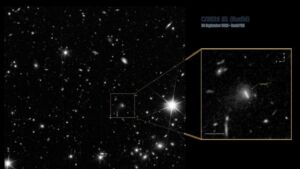
Instead of a static galaxy, scientists observed a streak running across multiple frames.
Mikko Pöntinen of the University of Helsinki identified the streak using software designed to detect moving objects in Euclid imagery.
Further investigation showed yet another feature of an active comet; the streaked object had a faint cloud of gas and dust surrounding it.
That cloud of gas and dust is called a coma.
Identifying a potential suspect is only step one
Identifying the streaked object was just the first step.
Scientists tracked the object over several other groups of images.
They also compared catalogs of known comets and asteroids. None matched.
That gave Mikko Pöntinen and his fellow members of the discovery team enough information to provide evidence to the Minor Planet Center for reporting the object as a candidate new comet.
Ground based observatories eventually contributed to tracking down the comet’s trajectory and confirming that it was indeed a comet.
On October 8th, the Minor Planet Center officially designated the object as Comet C/2026 S1 (Euclid), according to the European Space Agency (ESA).
Confirmation came relatively quickly after initial contact, according to the Caltech Euclid Science Center.
Finding the comet so far from the Sun changed the challenge
The amount of time needed for confirmation was unusually fast for an object discovered so far away from the sun.
Finding it this early also gave astronomers an opportunity to begin tracking it long before it moved closer to the inner Solar System.
Many comets spend most of their existence far from the regions of space where astronomers commonly search.
That distance can make them difficult to spot until they move closer to the Sun.
An unusual orbit kept the comet out of view
Its location may prove just as significant as the discovery itself.
Most planets revolve around the sun within a slightly flattened plane, but this comet is located far outside of that zone.
Currently, C/2026 S1 (Euclid) travels above this region, crossing through space over the top of the densely populated center of our solar system.
This positioning may have contributed to why it went undetected for so long.
Euclid was built to survey deep space rather than monitor the crowded regions of the solar system where most asteroid and comet searches take place.
Therefore, discoveries such as this are rare occurrences.
One unexpected discovery could support another mission
The comet discovery demonstrated another unforeseen capacity of the mission designed to study some of the largest known structures in the universe.
Euclid’s deep observations can sometimes detect transient objects that might otherwise go unnoticed.
This type of discovery may help identify future targets for the Comet Interceptor mission.
C/2026 S1 (Euclid) has been identified as the first previously unknown comet discovered by Euclid.
It may represent an early demonstration that a telescope designed to observe the distant universe can sometimes detect objects that were previously overlooked.
Read the whole thing?
Get the week's signal, not the noise
Our sharpest reporting on energy, climate and nature — free, once a week.