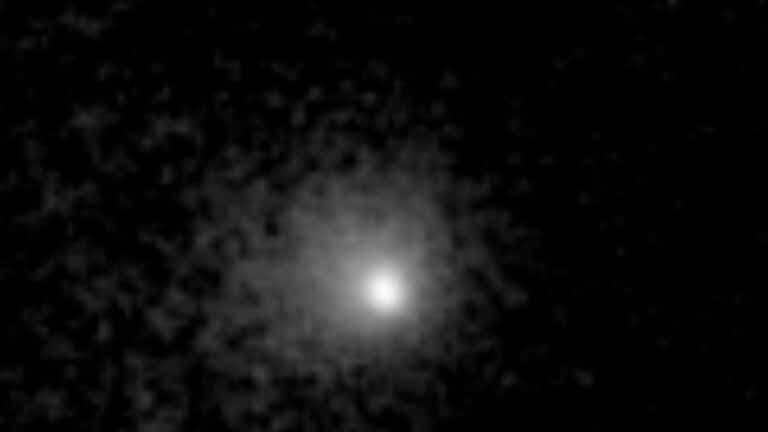
Astrophysicists have found three extremely unusual dwarf galaxies around the Pinwheel galaxy.
They stopped forming new stars despite the fact that they were totally isolated.
Small galaxies that wander alone in space are normally characterized by an abundance of cold gas, and, therefore, they still form new stars.
On the contrary, dead galaxies are usually located near giant celestial bodies that negate star-forming material with their gravity.
The discovery of dead galaxies far away from their giant companions contradicts the basic evolutionary theory of cosmology.
Identification of dead dwarf galaxies wandering alone in outer space
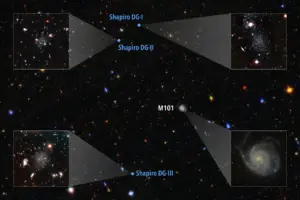
Three faint celestial objects, known as Shapiro Dwarf Galaxies I, II, and III, have been identified by astronomers through survey telescopic images in the archives.
Through deep space surveys, it was found that all three systems do not possess the cold hydrogen gas that is necessary to form new stars.
According to standard astrophysical theory, isolated dwarf galaxies always include active stellar nurseries.
Discovering inactive stellar systems floating miles apart from massive galaxies is one of the biggest mysteries facing scientists.
The features of these inactive systems do not conform to the usual laws of the environment that govern galaxy interactions.
Identifying violent interactions with neighboring massive host galaxies
According to some researchers, this type of dwarf galaxy is actually a ‘backsplash’ object that was ejected during an earlier encounter with something else.
This orbital path would have brought these tiny galaxies directly into the gravity field of the Pinwheel galaxy.
Tidal and ram-pressure stripping had removed the ambient gas clouds due to their high-speed movement.
Gravitational slingshots had then ejected these dwarf systems far out into more distant, less turbulent regions of space.
The dynamics of these encounters provide an explanation of how these isolated galaxies exhaust their gas before reaching their present locations.
Exploring different satellite systems for anomalous local galaxies
Analysis of alternative theories needs accurate distance measurements to establish if there are any gravitational links between the dwarf galaxies.
Shapiro Dwarf Galaxy II is situated at such a close proximity to spiral galaxy NGC 5585 that it could be considered a satellite.
As a satellite, constant interactions with the giant spirals in the environment can account for the loss of gas without any back-splash mechanism.
It is difficult to map exact three-dimensional coordinates from the ground-based optical telescopes.
Accurate measurements of stellar distances from space-based observatories are required to exclude alternative interactions in the local universe.
Testing lambda cold dark matter theories with observational anomalies
Galaxies are formed and evolved according to the lambda cold dark matter model.
According to simulation results, backsplash galaxies should be common in the local cosmos, but the number of confirmed backsplashes is quite few, according to the University of California, Berkeley.
Detection of these three quenched galaxies offers an important validation of theories of galaxy migrations in calm conditions.
According to The Astrophysical Journal, there is enough observational data for theorists to modify the equations of galaxy evolution without ignoring the basic principles of cosmology.
Using public surveys for groundbreaking undergraduate work
Cosmology research done by undergraduate students now makes extensive use of accessible astronomical databases combined with high-performance computing facilities.
The use of public sky surveys eliminates costs and enables students to achieve peer-reviewed scientific discoveries on their own.
It is expected that the use of future instruments like the Vera C. Rubin Observatory will yield numerous similar candidates.
Finding even more dead galaxies alone will tell us about the impact of such encounters on the evolution of our universe.
It can be expected that new archival research will unveil many more hidden events in space.
Read the whole thing?
Get the week's signal, not the noise
Our sharpest reporting on energy, climate and nature — free, once a week.