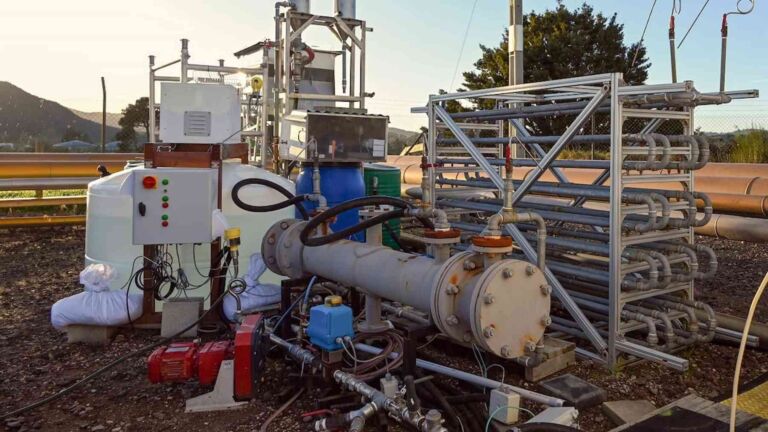
A small turbine sat at the mouth of Sequim Bay, Washington.
Underwater cameras watched every fish, bird and seal that came near it.
Again and again, something swam close enough to matter.
Almost nothing touched the blades.
Now the same question is being asked again, far from the water, inside a university tank in Seattle.
This time the animal is made of silicone, and researchers are trying to make it crash.
A rubber stand in forces the crash nobody wants to see live
The idea behind the lab work is simple once you see it. Nobody can wait around for a real seal to hit a real turbine, because everything the cameras in the bay recorded says that is a vanishingly rare event. So engineers built a stand in instead.
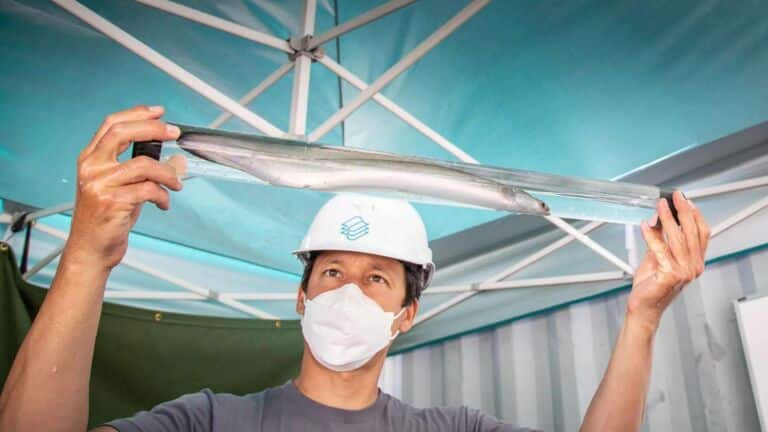
A silicone whale model roughly 10 inches long, shaped and textured like a killer whale, is released upstream in moving water and allowed to collide with a laboratory scale cross flow turbine. That repeatability is the whole point.
At the University of Washington’s Harris Hydraulics Lab, the model sometimes bonks against the turbine blades, sometimes takes a glancing blow and sometimes sails past undisturbed. Each version of that story gets recorded the same way, run after run, building a record of impacts that open water alone could never supply fast enough.
Strain gauges built into the blade feel the hit first
What actually catches the collision is not a camera at all. The researchers placed tiny electrical sensors called strain gauges, normally used to measure forces on a structure, onto a turbine blade. The voltage changes when force is applied, so even poking the blade raises the strain and the voltage.
Those electrical sensors turn a bump nobody can watch for into a spike on a laptop screen. The team confirmed that head on collisions were identifiable in the strain data. The caution attached to that result matters as much as the result itself.
The laboratory data indicate strain gauges are suitable to detect collisions in controlled settings like a flume, but more work is needed to understand how this scales to larger turbines or the rougher flows found at real tidal energy sites, according to the project page for the work. It still matters because cameras have real limits underwater, between murky currents, nighttime hours and the cost of running them for weeks at a stretch.
Four fish strikes turned up across 109 days of watching
The lab work only exists because of what happened first in open water. A sensor package including optical cameras monitored animal interactions with a small, roughly one square meter cross flow tidal turbine deployed off Washington State for 141 days, at a site with peak flow speeds of about 8 feet per second. The team then analyzed optical camera footage spanning 109 days of turbine operation, as reported in the resulting paper.
The numbers that came back were almost reassuring. Those 109 days produced 1,044 observations of fish, seabirds and seals, with no collisions involving seabirds or seals recorded, though seabirds appeared only in daylight and only while the turbine was stationary, while seals were seen day and night, including while the rotor was turning.
Fish did make contact, but rarely. Four instances of fish collision with the moving turbine were observed, out of 229 individual fish and five fish schools seen encountering it, and in all but one case the animals swam away following the collision. The authors describe the imagery as the first optical camera record of fish, bird and marine mammal interactions with a tidal turbine in North America.
A decade of paper models led to the water test
Long before any rubber whale went into a tank, engineers tried to answer the collision question with modeling. Earlier work modeled the forces a turbine blade might impose on a marine mammal, tested the resilience of seal tissue, and built a simple model for a first order assessment of potential risk. That approach could estimate risk on paper, but it could never tell engineers whether a real sensor would actually notice a real hit.
So the project moved from paper to water, much as the same careful site by site caution shaped the amphibian refuge work built beside wind turbines in Spain. The silicone whale models do not represent marine mammal behavior, but they allowed repeatable tests of what a blade feels during a strike.
A researcher on the project summed up the appeal of reusing a part the turbine already carries, saying it “felt like a step forward to monitor marine life by using a strain gauge, which might already be on a tidal turbine blade to monitor its performance.”
A single season of data, and what comes next
Underwater cameras cost money, need power and cannot see through murk or darkness, which is exactly why a blade that reports its own bumps looks useful. The researchers frame the field work as groundwork rather than a verdict, with one coauthor saying “This study was a first step, but a promising one.”
None of this proves marine turbines are harmless everywhere they might be built. Sequim Bay is one site with one small machine, and ocean conditions vary enormously from one coastline to the next.
What the toy whale and its well documented blade do offer is a method, a way to keep learning what a tidal turbine does to animals sharing its current long after the cameras in the bay switch off, the same patient tracking that let researchers in Missouri test turbine shutdown speeds for bats. Cheaper sensors, the kind now logging hits in the tank, are being pitched as a way to keep watching long after a camera crew would have packed up and gone home.
Read the whole thing?
Get the week's signal, not the noise
Our sharpest reporting on energy, climate and nature — free, once a week.