

Harbor porpoises are known to leave when offshore pile driving noise occurs.
However, it remained difficult to determine just how far they would travel before the disturbance faded.
This question was central to research conducted during the construction of the Dogger Bank C offshore wind farm.
Passive acoustic monitoring was conducted in real time while the heavy industrial noise from construction was heard.
Understanding the problem required a different approach
The study took place at the Dogger Bank C offshore wind farm in the North Sea.
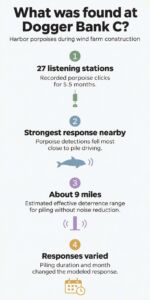
Twenty-seven (27) passive acoustic monitoring moorings were used to measure harbor porpoise activity in relation to pile driving at the construction location.
Monitoring moorings were used across multiple depth zones and were placed differently around the piling location to determine animal activity prior to and after each construction event.
Devices continued to record data continuously throughout all depths to capture echolocation clicks as animals hunted.
These spatial gradients illustrated how the presence of animals changed relative to active construction equipment.
Once it became clear that the piling noise was driving the response, attention shifted to what those changes revealed about porpoise displacement.
Distance remained the most important missing piece
It is already known that harbor porpoises can be temporarily displaced by underwater noise generated from piling for a short duration.
Previous marine monitoring confirms these evasive movements intensify when driving heavy steel foundations into seabed sediments.
Although harbor porpoises are known to respond to construction noise, previous studies had difficulty estimating how far that response extended around offshore wind projects.
Installing massive steel monopile foundations generates intense low-frequency sound pulses that can travel long distances underwater.
Therefore, conservation planning depends on accurate estimates of distance from a construction site where animals will not respond to the noise.
A clearer picture of the boundary started to emerge
As part of the SMRU Consulting Final Report, the monitoring network tracked changes in porpoise activity at various distances from the construction site during piling activities.
Animals were less likely to respond at increasing distances from the piling site.
Strongest responses were observed closest to construction activity and declined sharply within approximately the first ten kilometers.
Detections were lowest near active hammers. When combining these observations, the average effective deterrence range was found to be 14.4 km or roughly nine miles.
Effects typically dissolved within twenty-four hours following hammer strikes.
Not every response followed the same pattern
Findings did not suggest that every piling event produced the same level of response.
Duration of piling events, seasonal variation in baseline animal density, and local propagation properties of sound waves influence the probability of porpoise displacement.
Piling activity longer than one hour was generally associated with a higher probability of response than piling activity less than one hour.
Local acoustic propagation characteristics dictated how far sound pulses traveled.
Variation shows why a single result should be considered an example reference point rather than a rule for all offshore wind projects.
The estimate gained meaning alongside other studies
Empirical data collected from other areas in Scotland show equivalent avoidance thresholds for unmitigated monopiles.
Specific tools designed to reduce noise, such as bubble curtains, can greatly reduce deterrence zones.
The estimated 14.4 km deterrence zone also lies near the lower end of ranges currently assessed for evaluating disturbance from piling activity.
Results therefore offer value beyond Dogger Bank C by contributing to current understanding of effects of construction-generated noise on harbor porpoises.
Its value extends beyond Dogger Bank C
As development of offshore wind energy increases, the importance of developing accurate estimates of marine mammal disturbance will continue to increase.
Real-time tracking provides concrete evidence anchoring management frameworks.
Future research may reveal additional information regarding how harbor porpoises react to construction-related noise in various environments.
Read the whole thing?
Get the week's signal, not the noise
Our sharpest reporting on energy, climate and nature — free, once a week.


