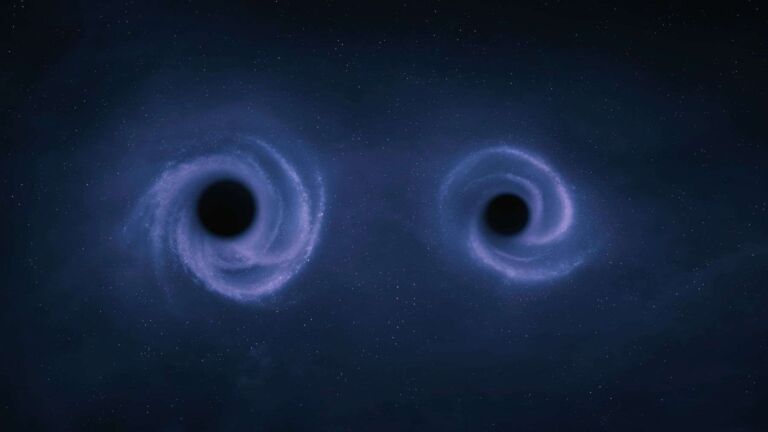
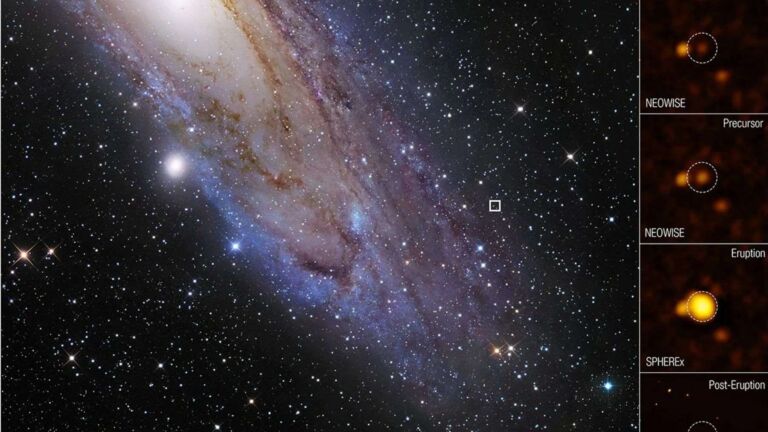
When a massive star dies in a supernova, it goes out like a detonation — a blinding explosion visible across cosmic distances. But astronomers have long suspected that some stars simply vanish instead, collapsing silently into black holes without any flash, any shockwave, any signal at all.
For decades, that quieter fate remained theoretical. Now a Caltech-led team studying 257 black hole collision events has found a strange pattern in the data — a telltale gap in black hole masses that may finally offer evidence of stars that died without ever exploding.
A pattern hiding in 257 collisions
To find the signal, researchers needed scale. Isaac Legred, then a PhD student at Caltech working under professor Katerina Chatziioannou, led the team through mass and spin data from 257 black hole mergers recorded by the LIGO, Virgo, and KAGRA detector network over the past decade. The study was published in Physical Review D.
What came out of that dataset was immediately striking. About three-quarters of all merging black holes clustered around 10 times the mass of the Sun — a statistical concentration that doesn’t happen by accident. Something specific is driving black hole formation at this particular size, and the regularity of it was the first sign that something unusual was at work.
The gap that changed the picture
The peak at 10 solar masses was surprising on its own. What the researchers found just above it was harder to explain. Right after that concentration, the data showed a distinct shortage of black holes with masses between 12 and 16 times that of the Sun — a gap that had never been identified before in the black hole mass distribution.
The contrast makes the pattern sharper and harder to dismiss. An unusual abundance followed immediately by a sudden scarcity raises a precise question: what internal stellar physics produces so many 10-solar-mass black holes while suppressing formation in the range just above? Legred describes it as a “special cocktail of internal physics” that may set this group apart from the broader black hole population. The gap, in other words, isn’t just an absence — it’s a clue.
Spin rates add another clue
Mass alone can tell you a lot, but spin preserves something different — information about the conditions under which a black hole originally formed. So the team didn’t stop at mass distributions.
Black holes near 10 solar masses showed rotation rates clustered within a narrower range than the broader population. That consistency matters. Objects with random or varied origins would show far more spread in their spin properties. The combination of similar masses and similar spins points toward a shared formation history, and together with the mass peak and the gap, the spin data builds a case for a distinct subpopulation with a unified astrophysical origin rather than ordinary black holes scattered at random.
Stars that vanish without a trace
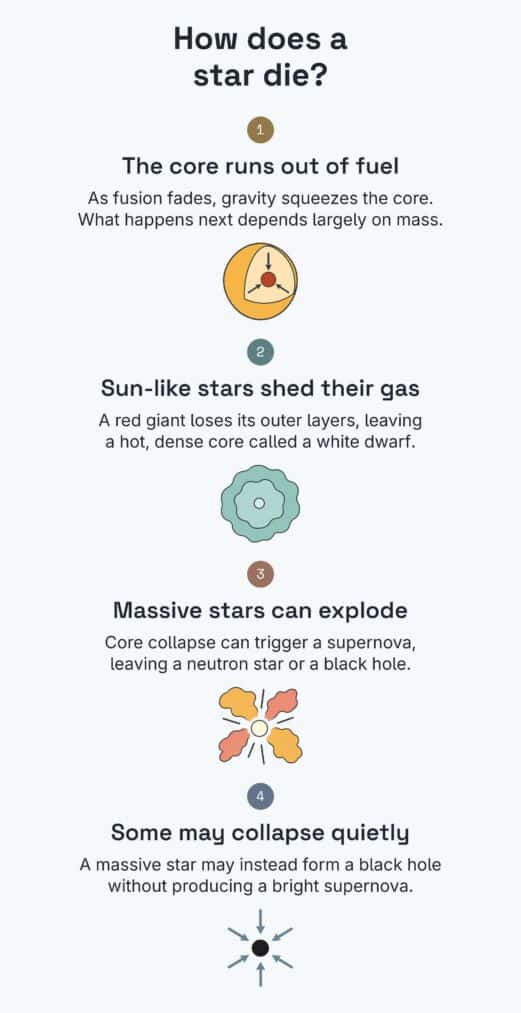
What could produce this pattern? The leading explanation is what researchers call “failed supernovae” — massive stars that collapse directly into black holes without ever detonating.
A normal stellar death is anything but quiet. Supernovae release enormous amounts of energy across vast cosmic distances. A failed supernova does the opposite: the star simply disappears, leaving what Legred describes as “a dark patch of sky.” No explosion, no shockwave, nothing for telescopes to catch.
That invisibility is precisely why this explanation has been so difficult to test — no individual failed supernova has been confirmed yet, though the theory has strong theoretical grounding. The new gravitational wave data are consistent with it, but the researchers stop short of claiming confirmation.
What gravitational waves reveal that light cannot
This is where gravitational wave astronomy earns its value. LIGO — funded by the NSF and operated by Caltech and MIT — first detected gravitational waves in 2015, opening an entirely new observational window on the universe. The LIGO-Virgo-KAGRA network has since logged more than 300 black hole collisions.
That growing dataset makes population-level analysis possible. Instead of studying one event at a time, scientists can now examine the collective properties of hundreds of mergers and ask where these objects came from. No optical telescope could answer that question for objects that may have formed without producing any light.
More data and follow-up studies are still needed before failed supernovae can be confirmed as the definitive explanation. But the direction is set. As the detector network accumulates events — and future upgrades push sensitivity further — the picture of how the universe’s black holes are born will only come into sharper focus. The silence of dying stars may finally be getting loud enough to hear.
Read the whole thing?
Get the week's signal, not the noise
Our sharpest reporting on energy, climate and nature — free, once a week.