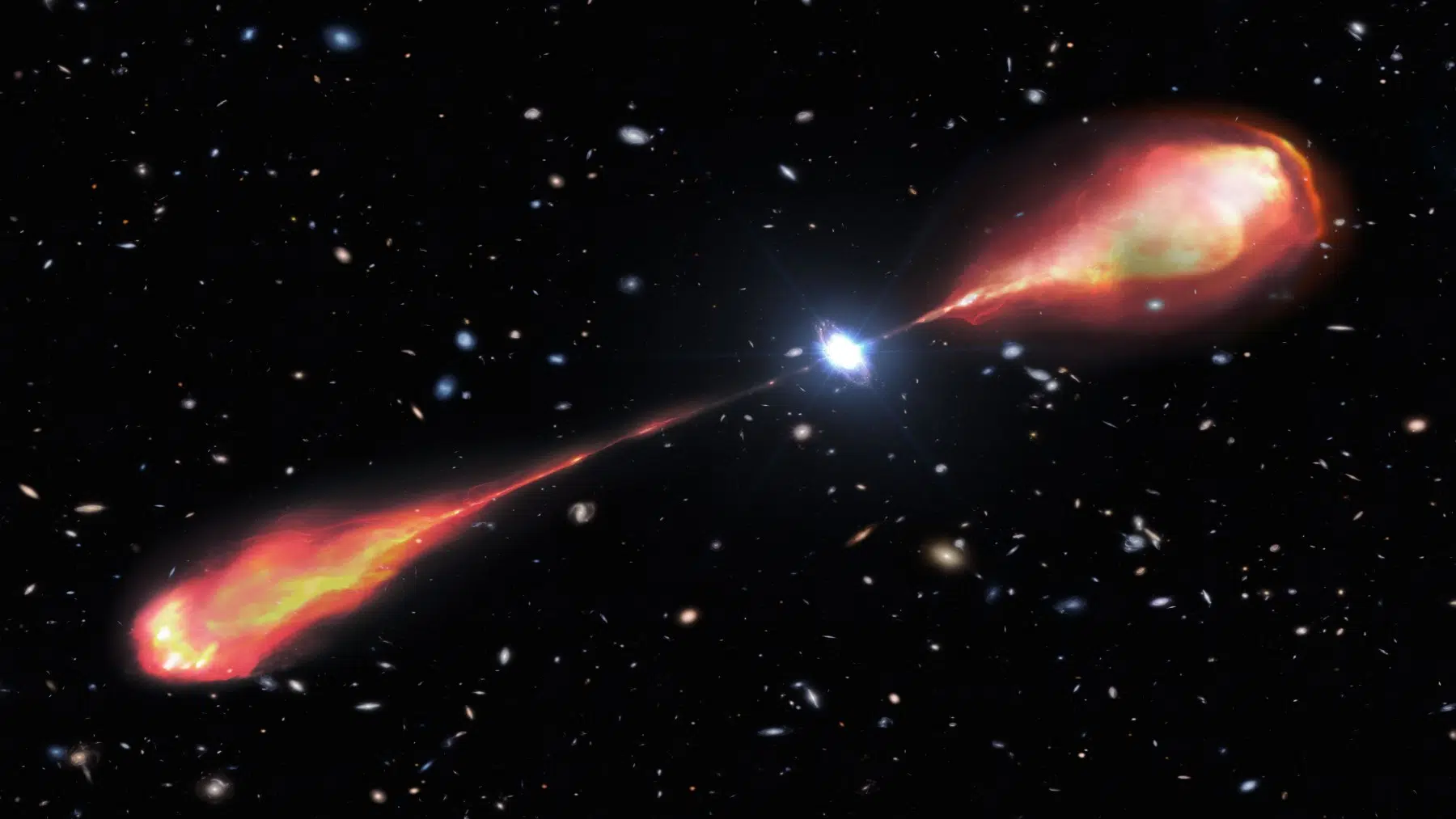
The Milky Way is often referred to as a medium-sized galaxy in the universe, with hundreds of billions of stars and a massive black hole at its center. These cosmic monsters can’t be avoided or destroyed, and once the gravitational field from the black hole starts pulling closer what’s near, nothing can be done unless the object can overcome the speed of light, but studies show that not even light can run away from it.
The fireworks coming from the supermassive black hole in the Milky Way
Scientists have discussed the power of black holes since their discovery, but what actually goes on in the disk that surrounds it remains a mystery. Recently, while observing Sagittarius A* – the black hole located in the middle of the Milky Way – scientists noticed an uncommon behavior.
Although black holes cannot be seen and the only way scientists notice their presence is through a distortion of space-time, Sagittarius A* is visible, and through 2023 and 2024, scientists observed something that’s not normal: flicks of light coming from the dust that surrounds it.
Weak flickers are common and usually caused by less intense changes in the disk, but the bright, large flares come from a very intense change in the environment, with powerful magnetic fields colliding in a high-pressure environment. This phenomenon releases energetic particles close to the speed of light, and the collision gives a bright burst of radiation that is ejected and can be observed using infrared and X-ray instruments.
The team led by Farhad Yusef-Zadeh, the professor of physics and astronomy at Northwestern University, used the James Webb Telescope’s NIRCam (Near-Infrared Camera) at NASA to observe the black hole and its changes for multiple hours during the span of a year, totaling 48 hours between 2023 and 2024.
The bottomless pit is close to the Earth
The disk close to “the point of no return”, the boundary beyond which nothing can escape, contains a steady flow of materials, such as gas or plasma and cosmic dust – but differently from the Saturn rings, this matter is about to enter deep into the event horizon, where not even the light can get away.
Another factor that helped the capture is the distance between Earth and Sagittarius A*, which is only 26,000 light years away – which is considered close in the outer space scale.
“Sagittarius A*” behavior helps prove Einstein’s theory
The “beacon” coming from the cosmic phenomenon is important to help scientists test theories 100+ years old, like the general theory of relativity of Albert Einstein. The first study, published in 1905, approached the correlation between space and time, stating that time is not the same for everyone, an object moving fast looks shorter from an outside view, and nothing can go faster than light from point A to point B.
The second study, published in 1915, incorporates gravity in the discussion, stating that the gravitational force is not exactly a force, but a bending in the spacetime – big objects in space, like planets or stars, can bend the surrounding environment, and gravity is a consequence of it.
The theory inspires beyond science
This theory generated not only many discussions in the scientific field but also inspired movies like Interstellar. The picture made by Christopher Nolan approaches the theory of relativity and the impact of bending the spacetime, adding to the discussion about how black holes interact with the fabric of space – humans can’t travel the full distances in some situations because of the time required to get there.
Read the whole thing?
Get the week's signal, not the noise
Our sharpest reporting on energy, climate and nature — free, once a week.