
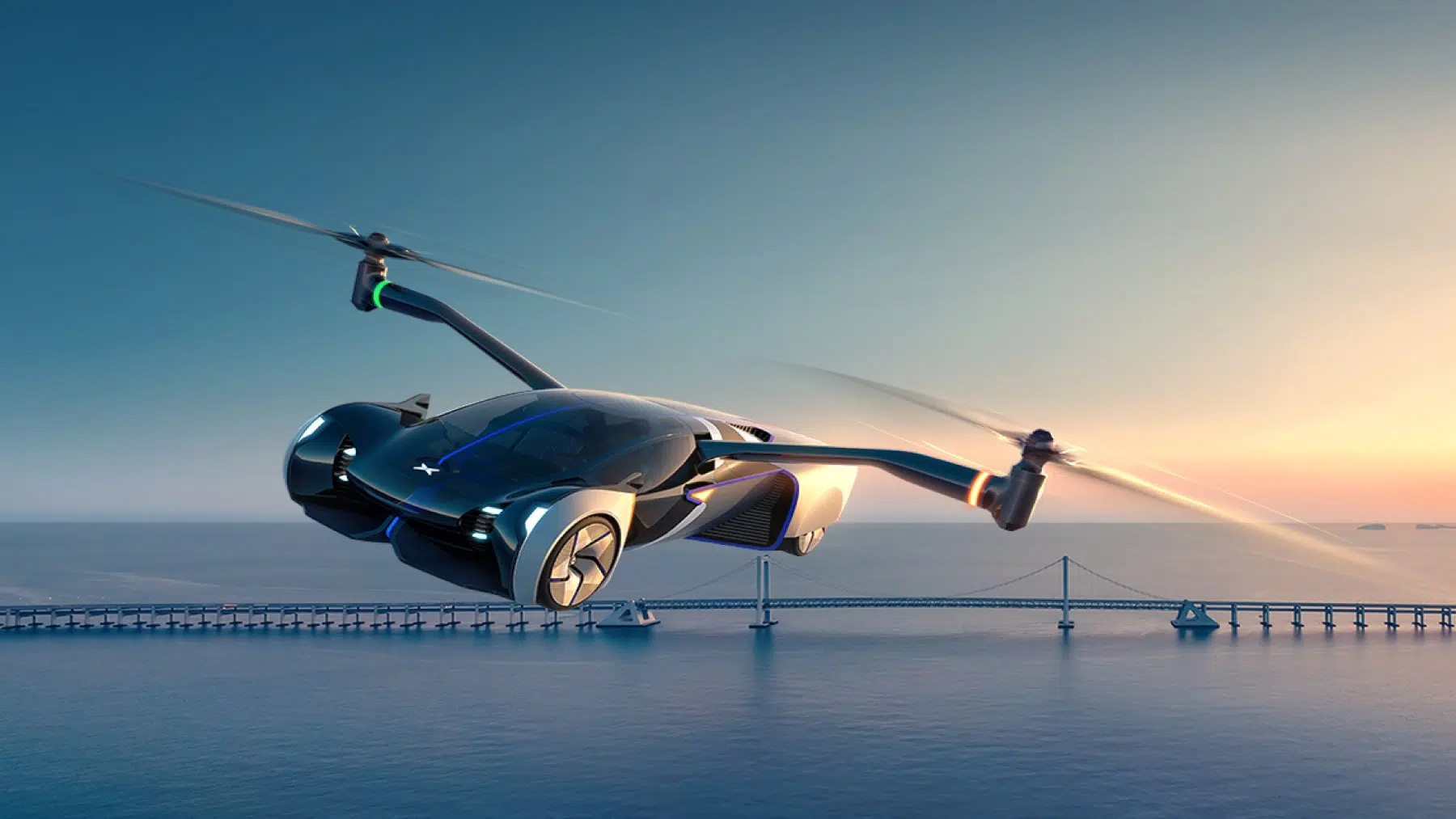
Flying cars have been in the imagination for a very long time. Flying cars have been a subject of fascination for decades, and several companies or individuals have contributed to their popularization, particularly Henry Ford, the founder of the automobile company that bears his surname. The cinema has played a significant role in fueling public interest and imagination in technology, with science fiction movies showcasing the concept of flying cars.
XPeng advances flying car development
What was once thought to be decades away is now becoming a reality. With significant technological advancements, flying cars are finally coming to the real world, and Chinese manufacturers are at the forefront of this development.
Companies like BYD set the tone for electric cars globally. It’s now time for Chinese companies to take the next step and create another groundbreaking product: flying cars. In November 2024, the Chinese company Xpeng AeroHT announced the display of the modular flying car, the Land Aircraft Carrier, at the CES 2025 in January.
The vehicle features a large three-axle aircraft carrier, a range extender, and flying units with two seats inside, not yet designed for family trips. The mass production of the car is scheduled for 2026, with the company making final adjustments before its market launch, priced at around two million yuan (280,000 USD).
Mass production of the Land Aircraft Carrier underway
At the time, the company disclosed no plans for the potential launch of the car in North America, a common practice in the car market. Many models from various manufacturers primarily remain local, expanding only to a few nearby countries. This is often the case for cars in Europe, where well-known car companies such as Renault (France), Volkswagen (Germany), FIAT (Italy), and Land Rover (England).
The Xpeng Land Aircraft Carrier has an initial production capacity of 5,000 units per year, expanding to 10,000 units at full production, which might be relatively low, but it has already secured a couple of thousand orders from enterprises.
The flying car doesn’t fly
The flying car does not exactly fly; it is a massive vehicle with dimensions of 5.5/2/2 meters. The aircraft is hidden inside the Land Aircraft Carrier and can be released with a single button press. Being 100% electric, it supports 5–6 flights on a full charge. The “Mothership” can be used as a charger for the aircraft’s battery, powering 30% to 80% in 18 minutes thanks to its 800V high-voltage system.
Inside the aircraft, two passengers can fit, and like most electric cars, it offers manual and automatic modes. In November 2024, it performed its first public flight at the Zhuhai Airshow. The flying car is unique in that it can fit an aircraft in its trunk, but the development team went further and created an aircraft that can fit inside the trunk, effectively delivering two products to provide the most comprehensive service possible.
The overall model of the flying car resembles the Tesla Cybertruck, with design lines from the outside being very similar, resembling moon rover concepts – robots sent by NASA and other space companies to collect and study lunar soil.
The reality doesn’t live up to the imaginary expectation
The industry definition of flying cars is different from what the image that cartoons and movies set in the imagination of those who dreamed about a car that can fly – and not have an aircraft inside that can fly. What movies and cartoons presented was something related to a magnetic flight. However, the amount of fuel and power required to lift a car from the street is still unknown, and it may be more expensive than buying an electric car, something that has become common in most countries since mass electric car production started.
Read the whole thing?
Get the week's signal, not the noise
Our sharpest reporting on energy, climate and nature — free, once a week.


