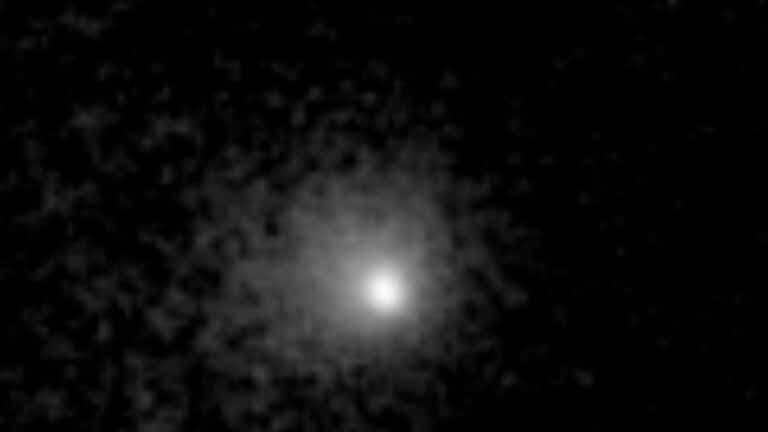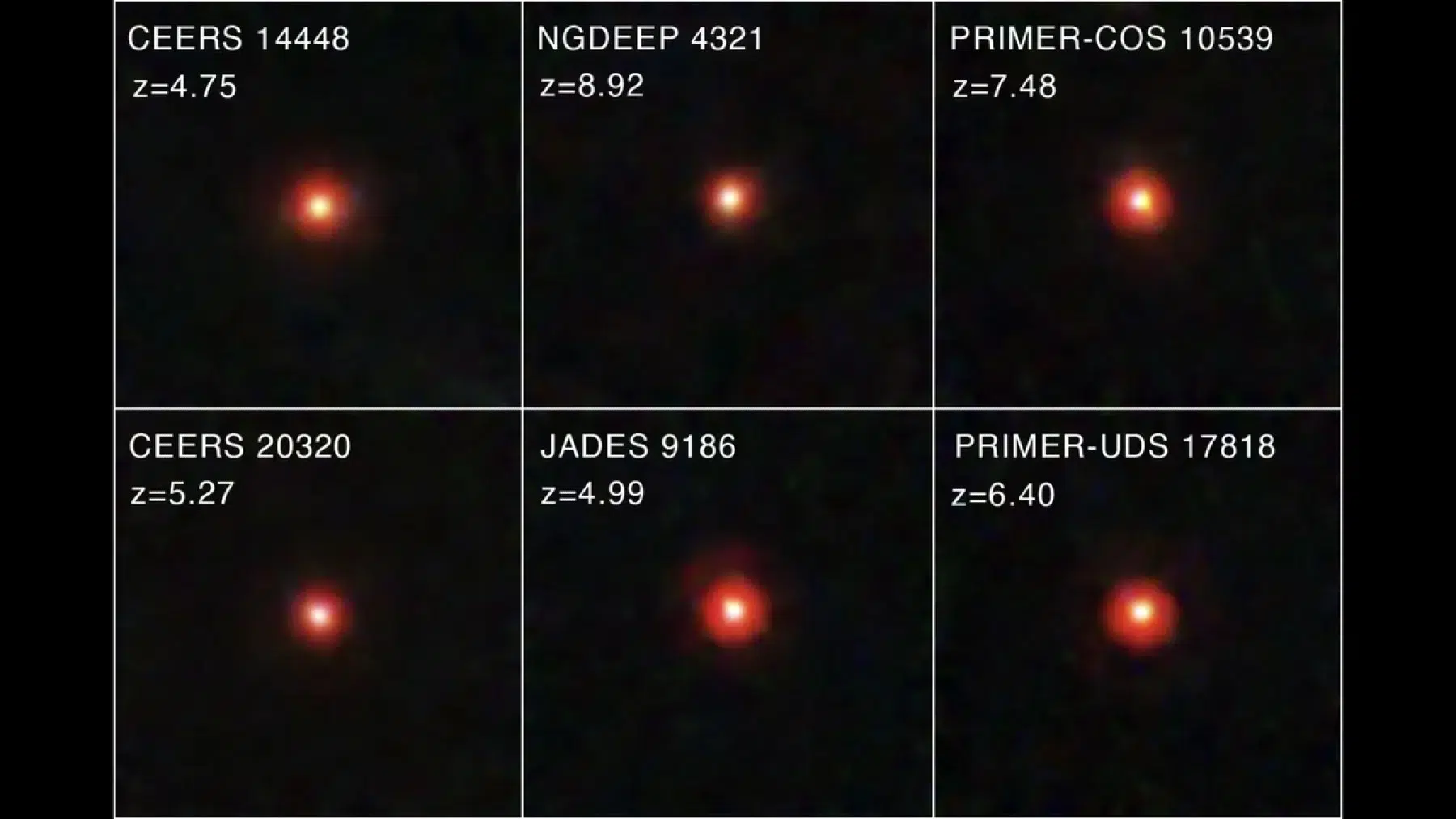
From the very first images James Webb returned, something was off. Tiny red dots kept appearing — in nearly every photo, across years of observations — and no one could explain what they were.
These weren’t faint smudges at the edge of detection. Some shone 100 billion times brighter than a star, yet carried almost no chemical fingerprint beyond hydrogen and helium. Every known category of cosmic object failed to fit. For four years, astronomers stared at something that simply had no name.
A red dot that refused to make sense
The red dots showed up persistently across JWST images — bright, insistent, and deeply confusing. In astronomy, extreme redness usually signals dust. A thick veil of interstellar dust can redden an object’s light, obscuring its true nature much like wildfire smoke reddening a city sky. MIT Kavli Institute director Robert Simcoe drew exactly that comparison. But when researchers looked more closely, the dust explanation fell apart entirely.
Beyond hydrogen and helium, the object’s light carried virtually no elemental or metal signatures — an absence that ruled out most known cosmic sources. The light was bright at higher wavelengths but vanished entirely below a specific threshold, a cutoff called a Balmer break, typically associated with dense, photon-absorbing gas in ancient stellar atmospheres. Vega is one familiar example. This red dot made Vega look unremarkable. “The break we observed in this object is the deepest break we have ever observed in any object,” said Rohan Naidu, an astrophysicist at MIT, “ruling out ‘ordinary’ stars as the source.”
The survey that stumbled onto something new
The discovery wasn’t the goal. Naidu and his colleagues were running a project called the Mirage or Miracle (MoM) survey, designed to find the oldest and most distant galaxies in the universe. JWST’s sensitivity lets it peer hundreds of millions of years into the cosmic past, further than any telescope before it.
The survey’s name captures a real tension. Some extraordinarily bright early galaxies — “miracles” — turned out on closer inspection to be something else entirely: mirages. “What we found was that what looks like an extremely bright early galaxy, aka a ‘miracle,’ in some cases actually could be a ‘mirage,'” Naidu explained. MoM-BH*-1 was flagged during routine image review. Nobody was hunting for a new class of cosmic object. They simply couldn’t ignore what kept appearing.
Simulations point to an impossible brightness
Stumped by their observations, the team ran simulations to find what astrophysical conditions could produce the red dot’s color using only hydrogen and no dust. The answer surprised them.
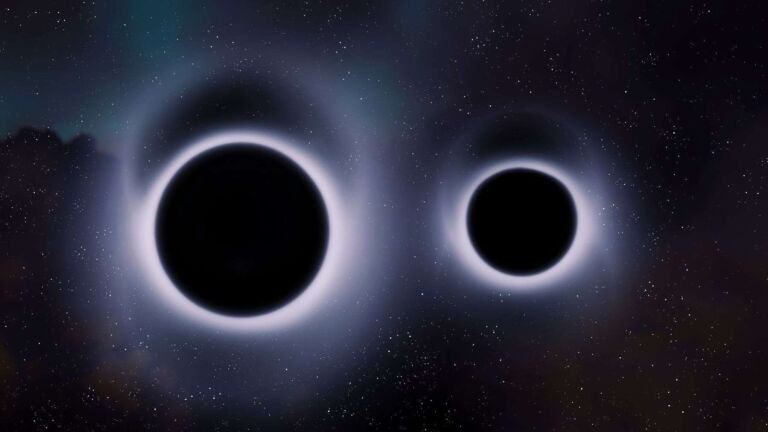
An extremely dense screen of hydrogen could produce red light on its own — at sufficient density, it wouldn’t behave like a wispy interstellar cloud but more like the surface of an enormous star. That still didn’t solve the brightness problem. The red dot shines at roughly 100 billion times the luminosity of a typical star, a level nuclear fusion simply can’t produce. When astronomers incorporated a black hole into their models and compared results against JWST observations, the numbers finally aligned. Only a black hole at the center of the system could plausibly account for what they were seeing.
What exactly is a ‘black hole star’?
The object that emerged from those simulations is unlike anything previously catalogued. A black hole star is a massive, dense gas cloud powered not by nuclear fusion but by a central black hole — one roughly 100,000 times the mass of the sun. The surrounding gas envelope stretches to a scale comparable to the entire solar system. “It’s huge,” Naidu said simply.
Named MoM-BH*-1, the object outshines its host galaxy so thoroughly that researchers describe what they’re detecting as “pure black hole star light.” It isn’t a star. It isn’t a quasar. It fits no existing category, which is precisely why identification took four years.
What comes next for black hole star research
MoM-BH-1 is likely not alone. Many unexplained red dots still lurking in JWST data may now be explainable through this new astrophysical model. None detected so far come close to matching its brightness, suggesting MoM-BH-1 may represent an extreme case within a broader, quieter population.
The discovery — published in Nature — wouldn’t have been possible without JWST’s unmatched sensitivity. The telescope continues reshaping what astronomers thought they understood about the early universe. As research around black hole stars develops, scientists will be watching those red dots with fresh eyes. What once looked like noise in the data may turn out to be a population of objects hiding in plain sight, waiting for the right framework to make them visible.
The complete study is available here: Naidu, R.P., Matthee, J., Katz, H. et al. A gas-enshrouded and gas-reddened black hole at cosmic dawn. Nature 656, 329–333 (2026). https://doi.org/10.1038/s41586-026-10846-4
Read the whole thing?
Get the week's signal, not the noise
Our sharpest reporting on energy, climate and nature — free, once a week.