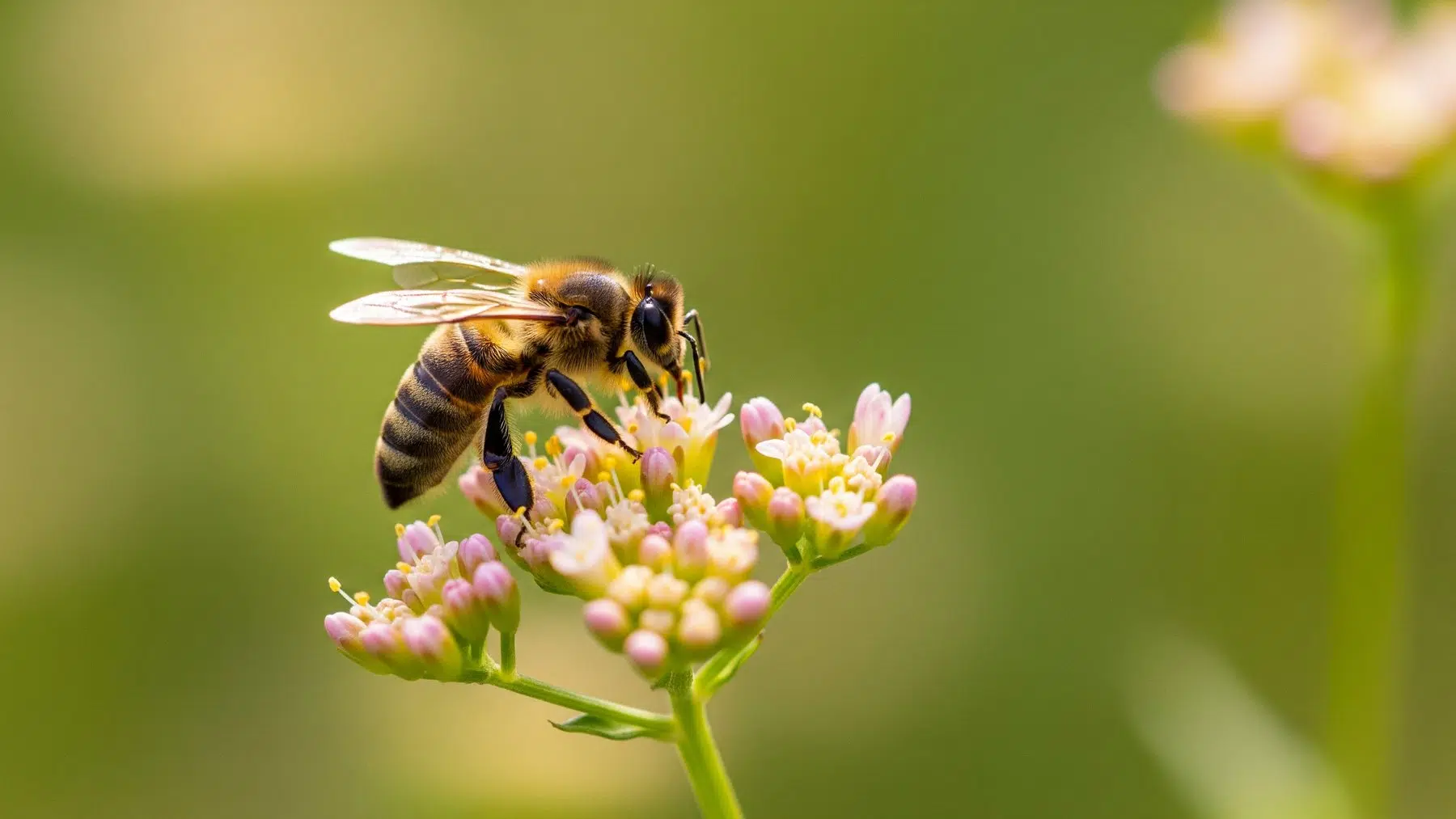
It is the size of a sunflower seed and weighs almost nothing.
It visits your garden, pollinates your food, and then disappears into the hive to do something that science spent three decades arguing was impossible.
A honeybee brain contains fewer than one million neurons, a number so small it barely registers against the 86 billion packed inside a human skull.
And yet researchers have just confirmed that what happens inside that impossibly tiny brain belongs on a very short list of cognitive feats in the animal kingdom.
The debate that wouldn’t die
For about 30 years, scientists kept running an uncomfortable experiment.
They would train honeybees to choose between images showing different numbers of shapes, reward the right answer with sugar water, and watch the bees pick correctly far more often than chance would allow.
The results looked like counting.
But the argument against them never went away.
Critics insisted the bees were not really counting at all.
They were just reacting to how visually busy or cluttered an image looked, not to the actual number of objects in it.
It was a hard argument to kill, and it kept the whole question of bee intelligence in a kind of scientific limbo.
The flaw that changed everything
The trouble with all those earlier experiments was in how the tests were designed.
Researchers kept building visual puzzles using human assumptions about what animals see.
But a bee’s eye is nothing like a human eye.
It perceives the world with far less fine detail.
Images that seemed perfectly controlled to a human researcher were actually loaded with visual shortcuts a bee could follow without ever counting a thing.
The new approach was to evaluate every test image the way a bee would, running the same visual filters a honeybee brain actually uses.
When that happened, all those old pattern based explanations collapsed.
What remained was something harder to dismiss.
What a brain lighter than a sesame seed can do
The picture that emerged is genuinely startling.
Studies showed that honeybees can count up to at least four objects and understand the concepts of greater than and less than.
They can even grasp the abstract idea of zero, a notion human children typically don’t comprehend until around age four.
Researchers also trained bees inside a Y-shaped maze where the color of a set of shapes told them which arithmetic rule to apply.
Blue shapes meant add one, yellow shapes meant subtract one.
The bees had to select the correct answer from options they had never encountered during training.
They learned it.
All of this with under a million neurons and a brain that weighs less than a grain of sand.
The real subject hiding in the hive
The creature at the center of this 30 year argument is the honeybee, one of the most familiar insects in every American backyard and every flowering roadside strip from Maine to California.
Published in April 2026 in Proceedings of the Royal Society B, the Monash University study settles the debate: do bees truly process numbers, or merely react to visual cues?
When stimuli are evaluated from a bee’s eye view, the evidence for numerical cognition is strengthened rather than diminished.
The implications reach far beyond the hive.
The bigger lesson may be that evaluating cognition through a human lens leads directly to underestimating what other species are capable of.
Scientists who study spider silk and other natural wonders are finding the same thing repeatedly: nature hides extraordinary engineering inside what looks, at first glance, like nothing at all.
What the bee is telling us
None of this means the honeybee is doing calculus between flower visits.
But it does mean that the line scientists drew between real intelligence and insect reflex is far less solid than anyone thought.
Neural network analyses indicate that counting can be mediated by very small neural circuits, which means small brained animals may have been underestimated across the board.
That finding matters urgently, because bees are under enormous pressure globally, with American beekeepers reporting record colony losses in recent years.
Understanding what a bee’s brain actually does may change how scientists approach hive health and how engineers design the next generation of tiny AI systems.
The honest caveat is that much of this research comes from controlled lab settings, and how numerical thinking plays out across a wild colony is still an open question.
But the core result is solid: the insect humming past your tomato plants this summer is carrying a mind that science spent 30 years underestimating, and the reckoning that followed is changing what we think a brain needs to be.
Read the whole thing?
Get the week's signal, not the noise
Our sharpest reporting on energy, climate and nature — free, once a week.