Every few years the same animal goes around the internet again.
The claim is always that it sees colors we cannot imagine, and that human vision beside it is a smudged photocopy.
The arithmetic behind that story is real. We run on three types of color receptor, and this one carries four times as many.
So a team in Australia finally sat the animal down and tested it properly.
It failed, and it failed by a margin nobody had prepared for.
What the twelve receptors actually are
The creature is a mantis shrimp, a stomatopod that lives in a burrow on tropical reefs and punches hard enough to crack aquarium glass.
Its eyes sit on stalks and move independently, each one split by a band of specialized rows across the middle.
Those rows hold 12 color receptor types, eight covering the visible spectrum and four reaching into the ultraviolet.
Human eyes hold three, tuned to broad and heavily overlapping ranges of wavelength.
Our brains then compare the output of those three against one another, and everything you have ever seen comes out of that comparison.
So four times the hardware sounds like it should mean four times the world.
That assumption sat in textbooks for roughly twenty five years without anyone testing it.
The test that ended the legend
Then researchers at the University of Queensland built the experiment that should have run decades earlier.
They worked with a small species called Haptosquilla trispinosa, which matters, because it is not the flamboyant peacock species in every photograph.
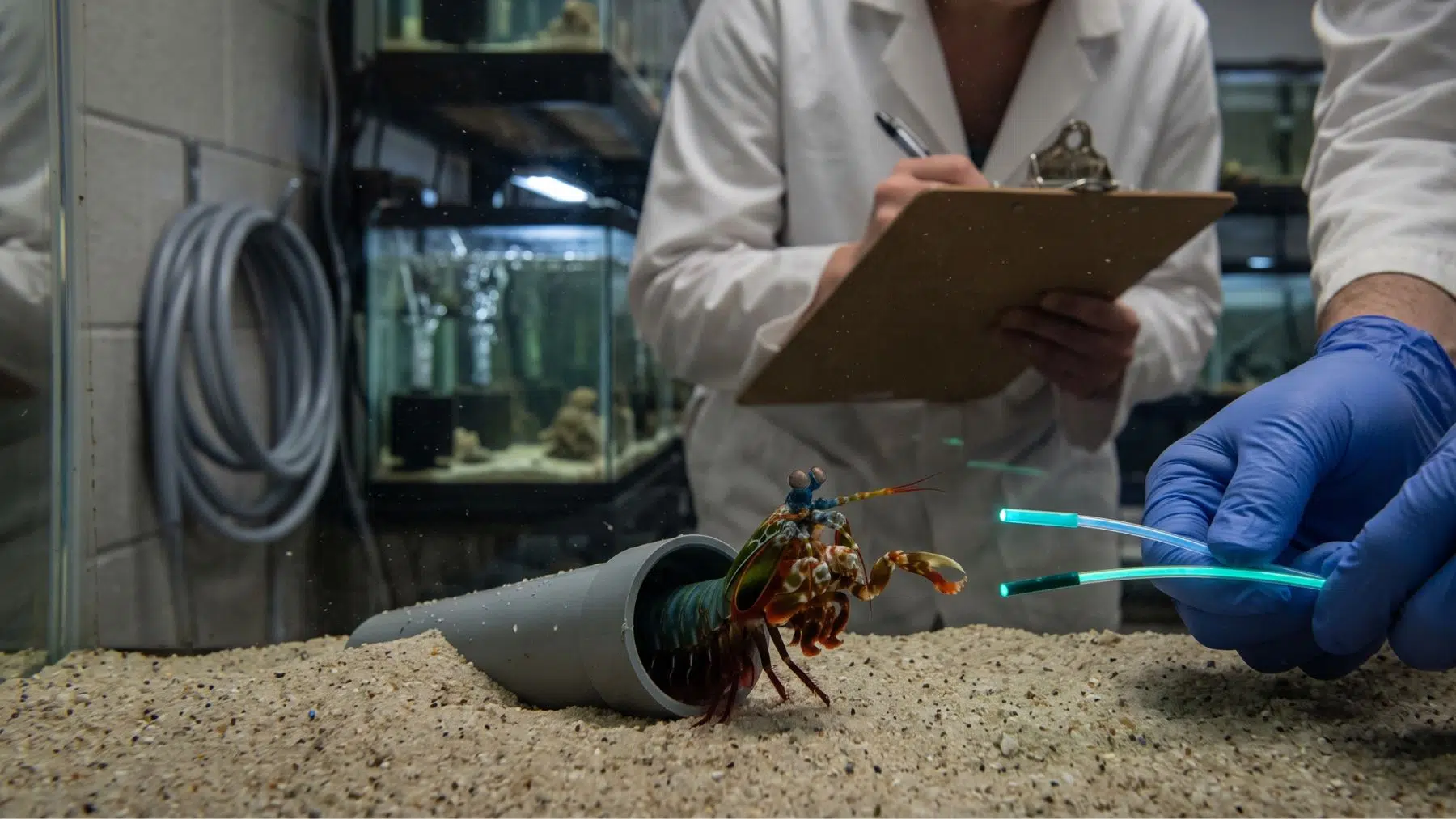
The animals were trained to strike the glowing tip of a fiber optic cable showing one color, and were fed when they got it right.
Then a second cable appeared, and its color was walked steadily closer to the first.
The point where it stopped choosing correctly is the discrimination threshold.
Two shades had to sit 15 to 25 nanometers apart before a mantis shrimp reliably noticed any difference.
A human manages between one and five, and a honeybee with far fewer receptors does better than the shrimp too.
The animal with the most celebrated eye in the ocean came in near the bottom.
What the eye is doing instead
Which is the interesting part, because failing that test is not the same as seeing badly.
It means the eye was never built to do what our eyes do.
We compare receptors and assemble a picture, and that comparison takes brain tissue and it takes time.
A stomatopod appears to skip the assembly entirely, sweeping its eye across an object and reading each of the twelve channels as a fixed value.
Justin Marshall, who led the work, compares the setup to a satellite rather than to an eye, since remote sensing runs on lookup tables that match a signal to an answer without building a scene.
The result is recognition without interpretation, which on a reef is worth more than richness.
Because a burrow entrance offers about one second to decide whether the shape in front of you is a mate, a rival or a meal.
The parts of the legend that survived
None of this makes the eye ordinary, and two findings since have made it stranger.
A team at the University of Maryland sequenced what those eyes express and found at least 33 light sensitive proteins, roughly double the sixteen anyone had expected.
Nobody yet knows what most of them are for, which is an unusual sentence to write about an animal this heavily studied, and the original Queensland result holds up as the study reported it.
Then there is polarization, where the creature has no competition at all.
It is the only animal ever shown to detect circularly polarized light, a property most people encounter only in 3D cinema glasses.
Some species carry circularly polarized patches on their bodies and appear to signal each other on a private channel nothing else can read.
The gap between a headline number and what a system actually delivers turns up in other places too, whether the argument is over a solar site or an offshore project.
Where engineers are copying it
So the useful lesson turned out to be the opposite of the meme.
Evolution did not build a better version of our eye. It built a different instrument, optimized for speed and for a kind of light we ignore.
Engineers noticed. A group at the University of Illinois built a sensor modeled on the stomatopod retina that reads color and polarization in the same frame.
Fitted to a colonoscope, it can pick out the disordered structure of cancerous tissue, and the chip costs under a hundred dollars, according to the university.
British researchers found something else in the same eye, a natural filter that outperforms the equivalent part inside CD and DVD players.
The animal never saw a rainbow we cannot see.
It carries a sensor built for a job we do not have, which is a stranger fact than the one the internet keeps repeating.
Read the whole thing?
Get the week's signal, not the noise
Our sharpest reporting on energy, climate and nature — free, once a week.