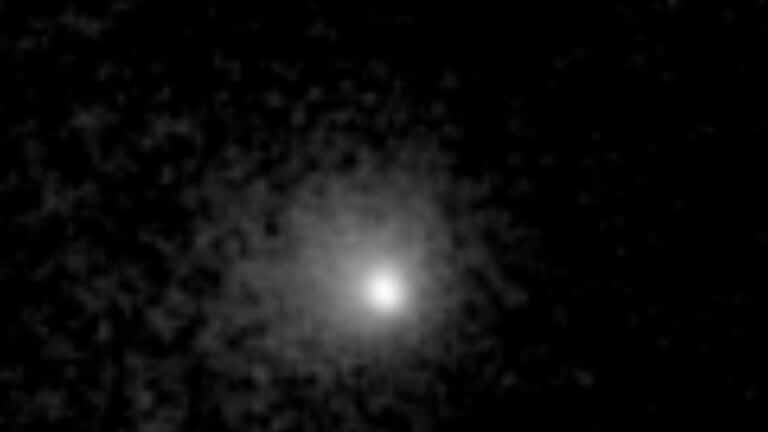
In 2019, a brief blue flash lit up routine optical survey data and quickly faded — just another transient event in a sky full of them. Astronomers logged it, catalogued it as AT2019ijn, and moved on.
Then came the radio data. Instead of fading alongside the optical signal, the radio emission did the opposite: it kept getting brighter. For nearly two years the signal grew, reaching luminosities more than 100 times beyond what similar events typically produce. Something had been quietly building in the background the whole time.
A flash that refused to fade
AT2019ijn first appeared unremarkable. It rose to peak brightness within just a few days — a fast blue optical transient, the kind of event that shows up regularly in survey data. What made it stand out, at first only slightly, was how it faded. Most similar transients drop off quickly in visible light. This one lingered, declining more slowly than expected. A small anomaly, easy to set aside.
The radio data changed the picture entirely. Rather than dimming alongside the optical signal, the radio emission kept climbing — steadily, for nearly two years. At 3 GHz, the signal eventually reached a luminosity more than 100 times greater than what typical supernovae or fast blue optical transients produce at comparable stages. Then it began a slow decay that continued for at least four years. Whatever caused this event had been quietly accelerating long after the initial flash.
The black hole hiding in the middle
The fast optical rise was the first real clue. That kind of rapid brightening is a known signature of a tidal disruption event — the violent process in which a star strays too close to a black hole and gets shredded by its gravitational pull. The specific characteristics of AT2019ijn, though, pointed to a particular type of black hole, one that astronomers have long struggled to find.
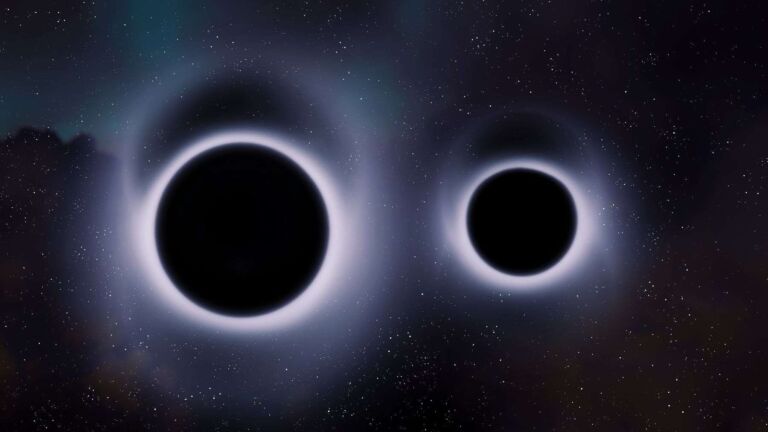
The evidence implicates an intermediate-mass black hole. These objects sit between the stellar-mass black holes formed when massive stars collapse and the supermassive black holes anchoring the centers of large galaxies — a missing link, theoretically important for understanding how the universe’s largest black holes formed and grew, but notoriously difficult to detect.
That difficulty is exactly what makes AT2019ijn significant. It offers a new detection pathway. If intermediate-mass black holes can reveal themselves through tidal disruption events and the radio flares that follow, astronomers now have a tool they didn’t have before.
A jet seen from the side
The most striking feature of AT2019ijn isn’t just that the radio signal grew — it’s why it grew so late. The leading explanation is a relativistic jet: a narrow beam of material launched at a significant fraction of the speed of light by the black hole during the disruption. The catch is that this jet wasn’t aimed at Earth.
When a jet points directly toward an observer, it appears bright almost immediately. Aimed to the side — what astronomers call an off-axis geometry — the picture changes entirely. As the jet slows and expands, its afterglow emission gradually spreads into the observer’s line of sight, and the radio flare arrives late, building over months rather than days. That geometry fits AT2019ijn almost exactly.
The implication is uncomfortable. If off-axis jets produce radio peaks that arrive long after the initial optical flash, many similar events may have already been missed — logged, filed, and forgotten before the real signal ever appeared.
How a global network of telescopes pieced it together
No single facility could have reconstructed this event alone. The NSF Very Large Array and the VLA Sky Survey provided the core radio dataset, tracking the signal’s behavior over time with enough consistency to identify the sustained brightening. That long baseline of observations was essential for distinguishing a genuine rise from normal variability.
ASKAP in Australia and the upgraded Giant Metrewave Radio Telescope in India filled in coverage across different frequencies. Multi-frequency data matters because different physical processes leave different spectral fingerprints, and combining those measurements with optical survey data allowed researchers to model the expanding outflow and test competing explanations for what was powering it. The conclusion — a narrow relativistic jet viewed from well off to the side — held up across the full dataset.
What comes next in the hunt for hidden black holes
The findings, accepted for publication in The Astrophysical Journal Letters, reframe how astronomers might approach unusual optical transients. Some events that looked ordinary at first glance may belong to a broader family of black-hole-powered phenomena. The difference, in many cases, may simply be whether anyone kept watching long enough.
New all-sky surveys that scan repeatedly in both visible light and radio waves are well positioned to find more events like AT2019ijn. As the sample grows, patterns should emerge — how often intermediate-mass black holes disrupt passing stars, how frequently those disruptions produce jets, what conditions determine whether a jet forms at all.
Each new detection adds a data point to one of astrophysics’ most stubborn puzzles: how the universe’s supermassive black holes got so large. Intermediate-mass black holes may be the bridge between stellar remnants and cosmic giants, and events like AT2019ijn may be one of the few ways to find them before they disappear back into the dark.
Read the whole thing?
Get the week's signal, not the noise
Our sharpest reporting on energy, climate and nature — free, once a week.