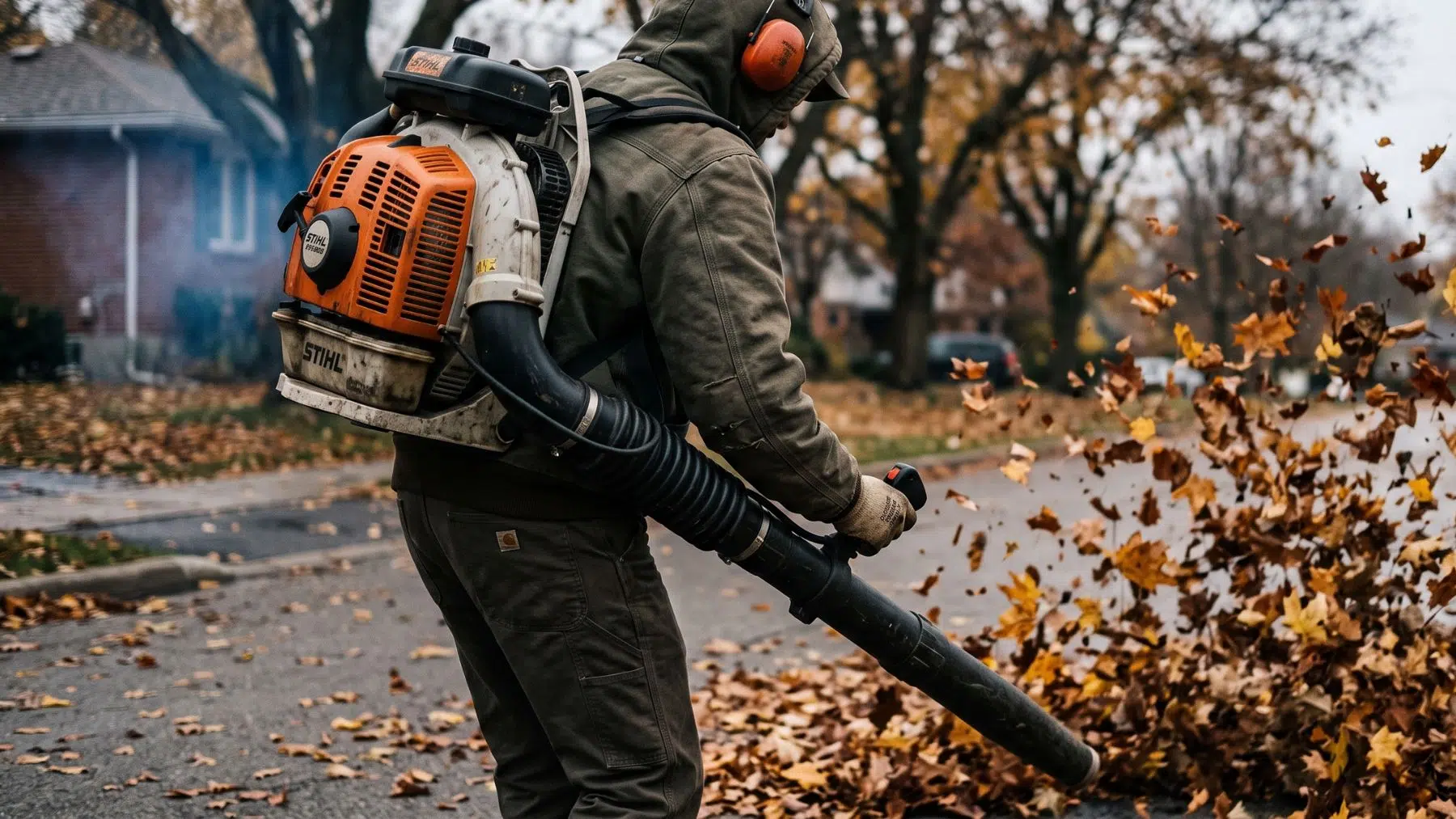
A landscaping truck parks at the curb on an October morning and three men climb out. Each of them straps a blower to his back and pulls the cord, and the engines catch on the second try and settle into a flat scream.
For the next hour the nozzles drive dry leaves off the lawns and into the gutter. Each of those engines is about the size of a coffee mug, and what comes out of their exhausts is wildly out of proportion to that.
A very small engine asked to do a great deal
A leaf blower has exactly one job, which is to move air fast, and fast air takes power, while power carried on somebody’s back has to be light. That combination has pointed the industry at the two stroke engine for fifty years.
A two stroke fires on every revolution instead of every other one, so it makes roughly twice the power for its weight, and it carries no valves, no camshaft and no separate oil system. The oil goes straight into the gas can, mixed at about fifty to one.
The finished machine weighs around twenty pounds and pushes air out of the nozzle at over 150 mph. That is a narrow jet rather than weather, and it falls apart a few feet from the tube.
Why that design pollutes the way it does
Here is the part that explains everything downstream. In a two stroke, the intake and the exhaust are open at the same moment, so fresh fuel and air rush in to shove the burned gases out and the two meet in the doorway.
A real share of that fresh charge goes straight out the pipe having never burned at all, and the oil rides out with it, which is why the exhaust is blue and smells the way it smells.
A car engine does none of this, and it also carries a catalytic converter and closed loop fuel control, while the blower has neither of those. Fifty years of tightening car standards simply went around this class of engine.
The sound is a separate problem entirely
Gas backpack blowers commonly run between 95 and 105 decibels at the operator’s ear. People reach for a jet takeoff as the comparison, which overstates it, because a jet measured close is far louder than that.
The exposure limit is the more useful number, because at 100 decibels federal health guidance puts the safe daily dose at roughly fifteen minutes, and a crew working a street works hours. The decibel scale is logarithmic, so every three points cuts the safe time in half again.
California regulators also looked at what operators breathe rather than hear, and found the volatile organic compounds alone could double the risk those workers already carry.
The number that actually made the news
The state’s air regulator ran the equipment against a modern car. One hour on the best selling commercial leaf blower produces about as much smog forming pollution as driving a 2017 Toyota Camry 1,100 miles, according to the board.
The same exercise puts an hour on a commercial mower at roughly 300 miles, which makes the blower nearly four times the mower, from a machine one man carries on his shoulders.
Two things get lost every time this statistic travels. It counts smog precursors, the reactive gases and nitrogen oxides that cook into ozone on a hot afternoon, and not carbon dioxide, and it describes a commercial machine, the professional backpack unit, not the handheld model in a suburban garage. The homeowner version is smaller, and it runs on the same principle.
What the leaves were doing there in the first place
A second argument runs alongside the engine one and has nothing to do with it. Mated bumble bee queens spend the winter an inch or two into the ground, very often under leaf cover, luna moths and swallowtails overwinter in cocoons built to look exactly like dead leaves, and woolly bear caterpillars tuck themselves into the pile itself.
Clearing a yard down to bare soil in November takes all of that with it, though the fix deserves precision, because the insect people are precise about it. The group behind the leave the leaves campaign recommends raking or an electric blower rather than shredding with a mower, and the society objects to chopping and hauling, not to moving leaves.
California has taken the engine end of the problem instead. Sales of new gas powered yard equipment ended in January 2024, with 30 million dollars set aside to help landscaping crews convert, while machines already owned stay legal to keep and to run.
The argument will outlast the rule, the way it does around a solar site or an offshore project. Which leaves a homeowner with one small decision, namely where the leaves end up, and what pushes them.
Read the whole thing?
Get the week's signal, not the noise
Our sharpest reporting on energy, climate and nature — free, once a week.