
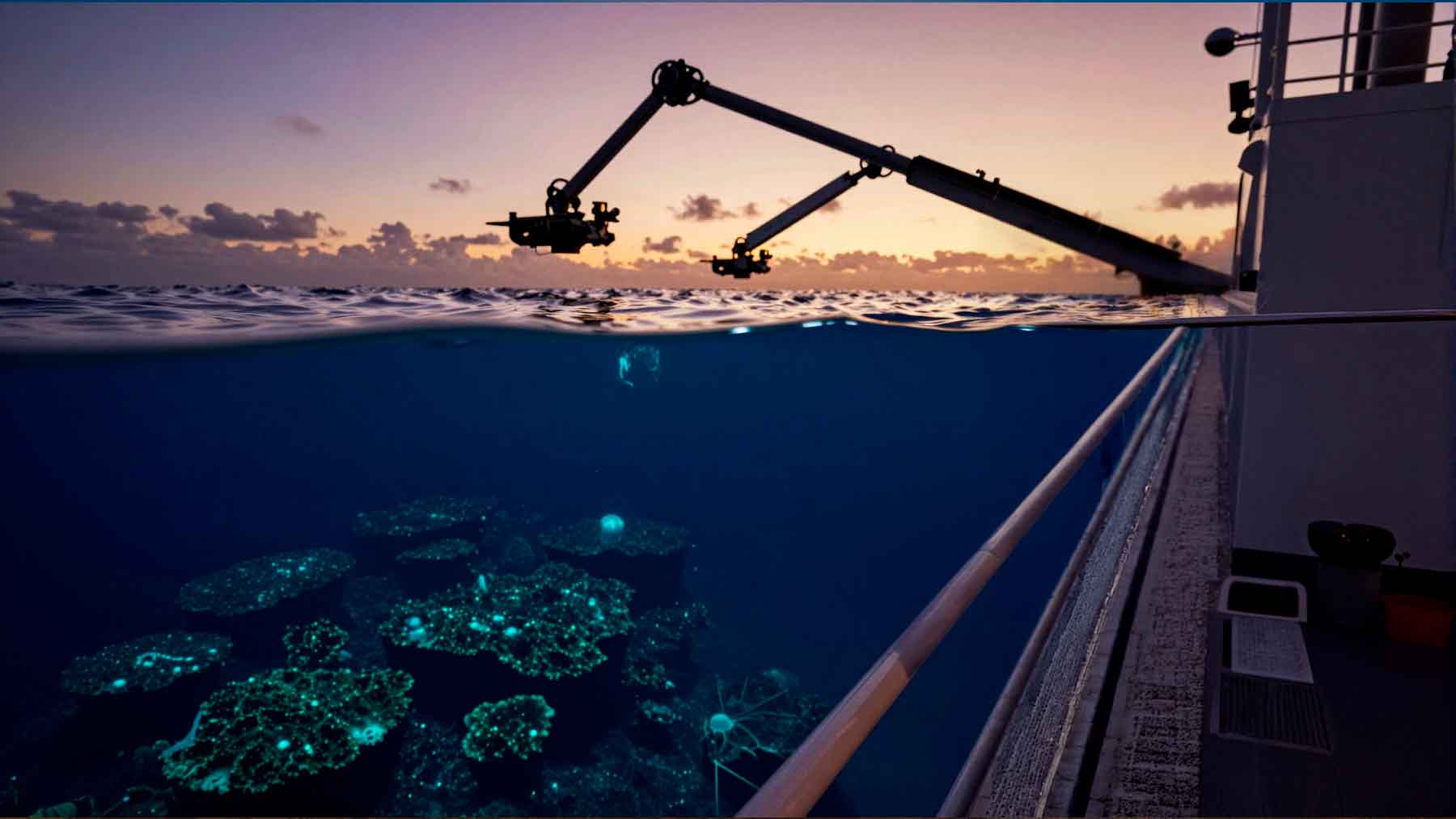
Growing up in the Florida Keys, Bella Iannotta Vignette learned the ocean the way other kids learn a neighborhood — by feel, by presence, by the life moving just beneath the surface. That early pull never let go. Now a graduate student at the University of South Florida, she’s trading shallow-water familiarity for something far less mapped: a 20-day expedition aboard the E/V Nautilus into the deep seafloor surrounding the Hawaiian Archipelago, where species waiting to be found may not yet have names.
A childhood by the sea, a career pointed downward
The Florida Keys don’t let you ignore the ocean. It surrounds you, defines the light, shapes the air. For Bella Iannotta Vignette, that proximity became something deliberate — a fascination with the life the water holds and the systems that sustain it.
That fascination carried her to the University of South Florida’s College of Marine Science, where her graduate research focuses on abyssal polymetallic nodule fields — vast, poorly understood zones shaped by biological and sedimentary processes scientists are only beginning to untangle.
Before this expedition, Bella built a track record across the Pacific in benthic habitat characterization, biological specimen collection, and taxonomic identification. That last skill matters most when something unknown drifts into frame on an ROV camera. You need someone who can recognize it — or recognize that no one has before.
Into the unknown: what the Hawaiian deep sea holds
The E/V Nautilus will focus on two areas: unexplored ridges and seamounts in the eastern Papahānaumokuākea National Marine Sanctuary, and abyssal plain habitats southwest of the Main Hawaiian Islands. Both remain poorly surveyed despite sitting within one of the largest marine protected areas on Earth.
That gap isn’t surprising. The sanctuary spans an enormous stretch of the central Pacific, and its deepest zones are expensive and technically demanding to reach. Most research has historically concentrated on shallower, more accessible waters — leaving the abyss largely untouched.
What lives in those environments remains largely undocumented. Extreme pressure, near-freezing temperatures, and total darkness filter for highly specialized organisms, many of which may exist nowhere else. You can’t protect what you haven’t described.
The tools of deep-sea discovery
The E/V Nautilus carries the infrastructure that makes this work possible. Its remotely operated vehicles descend to depths no human diver could reach, capturing high-resolution video and collecting specimens with precision manipulator arms. Continuous mapping systems build detailed pictures of seafloor topography, guiding ROV dives and helping scientists prioritize targets as they go.
Two additional systems will be deployed: a benthic lander and a low-light camera rig for deep-sea coral monitoring. Corals in the abyss grow slowly and disturb easily, so dedicated tools allow observation without repeated intrusion. The Nautilus’s telepresence capability also lets shore-based scientists watch live ROV feeds and contribute to identification decisions in real time — Bella will work alongside both the onboard team and those remote collaborators simultaneously.
Ocean Census and the push to count every species
The Ocean Census program exists because species discovery in the deep ocean is drastically underfunded relative to what remains unknown. Its mission: accelerate the rate at which new marine species are found, described, and formally documented.
Participant Expeditions embed scientists from the broader Ocean Census Science Network into partner-led voyages, adding taxonomic capacity without duplicating logistics. Bella’s place on the Nautilus pairs her expertise with Ocean Exploration Trust infrastructure. Behind the program sits the Ocean Census Alliance — a coalition of marine institutes, museums, universities, and government partners whose work feeds directly into conservation policy, resource management, and international agreements about which parts of the ocean deserve protection.
Science at the surface: sharing the deep with the public
Bella’s role extends beyond specimen identification. She’ll contribute to live streams and onboard outreach, helping translate what the ROV sees into something accessible for audiences watching from anywhere in the world. The same telepresence technology connecting shore-based scientists connects the public — in real time — to a seafloor most people will never otherwise encounter.
That connection matters beyond education. Public awareness shapes political will, and political will shapes conservation budgets and regulatory frameworks. Every person who watches a live dive and sees a creature they didn’t know existed becomes a potential advocate for those ecosystems.
When the expedition wraps in October, data, specimens, and footage move into the longer pipeline of deep-sea science — species descriptions, habitat assessments, policy-relevant findings that could take years to fully publish. The work of building that record starts now, thousands of feet down.
Read the whole thing?
Get the week's signal, not the noise
Our sharpest reporting on energy, climate and nature — free, once a week.


