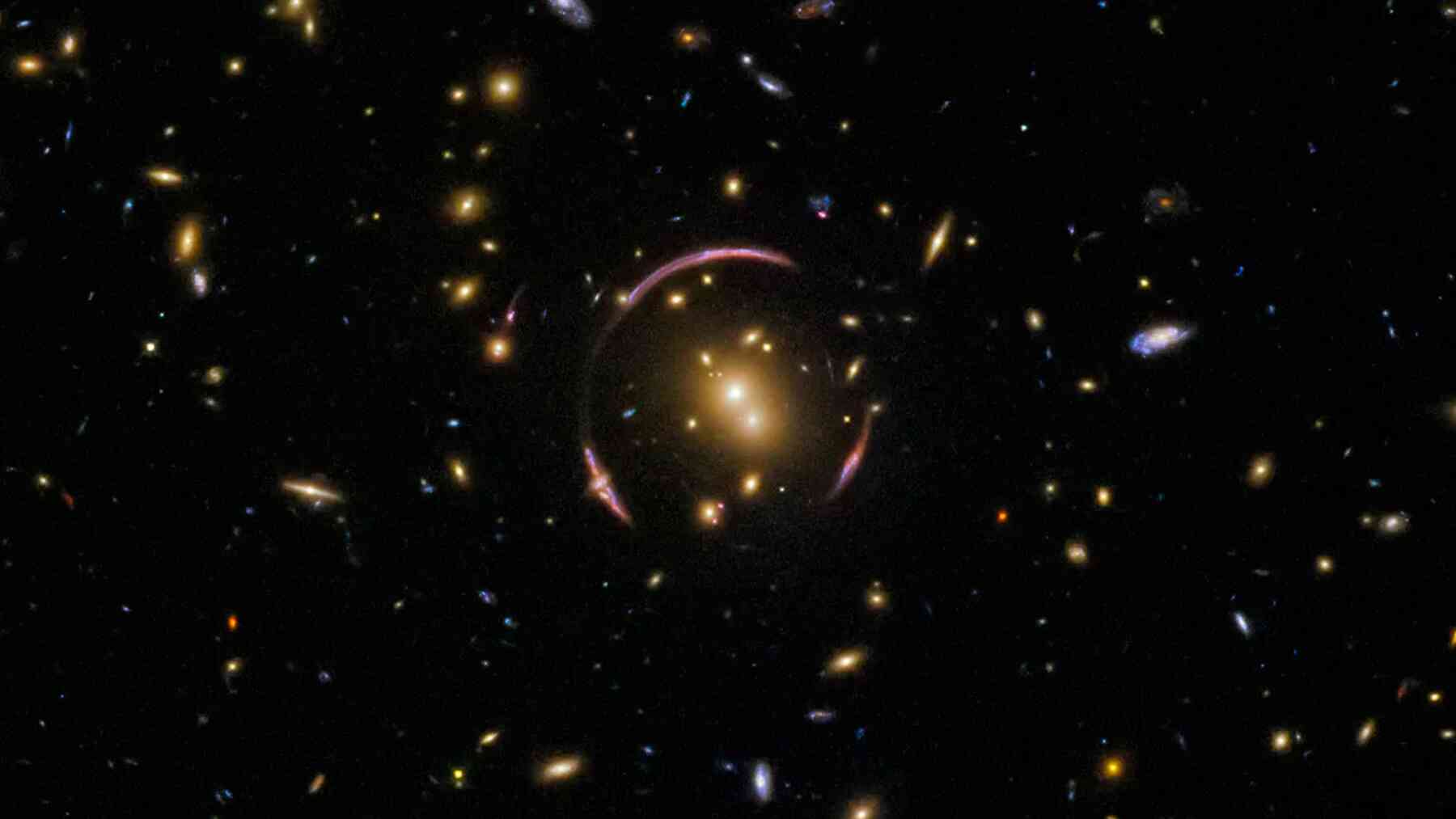
A new Hubble image of galaxy cluster MACS J1141.6-1905 looks almost impossibly crowded — dozens of galaxies in different shapes and sizes packed toward the center of the frame, interrupted here and there by the sharp, cross-shaped diffraction spikes of closer foreground stars. The cluster sits roughly four billion light-years away in the constellation Crater.
But astronomers were not simply admiring the view. Two separate observing programs pointed Hubble at this distant patch of sky for specific scientific reasons — reasons that go well beyond capturing a striking portrait of deep space.
A crowded corner of the universe
The Hubble image of MACS J1141.6-1905 rewards a slow, careful look. Galaxies crowd toward the center-left of the frame — some appear as tight ellipses, others stretch into elongated smears of light. The density alone signals that something massive is at work here.
Those bright cross-shaped spikes belong to foreground stars, not the cluster itself. Called diffraction spikes, they form when light from a point source bends around the supports holding Hubble’s secondary mirror in place — an artifact of the telescope’s design, not a flaw, and one of its most recognizable signatures.
The cluster sits roughly four billion light-years away, in the constellation Crater, named for an ancient cup. At that distance, the light now reaching Hubble’s detectors left this region of the universe long before complex life appeared on Earth.
Why Hubble looked here: X-rays and extreme brightness
Hubble did not arrive at this particular patch of sky by accident. The image combines data from two separate observing programs, both targeting massive galaxy clusters known for exceptional brightness in X-ray light.
X-ray brightness in a galaxy cluster is a meaningful signal. The hot gas filling the space between galaxies — intracluster gas — can reach temperatures of tens of millions of degrees, at which point it radiates in X-rays. Brighter X-ray emission means more gas present, and more gas means more mass. MACS J1141.6-1905 qualifies as an extreme example.
The two programs shared a dual scientific agenda: searching for distant background galaxies that the cluster’s gravity might be magnifying, and working to better understand the physical interactions occurring at the cluster’s core — a turbulent environment where galaxies, gas, and dark matter all converge.

Gravitational lensing: the cluster as a cosmic magnifying glass
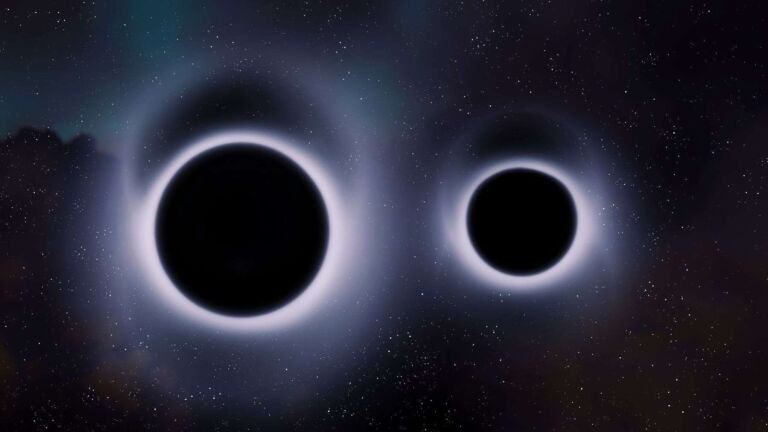
When light from a distant galaxy travels toward Earth, any massive object along the path can bend it. This effect — predicted by Einstein’s general theory of relativity and called gravitational lensing — allows a cluster as massive as MACS J1141.6-1905 to warp and amplify light from galaxies far beyond it.
The scientific value here is considerable. Many of the most distant galaxies in the universe are simply too faint for even Hubble to detect directly. A powerful foreground lens can magnify their light enough to make them visible and measurable, letting astronomers study structure, composition, and distance in ways that would otherwise be out of reach.
The greater the cluster’s mass, the stronger the lens. X-ray-bright clusters like MACS J1141.6-1905 are particularly attractive targets because their mass is not just large — it is well-documented, making them reliable, predictable tools for probing the far edges of the observable universe.
Hubble’s archive: 36 years of cosmic memory
The image of MACS J1141.6-1905 does not exist in isolation. It joins Hubble’s archive, which now holds 1.7 million observations accumulated across 36 years of continuous operation — a number that keeps growing.
Adding visible and infrared data from these X-ray-bright clusters was described as an “extra bonus” of the two observing programs, a deliberate enrichment of a resource astronomers treat as a long-term investment. Data collected today may answer questions that have not been asked yet.
That is the quiet power of the archive. Analytical tools evolve, algorithms improve, and questions that could not be posed in 2005 become answerable in 2025 using data that has been sitting in storage. Researchers routinely mine older observations and pull out discoveries that were invisible to the scientists who first collected the images.
MACS J1141.6-1905 is now part of that living record. Its light, captured in visible and infrared wavelengths, will remain available to future astronomers who may find in it something today’s researchers have not yet thought to look for. That possibility — that the most important use of a Hubble image may still lie ahead — is perhaps the most compelling argument for keeping the telescope pointed at the sky.
Read the whole thing?
Get the week's signal, not the noise
Our sharpest reporting on energy, climate and nature — free, once a week.