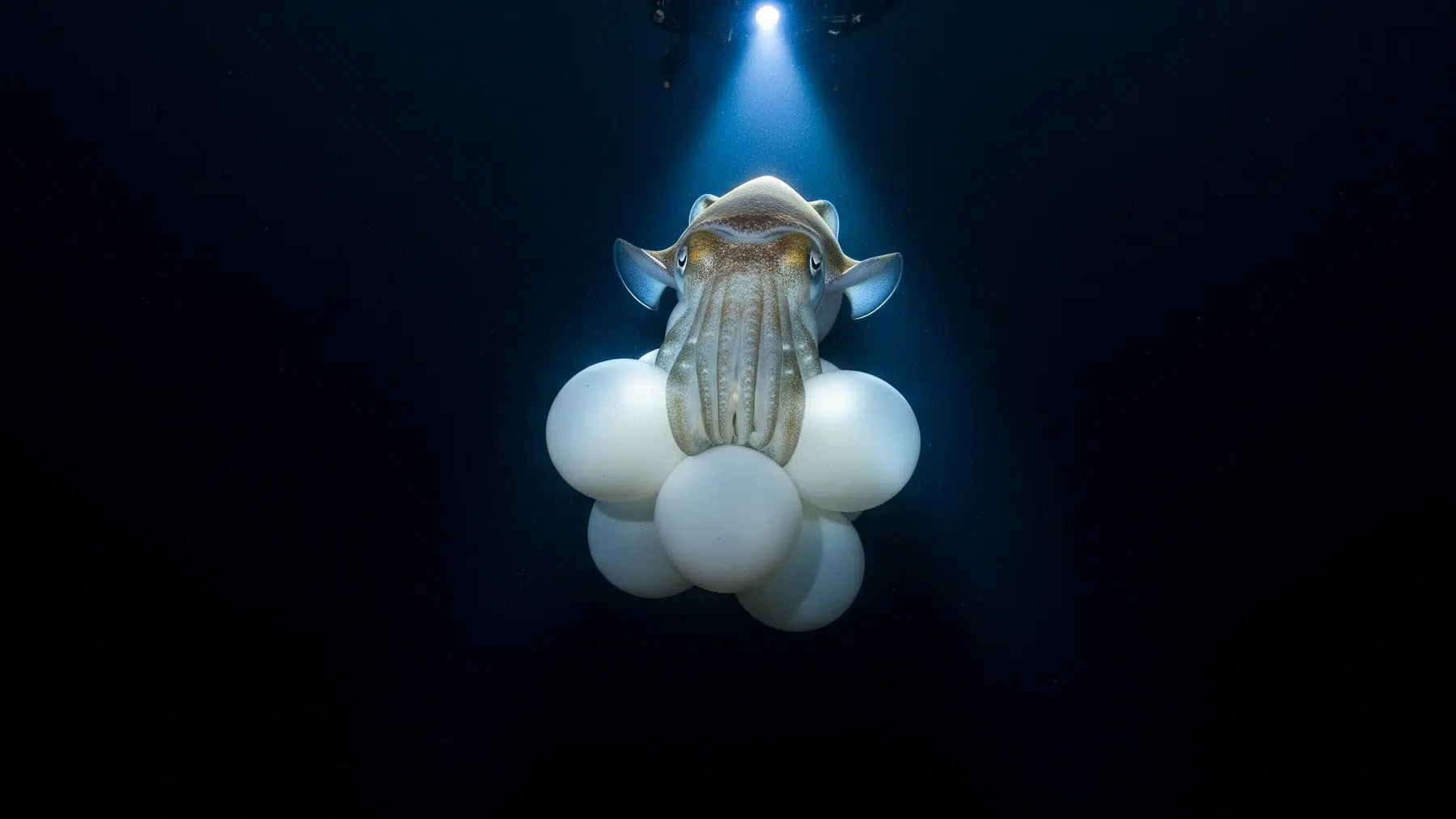
Somewhere in the dark water of the Gulf of California, nearly a mile and a half down, a mother was doing something that science had never recorded before.
She was not hunting.
She was not fleeing.
She was holding her eggs, each one twice the size of anything her species had ever been recorded carrying, and she had been doing it for a very long time.
What the robot found when it reached her would shift what researchers believed about how life survives in one of Earth’s most extreme places.
The ocean floor holds more life than most of us imagine
The deep sea covers more of our planet than every forest, desert and grassland combined.
Yet most of it has never been filmed, let alone studied.
Strange animals have evolved in complete darkness under crushing pressure, in near freezing water, with almost nothing to eat.
The creatures that survive there do not play by the same rules as the animals we know from tide pools and coral reefs.
They have had to find entirely different answers to the oldest problem in nature: how to keep your offspring alive long enough to carry on.
And one of those answers, it turns out, is staggering in simplicity.
Seventeen sightings across nearly four decades of searching
The Monterey Bay Aquarium Research Institute has been sending robots into the deep ocean for 37 years.
Over that entire span, their remotely operated vehicles recorded only 17 observations of brooding squids.
That number alone tells you how rarely anyone has witnessed what happens when a squid becomes a mother in the deep.
This kind of brooding, carrying eggs externally until they hatch, is known for only a handful of deep sea squid groups.
Each of those 17 moments represents a robot descending into pitch black water at exactly the right place and exactly the right time.
Then, in 2015, one of those robots found something no one was prepared for.
A robot 8,000 feet down, and a mother unlike any on record
The ROV Doc Ricketts was working an expedition through the Gulf of California when its camera found her.
The mother squid was cradling a cluster of eggs twice as large as those of any other brooding deep sea squid ever recorded.
The whole control room on the research ship stopped what it was doing.
The team reviewed every piece of footage they could find and examined museum specimens collected in the same waters over previous decades.
Then came the detail that made the discovery genuinely hard to believe.
Scientists estimate these eggs could take up to four years to hatch, a span that exceeds the entire lifetime of most shallow water squids.
A mother holding eggs for up to four full years, in freezing darkness, nearly a mile and a half underwater.
The giant eggs and the strategy hiding inside them
Here is what the deep sea squid was actually doing with those enormous eggs, and why it matters far beyond one remarkable sighting.
Size is not an accident in the deep ocean.
Juveniles from species that produce fewer but larger eggs show far higher survival rates than those hatching from small ones.
A giant egg is a packed survival kit: more yolk, more energy, a bigger and more developed hatchling ready to face an almost foodless world.
The find was published in the journal Ecology and is documented by MBARI, whose robots made the observation possible.
It is a reminder that the deep ocean is full of hidden strategies, shaped over millions of years, that we are only beginning to read.
The same ingenuity turns up elsewhere: engineers who studied how a gecko grips glass built a pad that held 250 pounds with no glue, and researchers tracking pigeon navigation for 60 years found the answer in immune cells of the liver.
What one mother in the dark teaches us about the whole ocean
The brooding squid of the Gulf of California is not a curiosity at the edge of science.
She is a window into how evolution solves impossible problems.
The deep sea has almost no food, almost no light, and almost no warmth.
A species that sends dozens of tiny fragile eggs drifting into that void is gambling heavily.
A species that holds a small clutch of giant eggs close, for years, is betting on quality over quantity.
Squids play a vital role in the ocean as fierce predators and a crucial food source, yet scientists still have enormous amounts to learn about deep sea species.
Every new ROV dive is another page of that story turning over.
The ocean keeps arriving in the same shape: far stranger, far more tender, and far more inventive than anything anyone assumed was down there in the dark.
Read the whole thing?
Get the week's signal, not the noise
Our sharpest reporting on energy, climate and nature — free, once a week.