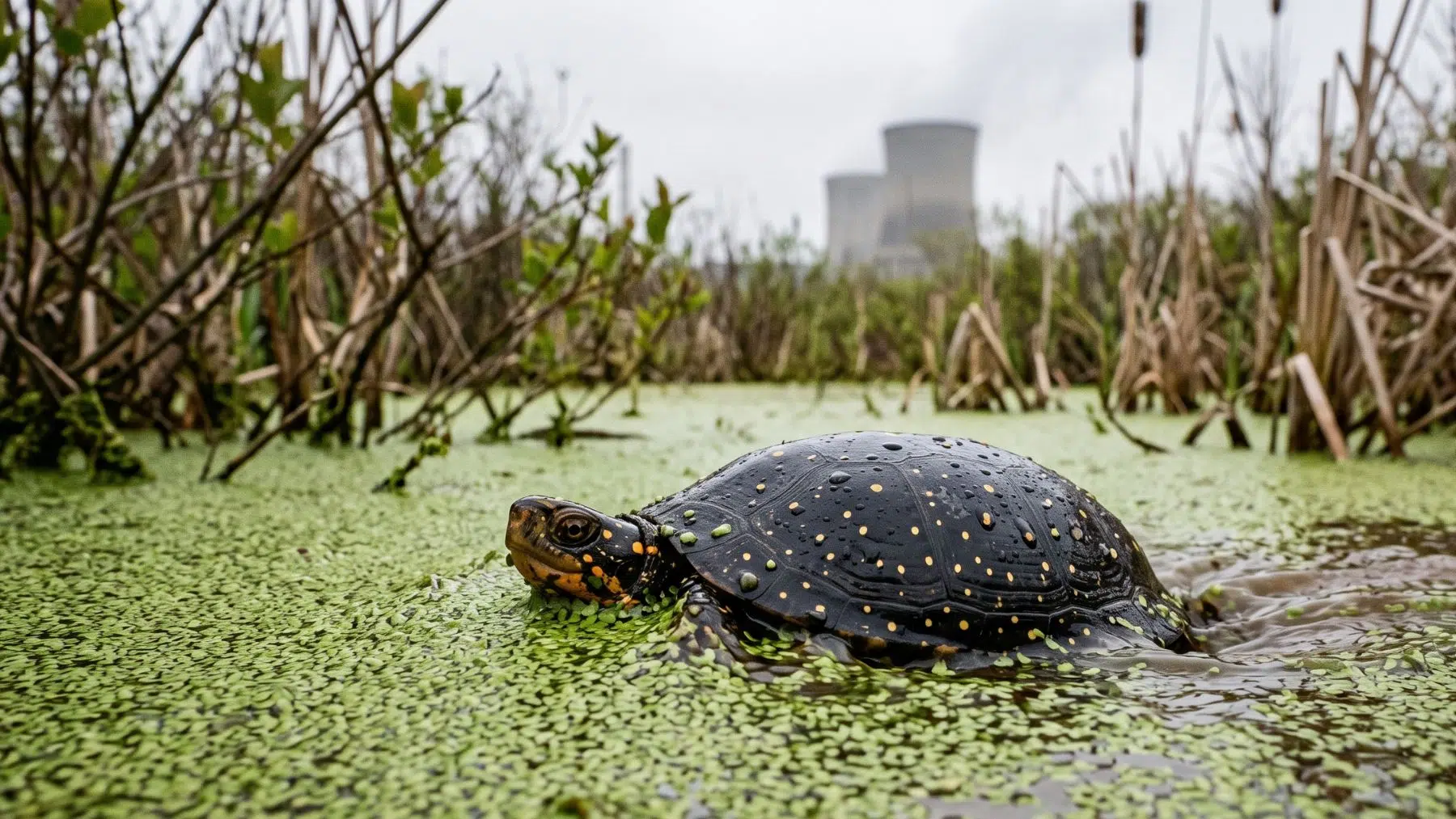
A shallow pool sits in a stand of buttonbush, a good distance back from the reactor building. The water is brown and still, the bottom is soft muck, and something about the size of a bar of soap noses up through the duckweed.
Its shell is nearly black, marked with a scatter of small yellow dots. Nothing here has been cleared or drained since the early 1980s, and that is not conservation policy, it is a side effect.
What Ohio did to the rest of its marshes
Start with what is no longer there. Ohio has drained roughly 90 percent of the wetlands it began with, and the Great Black Swamp that once covered the northwest corner of the state is cropland now, because tile drains, ditches and levees turned marsh into some of the most productive farmland in the country.
What survived is fragmented, and the fragments are mostly small and mostly cut off from one another, which matters because a turtle cannot cross four lanes of road to reach the next pool.
So the marshes that still hold water into midsummer have become strangely valuable, and a surprising number of them sit on ground somebody else owns.
A reactor that just bought itself another twenty years
The Perry Nuclear Power Plant stands on the Lake Erie shore in Lake County, Ohio, with Cleveland about 40 miles to the southwest. It is a single boiling water reactor that first fed the grid in 1986, running at roughly 1,240 megawatts, and Vistra owns and operates it.
Its original license was written to expire in March 2026, but in July 2025 the Nuclear Regulatory Commission approved a renewal that carries it through to November 2046.
The site around the reactor covers 1,100 acres, and only a fraction of that has anything to do with making electricity.
Why a power plant owns land it will never use
A nuclear station has to control ground it does not need, and the reasons are regulatory rather than industrial, because emergency planning, exclusion distance and the physical protection rules all demand a buffer around the reactor. The security perimeter itself, the fenced protected area, is small by comparison, and everything beyond it is simply land the company owns and nobody is going to develop.
At Perry that came to more than 850 acres of forest and marshland sitting between the plant and the public road, and in 1993 it was certified as an urban wildlife sanctuary by the National Institute for Urban Wildlife.
Three decades of nothing happening turned out to be a habitat program, and herons, belted kingfishers and a rare crane fly orchid all turned up in the surveys.
The turtle living in the buttonbush
Spotted turtles rarely pass five inches from one end of the shell to the other, and the yellow dots that give them the name fade as an animal ages, with no two carrying the same pattern. They want shallow marsh, wet meadow, fen, vernal pool or even a slow ditch, with a soft bottom and open sky above it.
Ohio lists the species as state threatened, and federally it is not listed at all, though it has sat under review since 2015 after a petition to the service.
Two pressures drive the decline, and only one of them has anything to do with habitat. A spotted turtle takes about a decade to reach breeding age and lays only a handful of eggs a year, so a population rebuilds very slowly, and the animals also sell well overseas, which makes illegal collection a serious threat on its own.
What the buffer proves and what it does not
Worth being blunt about what this is, because nobody set that ground aside for turtles. It stayed wet because a federal license required a buffer and a company had no reason to drain it, and the same accident produced the wildlife on artillery ranges, on bombing ranges and along the Korean demilitarized zone.
Exclusion is a blunt instrument, and it happens to work better than most things anyone designed on purpose. The plant is also not neutral toward the lake it sits beside, because its cooling system draws from Lake Erie and the effect on fish forms part of the environmental record the regulator reviewed.
Two things can be true at once, the way they are around a solar site or an offshore project. The license now runs to 2046, and the operator pointed to those same preserved acres when the renewal came through.
That means another twenty years of nobody walking through that marsh, and for an animal that needs ten years to breed, twenty is real. The fence was never built for them, and it is working anyway.
Read the whole thing?
Get the week's signal, not the noise
Our sharpest reporting on energy, climate and nature — free, once a week.