
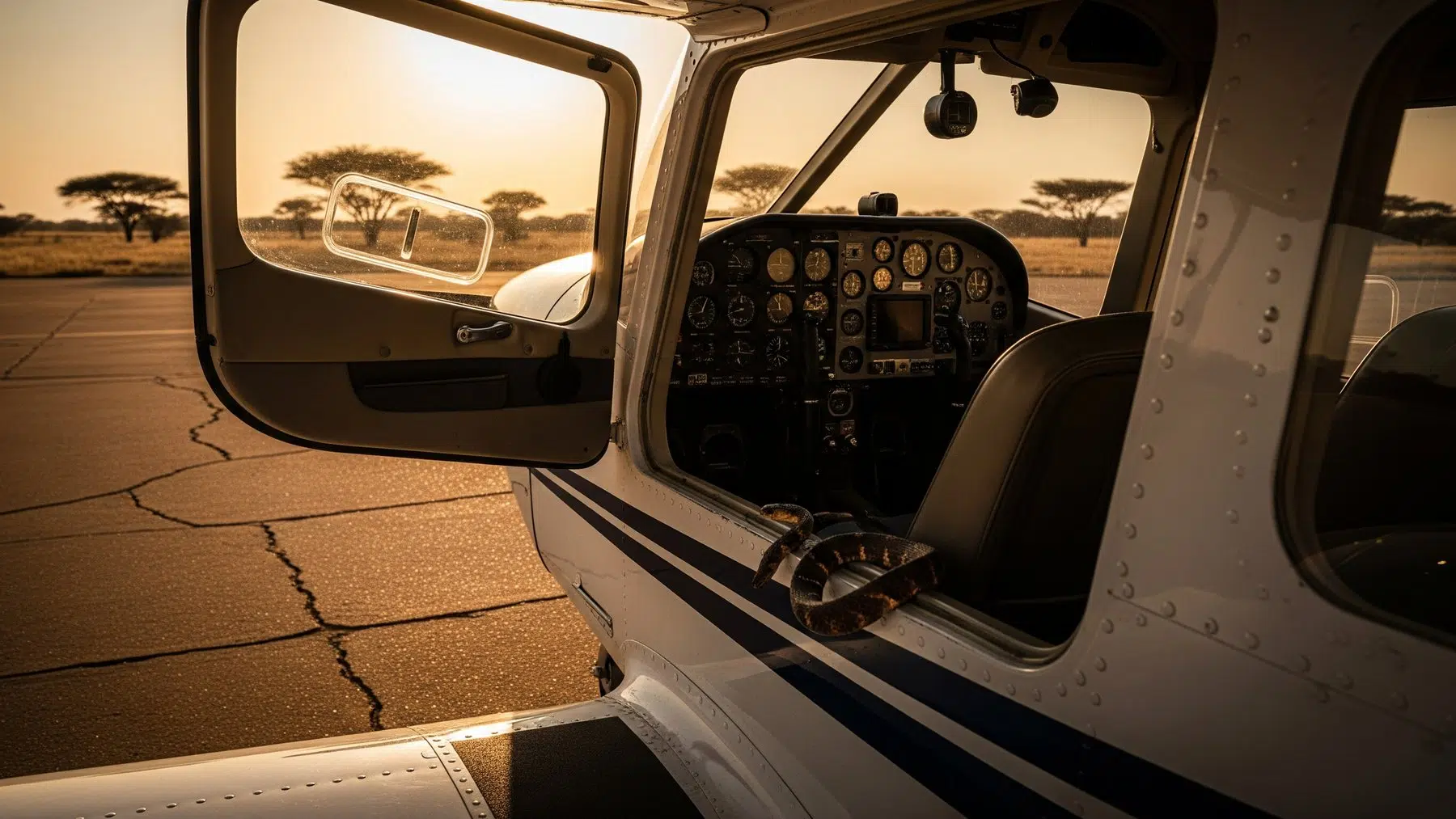
Something cold and unmistakably alive slid across the lower back of pilot Rudolf Erasmus at cruising altitude.
He glanced down and saw the head of a large Cape Cobra retreating under his seat.
He had four passengers behind him, a live venomous snake beneath him, and an aircraft to fly.
What happened next, and what the whole incident exposes about the gap between a pre-flight check and what is actually hiding inside a plane, is more unsettling than it first sounds.
The moment everything changed at 11,000 feet
Erasmus had four passengers on board his light aircraft when he felt “something cold” slide across his lower back.
He glanced down to see the head of a fairly large Cape Cobra receding under the seat.
His first instinct, he told CNN, was that “it was more as if my brain did not register what is going on.”
He took a breath and made a choice that would later draw praise from an entire country.
He kept composed for a minute or two because he did not want the passengers to panic, then informed them a snake was under his seat and that he needed to land as soon as possible.
Luckily, everyone remained calm.
Erasmus called air traffic control for permission to make an emergency landing in the town of Welkom in central South Africa, and still had to fly for another 10 to 15 minutes with the snake curled up by his feet.
What a Cape Cobra actually means for a small cockpit
This was not a harmless garden snake.
Cape cobras have a venomous bite, and adults can reach more than 5 feet long, according to the South African National Biodiversity Institute.
In a sealed cockpit the size of a large car, that changes everything.
A single bite during approach or landing would almost certainly be fatal, not from the venom alone but from what would follow: a pilot losing control of an aircraft carrying four people.
Erasmus kept his hands on the controls and his eyes on the runway, glancing down every few seconds to track where the snake had gone.
He later said he kept looking down throughout the approach, managing the plane and the animal at the same time.
After receiving permission, Erasmus landed at the airport in Welkom and all five people exited the aircraft unharmed.
The search that found nothing, and then the second flight
Local snake catchers were called to the plane after landing, but the snake had disappeared.
Erasmus and some engineers spent the next two days pulling the aircraft apart, removing seats, carpets and panels, stripping essentially everything they could reach from the frame.
Still nothing.
The engineering company Erasmus works for wanted its plane returned to the city of Mbombela in northern South Africa, so he had to fly it back, a 90-minute journey with the possibility that the cobra was still on board.
His passengers decided to find another way home.
This time Erasmus wore a thick winter jacket, wrapped a blanket around his seat, and kept a fire extinguisher, a can of insect repellent and a golf club within arm’s reach.
It is the kind of improvised armor that no flight manual has ever described, and it says everything about the situation he was walking back into.
How the cobra got there, and what aviation almost never checks
Before departure, Erasmus recalled hearing people at the airport say they had seen a Cape Cobra sheltering underneath the aircraft’s wing.
There was even talk the animal may have crawled into the Beechcraft Baron’s engine cowling.
The plane was searched and nothing was found, so everyone assumed the snake had returned to the wild.
It had not.
The cobra had moved deeper inside the airframe, into the hollow cavities that form the skeleton of any small aircraft, and simply waited through takeoff.
This is the real blind spot: pre-flight checks scan for mechanical faults, not for living things that slip inside between a check and a departure.
Snakes have been found on commercial jets before, including a United Airlines flight from Tampa to Newark and an AirAsia flight in Malaysia that diverted after a snake appeared in the overhead light compartment.
A reptile stowaway is not as rare as most passengers assume.
A pilot praised, a cobra still missing, and a question worth sitting with
The South African Civil Aviation Authority confirmed the snake was a large Cape Cobra and commended Erasmus for his composure in what became a viral incident around the world.
As for the cobra, its fate remains genuinely unknown.
The plane was completely stripped after the return flight, and there was still no sign of the animal.
Erasmus said simply: “I hope it finds somewhere to go. Just not my aircraft.”
Aviation safety is extremely good at engineering around mechanical failure and human error, but the natural world does not file a flight plan.
Every aircraft, from a light twin to a wide-body jet, is a metal shell parked in a living ecosystem, and as the aviation world keeps learning, ecosystems have a way of moving in uninvited.
No one was harmed, and Erasmus landed so smoothly that the real story is not the panic that almost happened, but the calm that did.
Read the whole thing?
Get the week's signal, not the noise
Our sharpest reporting on energy, climate and nature — free, once a week.


