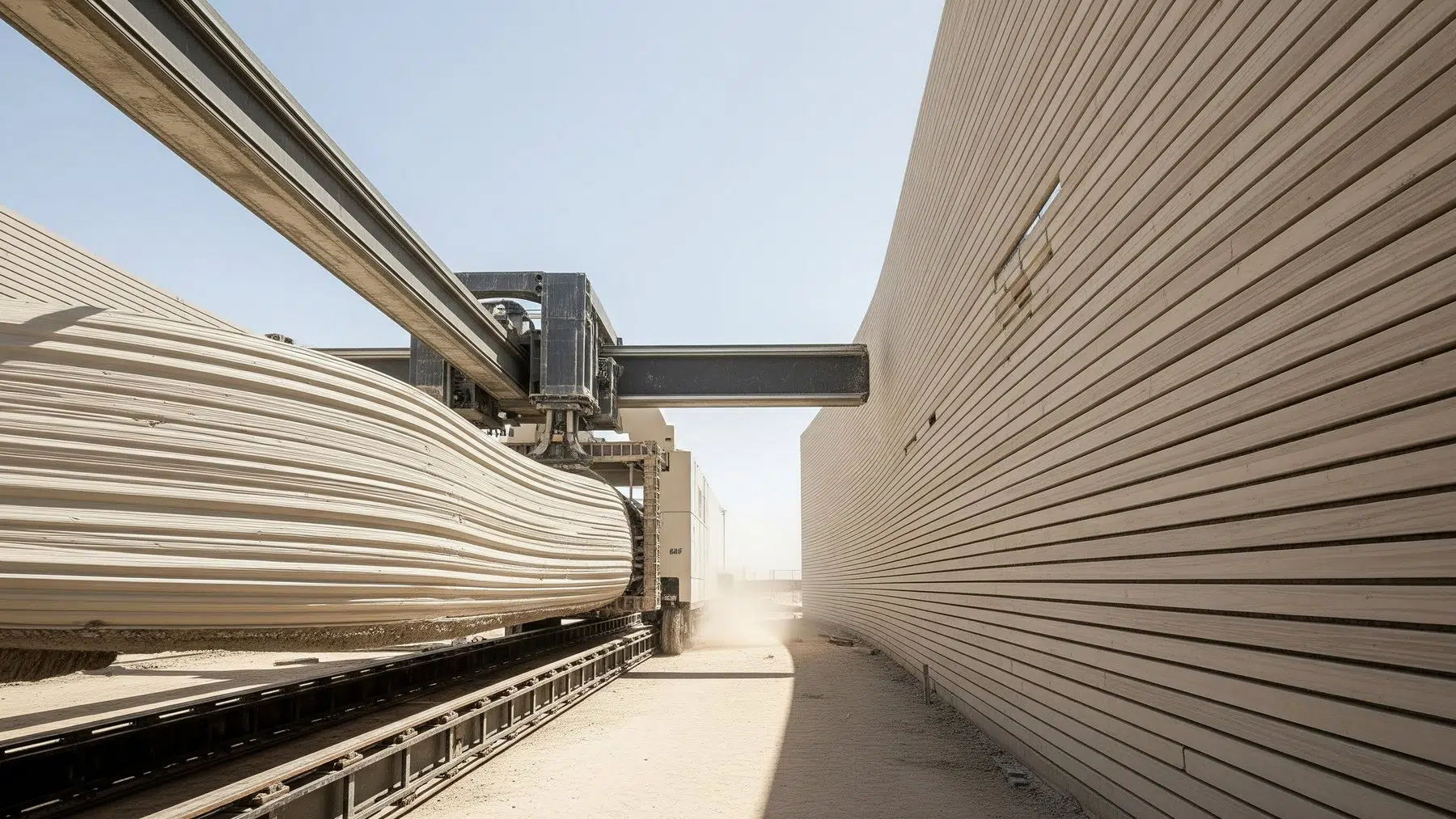
The machine standing in the Qatari desert does not look like a printer. It looks like a bridge somebody parked over a building site, a steel frame running 164 feet end to end and standing about five stories tall.
A nozzle travels along it, laying wet concrete in a bead roughly the thickness of a garden hose, and layer goes onto layer until a wall rises out of nothing. That machine has been taken apart and put back together fifteen times.
Two buildings, and neither one is a demonstration
Most printed buildings are proofs of concept, a small house or a bus shelter or a pavilion at an expo, something a visitor can walk around in ten minutes. These are not that, and the difference is not a matter of degree.
UCC Holding is building two schools for Ashghal, the Qatari public works authority, each carrying 215,000 square feet of floor area on plots measuring 328 feet a side. Both are two stories, with walls that curve in long lines meant to echo the dunes around them.
They belong to a wider program of 14 new public schools, of which only these two are printed, because the other twelve are going up the ordinary way.
A printer longer than an airliner
The machines are COBOD BODXL units, built in Denmark, and there are two of them on the site, each frame measuring 164 feet long, 98 feet wide and 49 feet high. That length beats every Boeing 737 ever flown, including the stretched MAX 10 at 144 feet.
Nothing about the operation resembles the printer on an office desk. The gantry rides on rails and the print head crosses the site on three axes under continuous control, while concrete arrives by pump and leaves the nozzle as an unbroken bead that has to stiffen fast enough to carry the next course.
Desert heat helps with that and punishes any pause in the flow. Nobody lays a block and nobody sets a form, which is where the labor savings live, though everything else on the site still looks like an ordinary jobsite.
What the record actually replaces
The world record before Qatar was not in Europe or the Gulf. It was a horse barn in Wellington, Florida, on a private equestrian property, finished by Printed Farms in 2023 at about 10,000 square feet using a COBOD machine of the previous generation.
Germany holds a separate title with the Wave House in Heidelberg, a data center of roughly 6,500 square feet inaugurated in February 2024. Set the 3D printed schools against either one and the jump speaks for itself.
The figure the builder and the printer manufacturer both use is forty times larger than anything printed before, but measured against the Florida barn the multiple comes out closer to twenty, so treat the forty as their number. Even at twenty, nothing else is in the same class.
The reason it came apart fifteen times
Here is the detail that says the most about where this technology actually sits, and it is not a flattering one. The largest construction printer in the world cannot span the building it is printing.
So the crews print one section, dismantle the entire gantry, shift it, and assemble it again over the next footprint, and they have run that cycle fifteen times, machine and supporting rig together, on a project the contractor announced as a world first. By July 2026 the site carried roughly 210,000 square feet of printed structure and about 301,000 square feet of extruded wall, and each teardown and rebuild had cost days that a conventional crew would have spent laying block.
One more thing gets lost in almost every story written about printed buildings, which is that the printer makes walls only. Foundations, floors, roof, glazing, wiring and every other trade arrive the conventional way.
The same idea, aimed at ground with no concrete on it
A separate company is pointing the technique at the Moon. ICON, a privately held firm in Austin, Texas, holds a NASA award worth 57.2 million dollars, announced in November 2022 through the agency’s small business program.
The work is called Project Olympus, and the targets are landing pads, blast shields, roads and eventually habitats built from lunar material instead of cargo, which is how the company lays it out. Hauling concrete 239,000 miles was never going to work, so the feedstock has to be the ground itself.
The scale deserves honesty back on Earth as well, because forecasts put the global market for construction printing near 4.2 billion dollars by 2030, a rounding error beside an industry measured in trillions. Public argument follows anyway, the way it trails a solar site or an offshore project long after the engineering is settled.
What Qatar has proved is narrow and still worth something. A printed building can now be school sized, and getting there took fifteen teardowns of the machine that made it possible.
Read the whole thing?
Get the week's signal, not the noise
Our sharpest reporting on energy, climate and nature — free, once a week.