
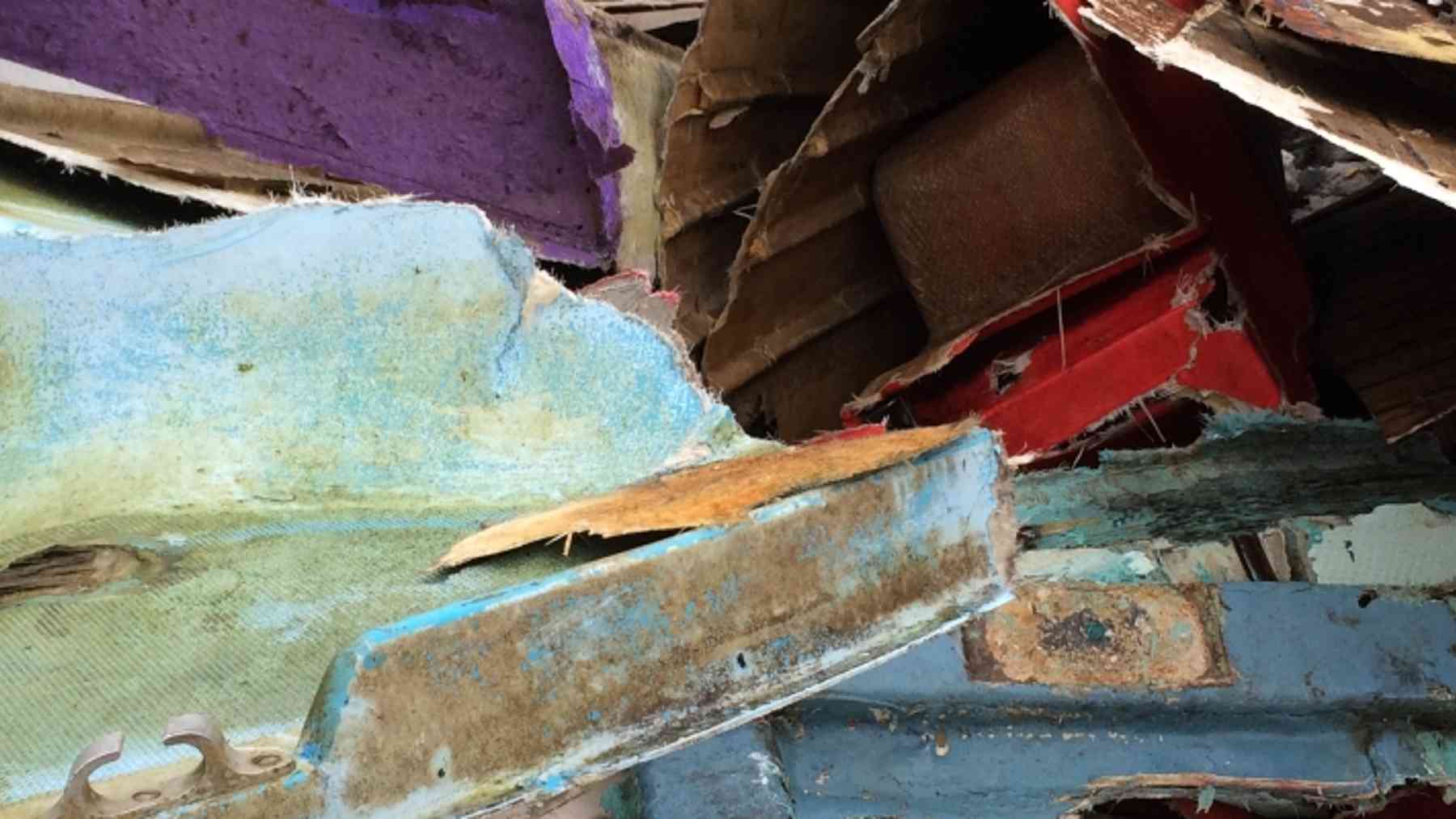
A cluster of derelict boats sat at Rhode Island marinas, hulls intact, going nowhere.
Nobody wanted them. No ordinary recycler could melt them down or pull them apart into anything worth selling.
So they were shredded.
The shredded fiberglass traveled south to a cement plant in Holly Hill, South Carolina, where it burned as fuel and its minerals stood in for raw materials the plant would otherwise have bought.
Why does a boat hull make sense inside a kiln when it makes sense almost nowhere else?
Why a fiberglass hull defeats almost every recycler
The quality that makes fiberglass a good boat material makes it a recycler’s nightmare. Glass fibers are locked inside a cured thermoset resin that cannot be softened and remelted the way a plastic bottle can, so pulling fiber and resin apart costs more than the recovered material is worth. Recycling streams built around metal, glass or wood have nowhere to put it.
That durability follows the hull into the ground. Unlike steel, which melts cleanly, or wood, which rots, fiberglass simply sits. Some state agencies still advise owners to strip a hull and then crush and bury it, because the material has so little recycling value on its own.
So an owner facing disposal confronts an unappealing math: tipping fees vary widely, but recycling still costs more than burying. That gap is exactly why hulls end up in landfills, in backyards, at marinas, and eventually in the water after a storm pushes them loose.
What the Rhode Island pilot actually did
The Rhode Island Marine Trades Association Foundation built its answer out of an unglamorous supply chain. Marinas and boat owners around the state handed over derelict and abandoned boats, crews stripped them of fuel, batteries and metal, and the hulls were cut apart and processed at a facility in Johnston before the shredded material was hauled south to Holly Hill.
Inside the kiln, the material did two jobs at once. It released thermal energy that displaced fossil fuel, and its mineral content supplied silica and alumina that substitute for raw resources otherwise mined for cement production. Both contributions matter to whether a cement plant will accept the load.
The pilot moved 60 tons of fiberglass, modest measured against the national scale. But volume was never the point. It was to prove the route worked end to end and to price out every link in the chain.
And it did work. The processed material was accepted by a commercial cement plant as both fuel and feedstock, which is the hurdle that stops most composite waste from reaching heavy industry.
The scale of what is waiting
Industry estimates suggest that 2 to 3 percent of all recreational boats in the United States reach the end of their usable life each year, roughly 200,000 boats annually. Most of that fleet was mass produced from the sixties onward, when fiberglass replaced wood as the hull material of choice, and almost none of it was designed with disposal in mind.
Because there is no national collection system, the boats scatter. Some become marine debris after hurricanes, fouling marshes and shorelines. Some are abandoned at marinas, where the operator eventually pays to haul them away. A Houston boat salvager who could not find anyone willing to take fiberglass sent more than 1,100 tons of hull material to a landfill instead, at a reported cost of about $40,000.
That is the shape of the problem everywhere. With fiberglass recycling priced above landfill disposal, the financial case for the better option has simply not existed for most owners.
What the WAVES Initiative is trying to build next
The foundation is now running the Waste Alternatives for Value and Environmental Sustainability of Fiberglass Disposal Initiative, which builds directly on the pilot. The stated goal, documented on the federal debris site, is to bring the cost of fiberglass recycling down far enough that landfill alternatives become genuinely accessible to an ordinary boat owner.
The crux is economies of scale. The shredding works and the kiln works. What does not yet work is gathering, dismantling and moving enough material, reliably enough, to bring the cost per ton within reach. The initiative is therefore widening the stream to include other composite waste, including manufacturing scrap and end of life wind turbine blades.
The same pressure is reshaping other stubborn waste streams, including the millions of tons of textiles Americans discard each year, and efforts to feed unconventional materials into cement making point in the same direction.
What the catch still is, and why the answer keeps getting closer
The honest accounting from the Rhode Island program is that shredded fiberglass has little to no market value by itself. The program had to pay for dismantling, shredding, transport and kiln acceptance. That financial gap is real and has not closed.
But the gap narrows for a structural reason. Co processed in a cement kiln, fiberglass supplies both thermal energy and raw material replacement, reducing the environmental cost of making new cement. As avoided fuel and avoided mining are valued more highly, the recycling case strengthens without any change in the technology.
A study completed under federal marine debris law, using the Rhode Island pilot as its model, concluded that a centralized, nationwide fiberglass vessel recycling program would present a viable solution. The pieces already exist: willing marinas, working shredders, kilns that have taken the material. What is missing is a collection network big enough to keep those kilns fed.
Read the whole thing?
Get the week's signal, not the noise
Our sharpest reporting on energy, climate and nature — free, once a week.


