
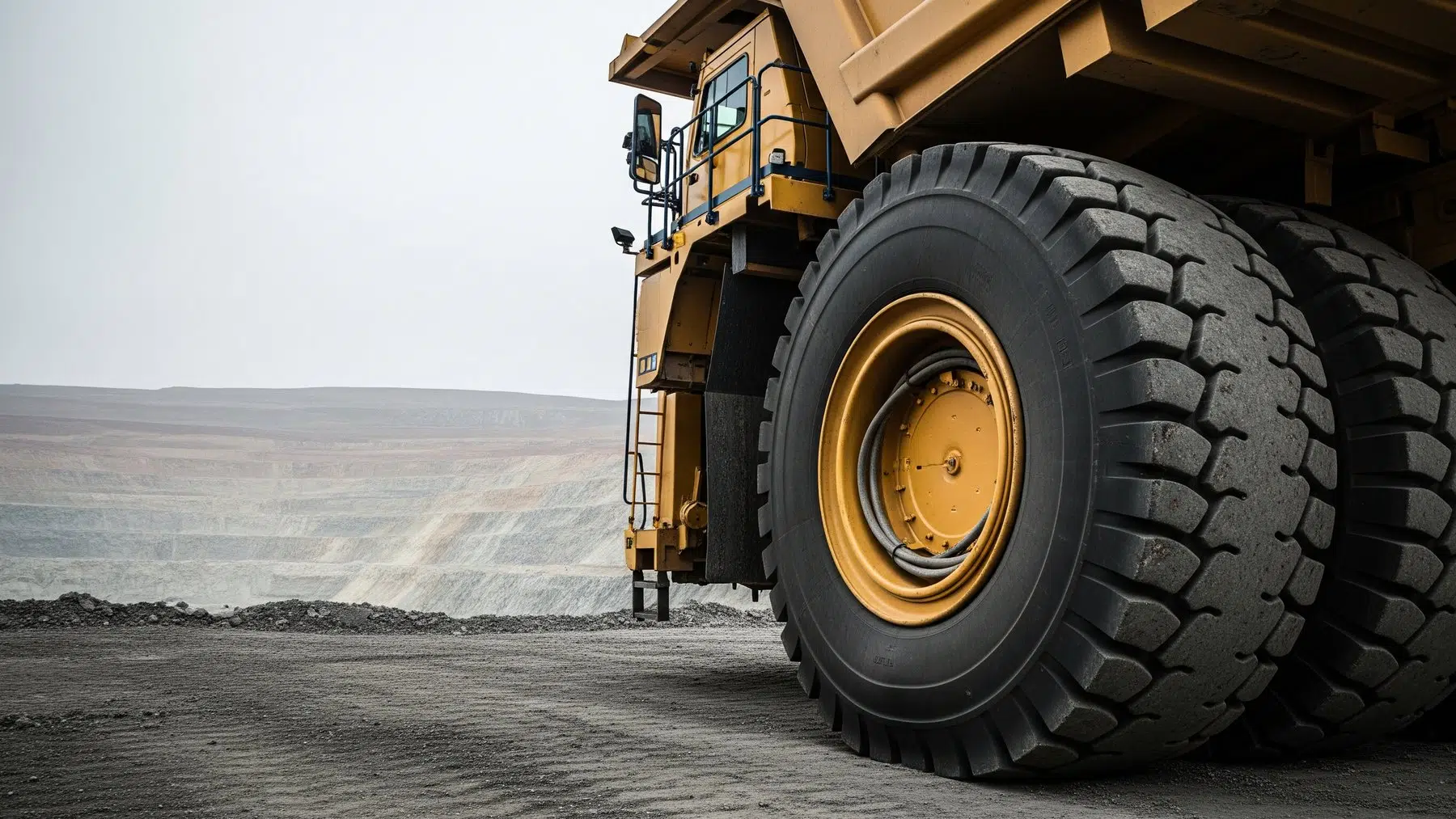
Picture a vehicle taller than a house rolling up a dirt ramp carved into the earth, fully loaded with enough copper ore to fill an Olympic swimming pool.
It weighs more than a million pounds at full load.
It climbs that ramp without drama, without shuddering, and without once changing gear.
For most drivers who have ever wrestled a truck up a steep hill, that last part makes no sense at all.
And the reason it can do it has nothing to do with the enormous diesel engine sitting under the hood.
The biggest trucks most Americans never see
There are roughly 1,800 of these machines working in mines across the world right now, and the most widely deployed model is built in Peoria, Illinois.
The Komatsu 930E is an ultra class haul truck, a category most people have never heard of and almost nobody outside the mining industry ever gets close to.
At full gross weight, it tips the scales at around 1.15 million pounds.
Its load bed can carry 320 short tons of ore in a single trip, enough raw rock to fill roughly 16 full size dump trucks you would see on a city road.
The tires alone stand over 10 feet tall, and a single replacement tire costs more than most American family cars.
These trucks run around the clock in copper pits in Arizona, gold mines in Nevada, and iron ore fields across the American West, yet most people have never once thought about how they actually move.
A ramp that would stop anything normal
The haul road inside an open pit mine is nothing like a highway.
It spirals down from the surface to the ore face far below, often stretching a mile or more in length, cut at steep grades that would make a fully loaded semi truck overheat and stall.
When a standard truck climbs a grade, the driver drops through the gears one by one, fighting to keep momentum.
Lose enough speed and the engine bogs down, the truck stops, and on a narrow mine ramp, stopping is not an option.
Now add 320 tons of ore to the bed.
The forces involved are so far beyond anything a conventional mechanical drivetrain can manage that the engineers who designed these trucks abandoned gears almost entirely.
What they put in their place is the real story.
The engine that almost nobody suspects
Open the hood of one of these giants and you will find an enormous diesel engine, rated at around 2,700 horsepower in the 930E.
Most people assume that engine is connected to the wheels through a transmission, the same basic idea as any pickup truck, just scaled up enormously.
It is not.
The diesel engine in an ultra class haul truck is not connected to the wheels the way most people picture.
Instead, it runs a massive onboard generator.
That generator produces electricity, and that electricity flows through thick cables to motors inside the wheels themselves.
The whole arrangement means the truck has no conventional transmission to shift, no clutch to slip, and no gear ratio to get wrong on a steep grade.
The wonder hiding inside every wheel
This diesel electric system is the genuine marvel at the heart of every ultra class haul truck, and it works on a principle most people associate with something far smaller: a locomotive, not a dump truck.
An electric motor produces its maximum turning force the instant it starts spinning, with no warm up, no gear hunting, no delay.
That means a fully loaded 930E, carrying 320 tons up a 10 percent grade, can pull away from a standstill with the same authority it has at speed.
There is a second wonder when the truck heads back down empty.
On the descent, those same wheel motors flip into reverse mode and act as generators, turning the truck’s rolling momentum back into electricity.
That electricity feeds into braking resistors or back to the grid on newer trolley assisted systems.
The truck is, in a very real sense, hauling its load on a wave of electrons rather than raw mechanical force.
Why this hidden system changes the way you see big machines
The diesel electric principle did not start with mining trucks.
Early diesel locomotives used it through much of the twentieth century, and it has been doing heavy work in the most demanding environments on Earth ever since.
Because the wheels are already driven by electric motors, swapping the diesel generator for a battery pack or a hydrogen fuel cell is an engineering step, not a revolution.
Several mines are already testing fully battery electric ultra class trucks.
The largest deployment so far put 100 autonomous battery electric haul trucks to work at the Yimin open pit coal mine in Inner Mongolia, with battery swapping technology keeping the fleet in near continuous operation.
The pit that most Americans drive past without a second glance is, wheel by wheel, becoming one of the most forward looking test beds for electric transport on the planet.
The diesel engine may sit at the center of these machines today, but the electric motor at each wheel was always the real heart of the story.
Read the whole thing?
Get the week's signal, not the noise
Our sharpest reporting on energy, climate and nature — free, once a week.


