The call came in around four in the morning on a farm road outside Lynden, Washington.
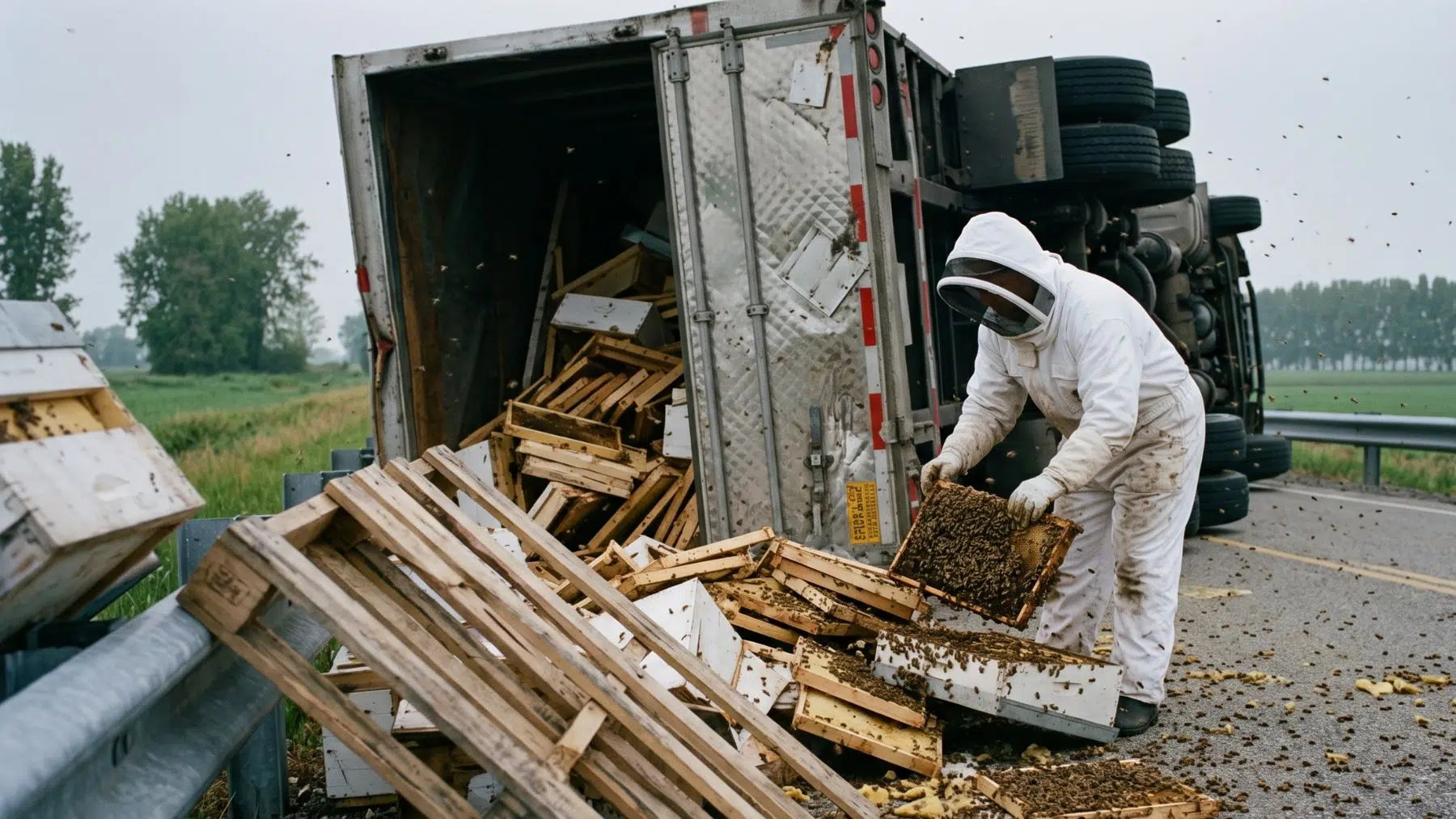
A commercial trailer had gone over on its side, carrying roughly 70,000 pounds of live honey bee hives.
Deputies arrived to find pallets slumped across the asphalt and the load still mostly holding together.
Shortly after nine, the hives came off the truck, and everything inside them came out at once.
What the county did over the next two days has since been written down as state procedure.
Two days on Weidkamp Road
The crash happened on the 8700 block of Weidkamp Road, a straight rural stretch between farm fields.
The driver was not hurt, which was the first piece of luck, and the second was the location.
A busy interstate would have forced a fast and brutal cleanup, but this road carries almost nobody, so the county could simply close it and wait.
Sheriff’s deputies, county public works and the emergency management division set up the scene together.
Master beekeepers drove in from around the region to help, some of them from an hour and a half to the south.
The deputy director of the county emergency management division ran the response on the ground and was stung repeatedly doing it.
The road reopened the following afternoon, roughly a day and a half after the trailer went over.
The number that traveled faster than the bees
Meanwhile the story had gone around the world, and it went with a figure that was wrong.
The first press release put the load at 250 million bees, and that number ran in outlets on several continents within hours.
Then people started doing arithmetic in public, because a healthy colony holds something like 20,000 to 60,000 bees in early summer.
A day later the sheriff’s office issued a correction that is worth reading twice.
A more accurate total was closer to 14 million, it said, according to one of the beekeepers doing recovery work at the scene.
Then it added a line most agencies would not have written. Thank you to those who challenged the math and helped get closer to the true number.
Why the plan was to wait
Which brings up the part that sounds strange until you understand bee behavior.
The instinct with an insect emergency is to spray it, and that instinct would have destroyed most of the load on the road.
A honey bee colony is organized around a single queen, so bees knocked loose from a hive will find her again and rebuild the cluster if left alone.
The county gave them 24 to 48 hours to do exactly that, and the beekeepers spent it restacking boxes and coaxing clusters back into them.
There is an economic argument underneath the biological one, since a full semi load of hives is worth roughly 250,000 dollars.
Destroy that and somebody’s pollination contracts for the rest of the season go straight down with it.
The document that did not exist
So the county had improvised something that worked, and the obvious question was why nobody had written it down.
The state agriculture department, the county emergency management division and the state beekeepers association spent the following months fixing that.
What came out is a ten page response plan covering how to handle exactly this, published by the department.
It sets safety protocols for first responders arriving at a scene they cannot walk up to in the normal way.
It tells recovery crews how to move damaged equipment without wrecking the colonies still living inside it.
And it draws a hard line on killing the bees, permitting it only when the risk to public safety and health is both immediate and high, as local reporting set out.
It also names who pays for the cleanup, which is the least romantic and most necessary page in it.
Why the bees are on the highway at all
Because none of this makes sense until you know that American pollination runs on trucking.
Hives get loaded at night while the foragers are home, driven hundreds of miles, and set down beside an orchard that needs them for two or three weeks.
Roughly 127,000 hives moved across Washington in the year of the crash, most of them chasing blueberries, apples and cherries.
The infrastructure carrying that traffic was never designed with it in mind, in the same way that a road verge or a bridge deck ends up doing ecological work nobody planned.
Wisconsin has since built a bee spill procedure of its own, so the idea is spreading between states.
One trailer went over on an empty farm road, and the result is a written rule about what a first responder does when the cargo is alive.
Read the whole thing?
Get the week's signal, not the noise
Our sharpest reporting on energy, climate and nature — free, once a week.