
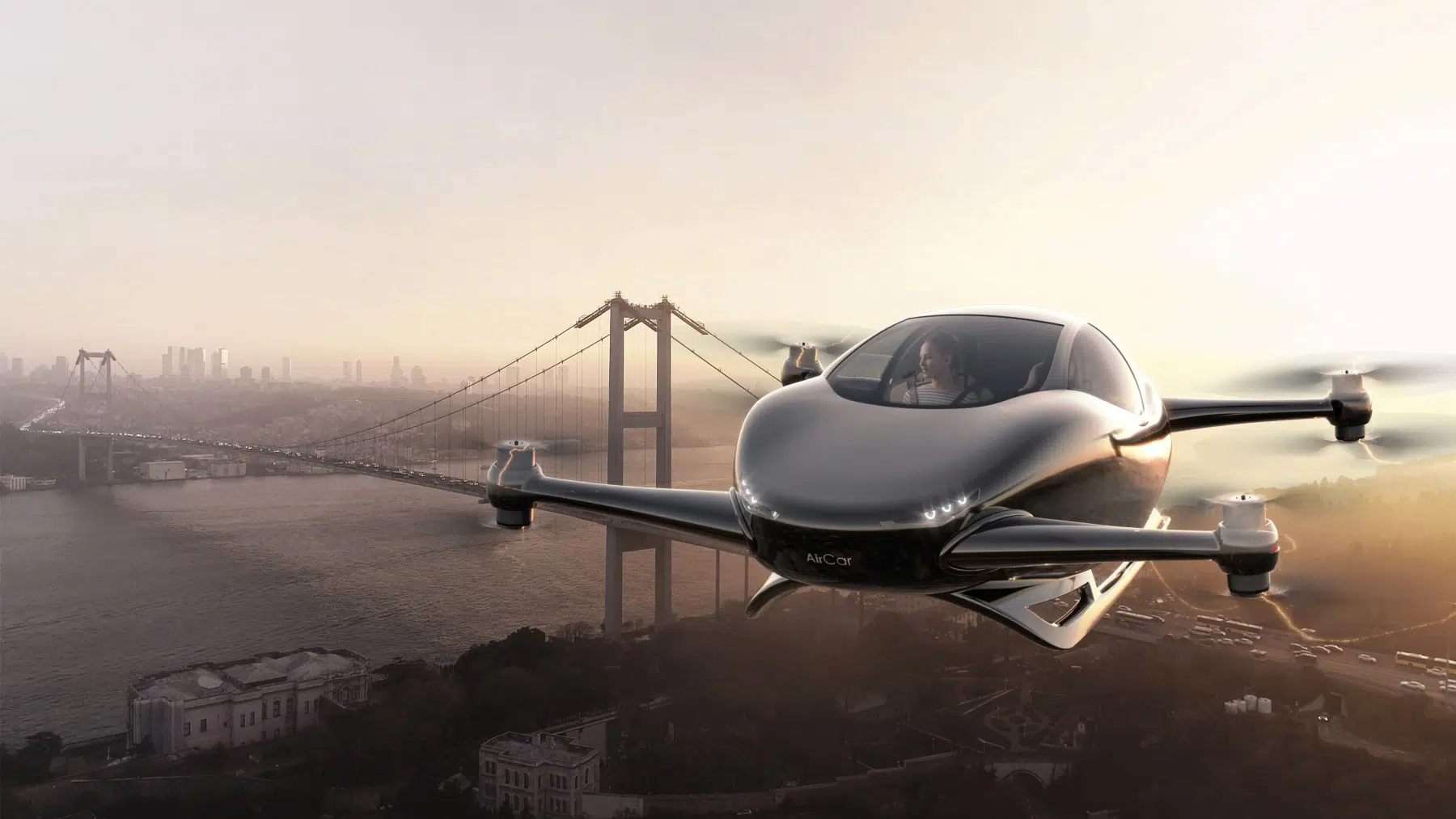
Science fiction has long tantalized generations with the notion of a machine that could soar, an alluring blend of freedom, convenience, and futuristic flair. Despite decades of prototypes and bold promises, most attempts at merging asphalt with airspace have ended on the drawing board or in limited-scale demonstrations. Machines were often hindered by slow-paced development, safety issues, and a high price that kept them well beyond the reach of all but the wealthiest experimenters. Not anymore.
Air mobility industry continues to evolve
The broader push toward personal air mobility has not stalled. Better materials, smarter controls, and streamlined certification processes are turning assumptions upside down, raising hopes that airborne machines might finally take flight, not just in fantasy, but in everyday life.
This surge in promise is now focused on a sleek dual-mode contender born in Slovakia. After logging more than 500 takeoffs and landings, the latest production prototype is ready for prime-time. And it’s not just a rigid sculpture – it transforms from car to plane in about 80 seconds, a process that no production roadable aircraft has achieved before.
New AirCar by Klein Vision
After more than three decades of development, Klein Vision’s flying car — officially known as the AirCar — is finally gearing up for takeoff. The Slovakian company says its next-generation prototype is expected to fly this September, and if all goes according to plan, it could earn its certification by the end of the month. That would clear the runway for customer deliveries to begin in early 2026. An amphibious version might also be in the works.
At the 2025 Living Legends of Aviation Gala in Los Angeles, Klein Vision revealed renderings of its 5th-generation AirCar. This new model builds on revelations from over 500 test flights with the current 4th-gen prototype – a sleek, two-seat roadable aircraft that looks more like a sports car with wings than anything out of a sci-fi film.
Company co-founder Anton Zajac, in an interview for New Atlas, explained that the production model will feature a lighter and stronger monocoque frame instead of the previous welded tube construction. This structural upgrade is not just cosmetic – it significantly boosts performance. According to Zajac, the machine is expected to cruise in the air at around 155 mph (135 knots), while on the road, it behaves like a true sports car capable of hitting 124 mph (200 km/h).
The machine can be used in different areas
Legally, the AirCar fits into existing frameworks. If you have a driver’s license, you can use it on the road. If you have a private pilot’s license, there is no additional training required to fly it. That was part of the point, Zajac explained – they wanted a dual-mode vehicle that was not a compromise. On land, it should feel like a high-performance car. In the air, it should handle like a conventional aircraft. Nothing new to learn. No weird transition modes. Just drive, unfold the wings, and go.
Type of fuel and market price
Fuel-wise, the AirCar uses standard high-octane gasoline and carries about 160 liters (35.2 gallons) across three tanks. This translates to a flight range of roughly 620 miles (1,000 km), and a driving range of about 497 miles (800 km). It’s designed to be filled up at a regular gas station and parked in a normal garage.
Altitude-wise, the machine is limited to 10,000 feet by default, mainly because it doesn’t carry oxygen tanks – though Zajac noted that with a small upgrade, it could reach up to 18,000 feet. The price will be in the range of $800,000 to $1.2 million, depending on engine type and cabin features. Co-founder Zajac said the sales could start as early as Q1 2026.
Read the whole thing?
Get the week's signal, not the noise
Our sharpest reporting on energy, climate and nature — free, once a week.


