Every time you turn on a gas burner or flip a heating switch on a cold morning, there is a chance the fuel behind it made an extraordinary journey. It started as a gas buried deep underground, then engineers performed a remarkable trick on it, and a chain of hidden consequences began that reaches all the way down to the ocean floor.
The everyday fuel hiding an extreme secret
Natural gas is so familiar it barely registers as a wonder. It heats roughly half of all US homes, fires power plants, and feeds industrial furnaces across the country.
But gas has a problem: it is enormous in volume. A gas molecule is mostly empty space, so trying to ship a useful quantity across an ocean by tanker would be like trying to carry air in a net.
The solution the energy industry landed on is one of the most extreme temperature tricks in everyday industrial life. Engineers found a way to squeeze that invisible, unruly gas into something you could theoretically pour into a cup.
Almost nobody who pays a gas bill knows it is happening.
When a gas becomes something else entirely
Engineers discovered that if you chill natural gas cold enough, it surrenders and collapses into a liquid. The temperature required is around minus 260 degrees Fahrenheit, colder than any place on Earth’s surface has ever recorded outdoors.
At that point something almost magical occurs. The volume shrinks to about one six-hundredth of what it was inside a pipeline.
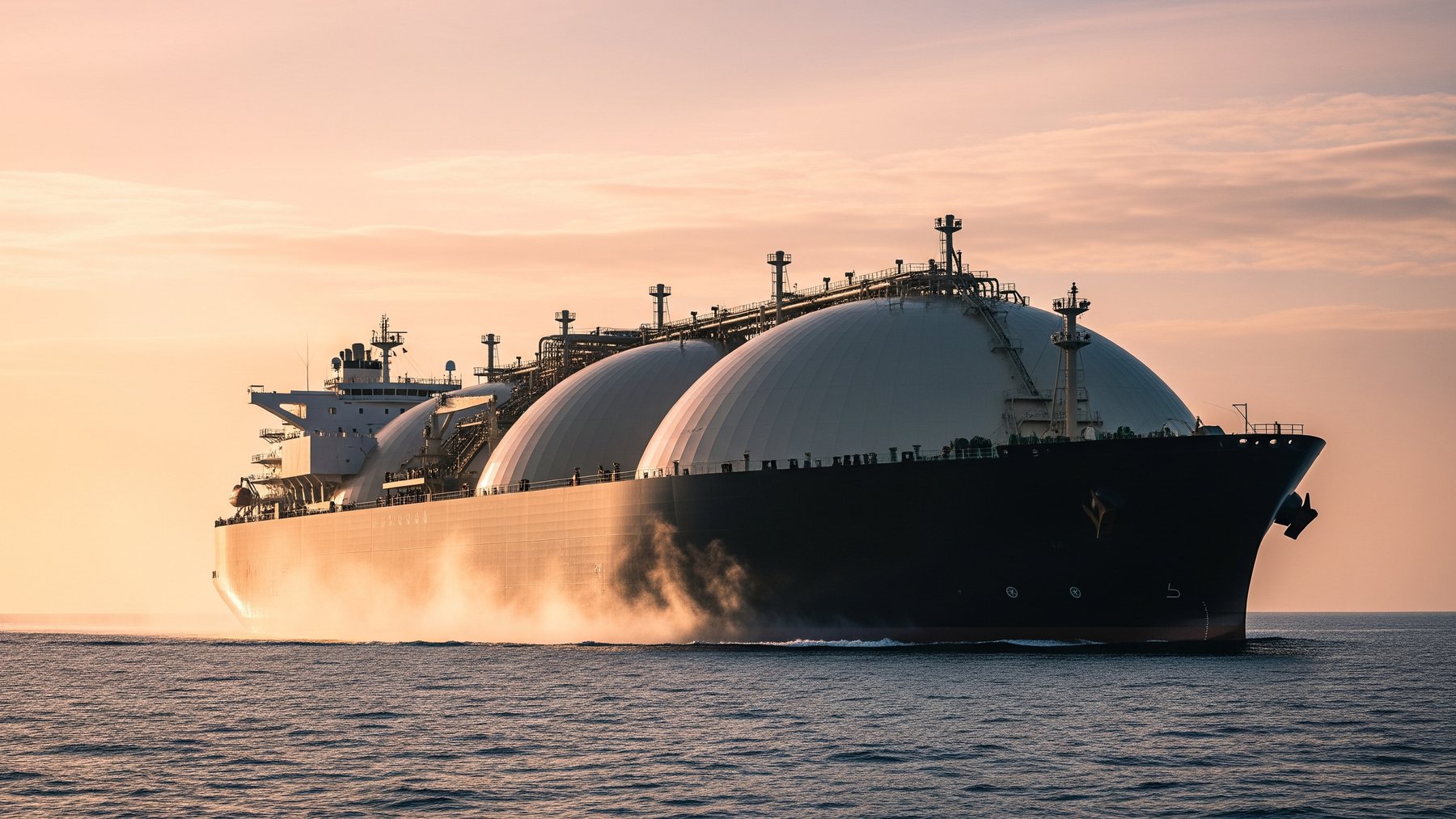
That same fuel now fits inside the curved, gleaming dome tanks of a specialized ship. Special tankers known as LNG carriers, outfitted with supercooled cryogenic tanks, transport the liquid from countries like Qatar and Australia to markets in Europe and Asia.
The ships themselves are engineering marvels, their hulls insulated so thoroughly that the cargo stays liquid for weeks at a stretch across open water.
A global river of cold running under the oceans
The scale of this trade is staggering. The US has been the world’s largest producer of natural gas since 2009, and since large-scale LNG exports began from the continental United States in 2016, the country has shipped LNG to over three dozen countries on five continents.
Every voyage keeps that cargo at an almost impossible cold. During the long crossing, a small amount of liquid inevitably evaporates, and this boil-off gas is often used to fuel the ship’s own engines, increasing efficiency.
It is an elegant system on paper. But when the tanker finally arrives and the terminal begins warming that frozen liquid back into gas, something unexpected happens to the water nearby.
The hidden world that extreme cold reaches
To turn LNG back into usable gas, terminals need an enormous source of heat. The most common and cheapest solution is the ocean itself, but the water returned to the sea has had its warmth extracted, arriving back several degrees colder than it left.
For corals and other marine creatures, that temperature drop can be deadly. One stretch of ocean shows the stakes in vivid terms.
In Batangas, Philippines, the Verde Island Passage is called the “Amazon of the oceans” because its waters hold the highest known concentration of shore fish biodiversity on Earth.
Many of the proposed LNG terminals in the Philippines are clustered in this area. Fishing communities report declining catches and worsening water quality near existing gas infrastructure, though the scale of harm remains contested: the Japan Bank for International Cooperation, a key funder of one terminal, says it found no evidence that LNG development had led to environmental degradation or a reduction in income for local fishing communities.
You can read about another unexpected relationship between lobsters and energy infrastructure, where the story took a far more hopeful turn, and about how offshore structures can reshape ocean life in ways almost no one anticipated.
The wonder hiding inside the cold chain
Here is where the story tips into something genuinely astonishing. The same extreme cold that threatens marine life near terminals is driving engineers toward solutions that are accidentally cleaner than anyone planned.
Some terminals are now being redesigned to use the cold as a resource rather than a problem. The deep chill released as LNG warms back to gas can cool data centers, freeze food, and drive air conditioning systems, turning waste into a secondary energy product.
Meanwhile, engineers and energy planners are increasingly exploring whether the same cold chain infrastructure that ships fossil fuel today could one day carry green hydrogen or biogas tomorrow without rebuilding a single terminal.
The gas that warmed your home this winter may have crossed an ocean as a liquid colder than the coldest temperature ever recorded on Earth’s surface, touched the sea around a coral reef on its way back to being a gas, and set engineers racing to imagine what else that cold chain could carry.
That is not a bad journey for something you light with a spark.
Read the whole thing?
Get the week's signal, not the noise
Our sharpest reporting on energy, climate and nature — free, once a week.