The idea is almost insultingly cheap.
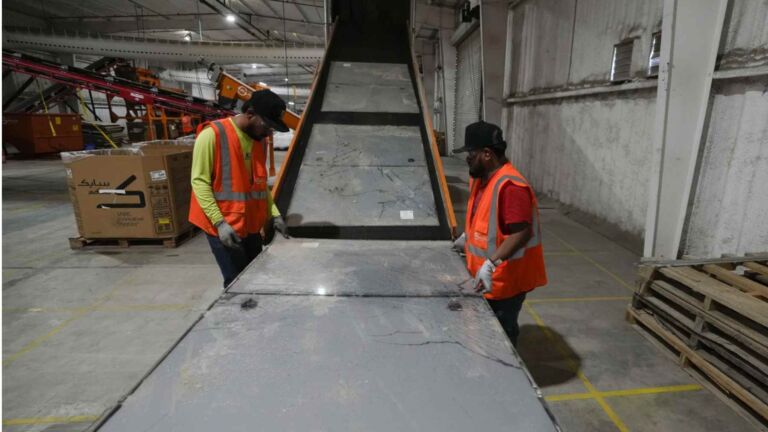
No sensors, no radar, no shutdown system, no software that decides when to stop a machine and start it again. A roller, a bucket and a rope crew.
One blade out of three goes dark.
The other two stay white, the rotor keeps turning, and the power output does not change by a measurable amount.
The reasoning behind it is older than the wind farm.
It came out of a report on how a bird’s eye handles fast movement, written for an American energy laboratory back when most turbines were a third of the size they are now.
Why a turning blade disappears
A raptor has extraordinary resolution and a slow refresh.
Its eye resolves fine detail at distances that would leave a person guessing, but it samples the world at a rate that cannot keep up with something moving very fast very close.
That combination produces smear.
Past a certain tip speed the blade stops registering as an object and becomes a faint transparent blur, so the bird reads the swept circle as open air and flies into it.
Contrast is the lever.
A dark blade against a pale sky puts a hard edge into that blur, and the theory is that one dark blade is enough to make the rotor read as a solid thing rather than a hole.
The island where this was tried
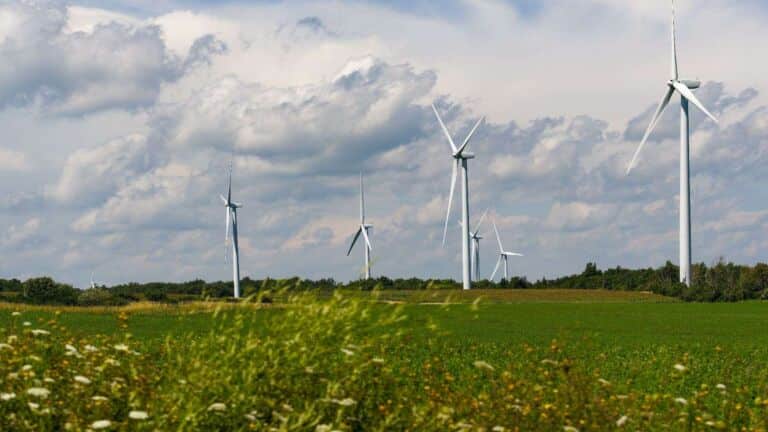
Smola is a low, wet, treeless island off the coast of central Norway.
Sixty eight turbines stand on it, 150 megawatts in total, put up in two phases and producing enough for something like 17,800 Norwegian households.
They are not tall by modern standards.
Towers about 230 feet high, rotors between 249 and 270 feet across, which puts the swept circle exactly where the local birds already flew.
The local bird is the issue.
White tailed eagles nest on that island, with wingspans reaching eight feet, and they hunt by looking down rather than ahead.
What the study actually did
Four turbines had one of their three rotor blades painted, over eight days in August of 2013.
Four neighboring turbines were left alone as controls, and carcass searches ran across the whole set from 2006 to 2016, giving seven and a half years before and three and a half after.
The totals are small.
Across a decade of searching, the eight turbines produced 42 carcasses, which is the number the entire result rests on.
The direction is not in doubt.
Painted turbines went from 11 to 6, while the untouched ones went from 7 to 18 over the same stretch.
The eagles are starker still.
Six were found under the painted turbines beforehand and none at all under the controls, in either period, which leaves that headline with nothing to measure itself against.
Somebody tried it again and got nothing
A Dutch pilot ran from 2021 to the middle of last year.
Seven turbines at a coastal site had one blade blacked, and the monitoring was far heavier than carcass searching, using thermal and high resolution cameras, vibration sensors and bird radar.
The finding was no finding.
Painting the pilot blades produced no significant reduction in strikes, and the suggested reason is that a black blade needs a pale background to work against.
That is not a small footnote.
It is the first serious attempt to repeat the Norwegian result somewhere else, it used better instruments, and it came back empty, which is why other patterns including painted stripes and red banding are back on the table.
What would actually settle it
A far larger trial is running in Wyoming.
One blade has been painted on 36 turbines with roughly a hundred untouched ones alongside them, which is nine times the treated sample the Norwegian work had.
The searching is better too.
Trained dogs work the ground under the rotors, and the count will run for several years, at a site whose operator has already paid heavily over bird losses.
That history is part of why it was chosen.
Dozens of golden eagles were counted at the same complex in the enforcement case that preceded it, which makes the site both the hardest test and the one with the most riding on it.
Turbine bases matter as much as blade tips, as anyone watching a Wyoming prairie for pollinators will tell you.
One limit sits above all of this.
A great many collisions happen after dark, and no amount of paint is visible then, so even a working black blade can only ever address the daylight half of the problem.
What the paper claims is narrower than the headline it produced.
Four turbines on one island showed a large drop against four that got worse, and the honest position is that this is a promising lead rather than a solved problem.
Read the whole thing?
Get the week's signal, not the noise
Our sharpest reporting on energy, climate and nature — free, once a week.