Somewhere in the suburbs right now, one is lifting a trash lid, working a latch, or sitting on a porch railing watching the neighborhood like it owns the place.
Most people write it off as a nuisance.
Researchers, it turns out, have been underestimating it for a very long time.
A study published in 2026 just revealed something so unexpected about this animal’s mind that it is forcing scientists to rethink what animal intelligence actually looks like.
The animal almost every American has seen but never really looked at
It shows up at dusk, bold as anything, moving down a suburban driveway like it has an appointment to keep.
It has been doing this across North America for thousands of years, from the dense forests of the Southeast to the manicured yards of the Pacific Northwest.
By one estimate, raccoon populations inside American cities have exploded in recent decades, with densities in some urban areas far higher than in any wild habitat they originally came from.
Most homeowners see a pest.
Scientists have been finding something altogether different, especially in the last few years.
Even their tracks tell a story: five long fingers splayed in the mud, less like a paw print and more like a small hand pressed deliberately into the earth.
A brain built more like yours than you might expect
Raccoons exhibit advanced intelligence, problem-solving and memory abilities, with brains densely packed with neurons and specialized cells similar to those found in primates.
That is not a small thing.
Their dexterous forepaws are mapped in the brain the way human hands are mapped in ours.
Every time one feels its way around a latch or a lid in the dark, the neural architecture firing inside its skull is closer to a human hand exploring an object than to a paw simply pawing at it.
Although the species is known for its curiosity and problem-solving skills, raccoons have largely avoided the scientific spotlight.
That gap in the research is starting to close, fast.
The puzzle box that started changing minds
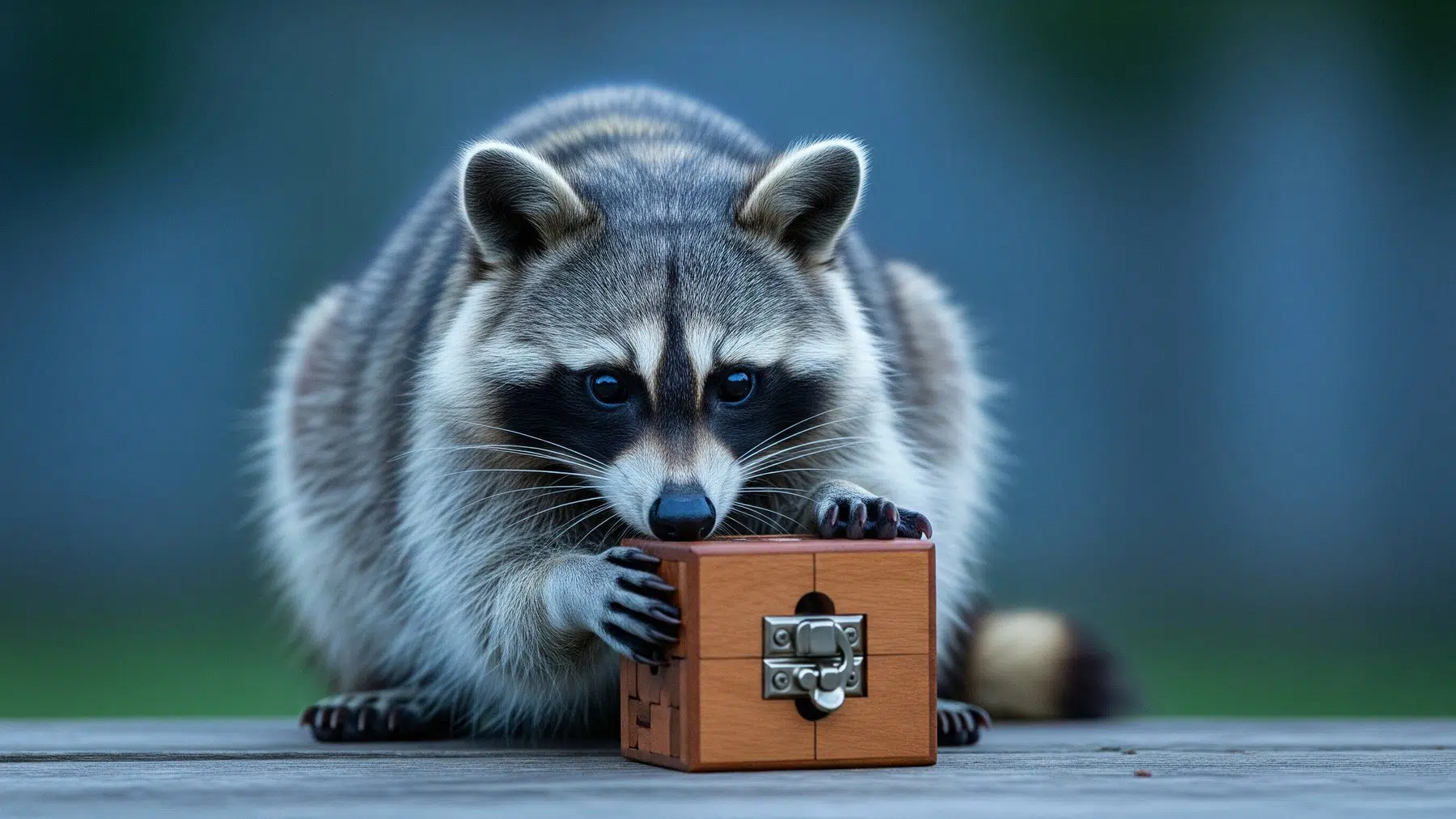
Scientists had already placed puzzle boxes in real backyards, setting them out near residential yards in places known for high raccoon activity.
They designed a new type of box with 24 food-filled compartments rather than the typical single compartment, giving more data points and more chances to watch raccoons pivot when one approach stopped working.
In one instance, a raccoon shoved a skunk out of the way to fiddle with a difficult latch, then opened it with ease.
In another, some raccoons waited near the box until a competitor solved it, then shoved that animal aside and claimed the reward without any of the work.
That is not scavenging.
That is strategy.
One raccoon named Great Basin dodged competitors entirely by jumping on top of the contraption and unlatching a difficult lock while hanging upside down.
Researchers watching the footage described the move as improvised and immediate, with no trial-and-error warm-up at all.
The marshmallow that revealed the real surprise
Then came the finding that changed the conversation entirely.
Researchers built a custom multi-access puzzle box fitted with latches, sliding doors and knobs, grouped into easy, medium and hard entry points.
Each 20-minute trial contained a single marshmallow, yet raccoons kept opening new mechanisms long after eating it.
They kept going not for food, but simply to find out what the next door would do.
A UBC study in the journal Animal Behaviour describes this behaviour as “information foraging,” because no additional reward was given for continuing.
That kind of curiosity, the drive to learn for its own sake, is something scientists once reserved almost exclusively for humans and the great apes.
The same instinct to probe a familiar thing and find a stranger truth underneath drives the dishwasher pods story, and it echoes in the biology of the palm-sized crab that has been pushing fifty miles up American rivers on an equally underestimated body.
What the masked forager is telling us about intelligence itself
The raccoon rummaging through your compost at midnight is not just hungry.
It is, in a meaningful sense, exploring.
Studying raccoons in naturalistic settings may provide valuable insights into neural mechanisms underlying impulse control, attention and cognitive flexibility that are directly relevant to human brain function.
Their ability to solve puzzles for the sake of information, rather than immediate nutritional gain, suggests a behavioral flexibility that lets them thrive wherever humans build cities.
Researchers are careful to note that the study used captive animals, and wild raccoons facing hunger, territory disputes and weather may behave differently.
But the core finding still stands: the animal most Americans shoo off their porch is driven by the same restless need to figure things out that has powered human curiosity for tens of thousands of years.
A raccoon at a puzzle box is not a party trick.
It is a window into a mind that has been taking notes on us for just as long as we have been ignoring it.
Next time one sits on your fence and stares back at you, it may genuinely be sizing up the problem.
Read the whole thing?
Get the week's signal, not the noise
Our sharpest reporting on energy, climate and nature — free, once a week.