For the rest of the migration season, the Trail Bridge Powerhouse will serve fish before electricity.
An Oregon hydroelectric plant has effectively hit “pause” until the end of the year.
The temporary change will allow thousands of salmon and trout to move through the waterway.
On July 2, the Eugene Water & Electric Board (EWEB) shut down electricity generation at the Trail Bridge Powerhouse. The seasonal shutdown was implemented because fish migration is typically completed by that date.
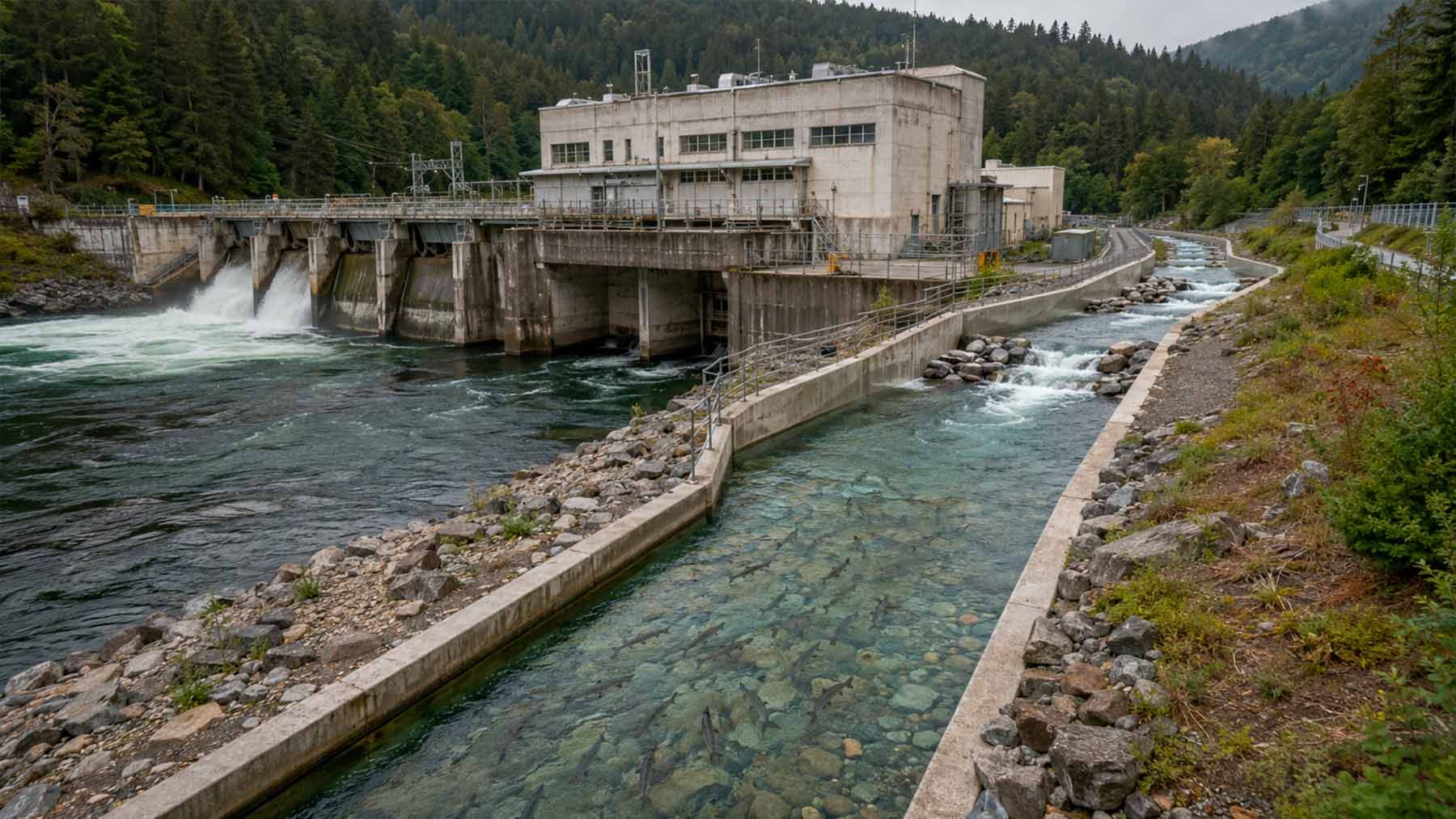
Instead of flowing through turbines, water is being diverted through the dam’s spillway for fish migration.
A river route fish still follow
The Trail Bridge Dam, located on Oregon’s upper McKenzie River as part of the Carmen-Smith Hydroelectric Project, is currently being utilized as a migratory route for fish. In addition, it is considered the highest point at which fish can naturally migrate past.
Different areas within a river support different phases of life, including juvenile growth, spawning, and seasonal refugia. However, hydroelectric dams can disrupt this process.
Consequently, utilities and wildlife managers collaborate with each other to provide improved routes for fish passage throughout a watershed.
The change comes during a critical period for fish migration.
Therefore, adjustments to dam operations were made at Trail Bridge so migrating fish would have easier access to pass downstream.
More than a temporary shutdown
This short-term modification of the dam operation is merely one component of a longer-term program. EWEB is implementing changes for permanent downstream fish passage improvements at Trail Bridge.
Through these efforts, fish could gain access to river sections that are currently harder to reach.
Additionally, a $24 million investment is planned for an additional downstream passage solution.
Another proposed plan includes the installation of a trap-and-haul fishery below the dam. This system is designed to assist with transferring adult salmon and bull trout into upstream spawning habitats.
Together, these two systems improve connectivity between habitats that are separated by hydropower structures. Restoring those connections can help fish reach habitats that once became inaccessible.
Presently, the shutdown represents an interim solution while those longer-term fish passage improvements continue to advance.
That raises an obvious question about the powerhouse itself.
When water stops making electricity
Typically, most hydroelectric facilities require a constant flow of water to produce electrical energy.
The water then flows over or under large turbine blades. After exiting the turbine blades, the water continues downstream.
At Trail Bridge, similar to other hydroelectric facilities, water does make use of a turbine to produce electricity prior to continuing downstream.
In this instance, however, the route taken by the water has changed.
Why and how will the hydroelectric plant pause?
EWEB decided to stop generating electricity at the Trail Bridge Powerhouse and send water through the spillway instead. Utility personnel refer to this method of operation as a “full spill.”
Under typical operating conditions, water that moves through the powerhouse produces electricity. During fish migration season, however, that exact same water bypasses all of the generating apparatus altogether.
Diverting the water through the spillway allows migrating fish to have a safe route downstream from the dam.
Ultimately, its federal license permits the full-spill operation.
One reason the full-spill operation was possible is that Trail Bridge is not the major generating unit in the Carmen-Smith project. While Trail Bridge produces approximately 9-10 megawatts, Carmen Powerhouse produces 110 megawatts.
For four months after July 2, water that would normally generate electricity will instead support fish migration.
The shutdown shows how a hydropower facility can temporarily change its role when river conditions require a different priority.
Similar fish-passage projects are exploring whether other rivers can reconnect migration routes that dams once interrupted.
Read the whole thing?
Get the week's signal, not the noise
Our sharpest reporting on energy, climate and nature — free, once a week.