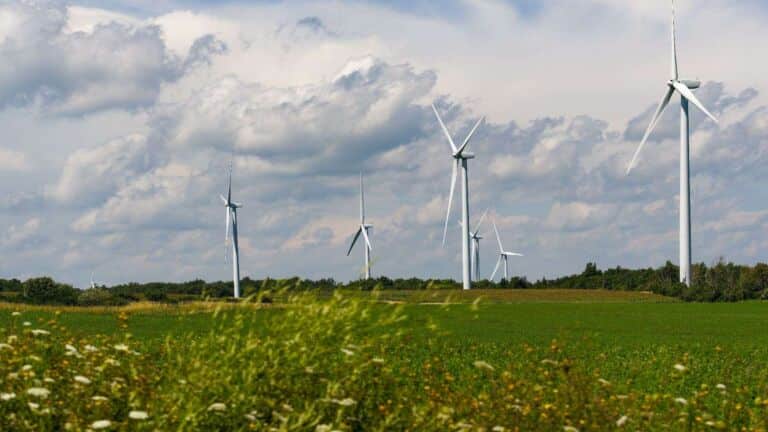
The prairie in southeastern Wyoming does not offer much to look at.
Grass, sage, a lot of sky.
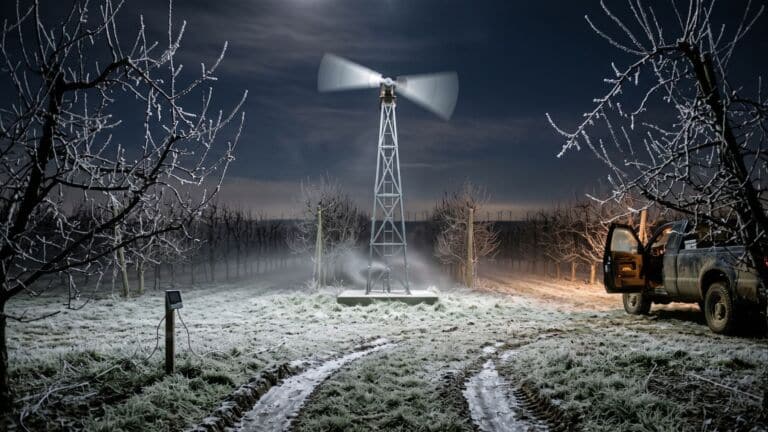
Then the towers, spaced out across it, each one standing on a wide pale cylinder that is the brightest object for miles in any direction.
A crew walked transects out from those towers with nets.
The expectation was that pollinators would thin out under the machines and pick up in open country, and the numbers came back the other way around, highest at the bases and falling with every mile.
What a white cylinder does on an open plain
Color is the first explanation, and it is the one with evidence behind it.
Insects on a plain read color as advertising, and a tower base is a very large flat surface painted a very specific shade.
Somebody tested this directly.
An earlier trial put out turbine mimics in nine different colors and counted what landed on them, and abundance was highest beside the white, violet and blue ones.
The dull colors did the opposite.
Green, orange, yellow and both shades of gray drew the fewest insects, which turns paint into a design choice with an ecological consequence rather than a cosmetic one.
The flowers that were shut and still made seed
The second finding is stranger and rests on thinner ground.
Researchers bagged flowers on native forbs so no insect could reach them, leaving self pollination as the only route to a seed.
Those bagged flowers did poorly, as expected.
They developed about 7 percent of their seeds against 45 percent for flowers left open or hand pollinated, which is the ordinary answer and not the interesting part.
The interesting part is where they did best.
Seed number and mass in the bagged flowers fell with distance from the turbines, and the proposed reason is infrasound, the low frequency vibration these machines put out at or below 20 hertz.
Shaking a flower drops pollen onto its own stigma. That is the idea, and nobody put an instrument out to measure the vibration and confirm it.
What the survey actually collected
The work ran across six sites, from inside a 74 turbine facility out to a reference point about 17 miles away.
Two summers of sampling, mid May to August, with hand netting on transects and blue vane traps left out for stretches between May and July.
More than 3,000 insects came in.
Ninety nine percent of them were bees, across 31 genera including eight bumble bee species, plus 12 species of butterflies.
The two methods disagreed, which matters.
Netting found bees and butterflies most abundant inside the facility, while the vane traps caught the fewest there, and the authors read that as the traps losing a competition for attention against the towers.
The community was also skewed. At the facility 94 percent of bees were medium tongued, a mix that cannot reach into deep flowers.
Why this is not simply good news
Pulling insects toward a wind facility is not the same as helping them.
The authors say so plainly, pointing out that concentrating insects near turbines is a reason to reduce attraction rather than a conservation win.
The caveats are theirs too.
Both field seasons ran through drought, the vibration was inferred from distance rather than recorded, and every net and trap sat at ground level while insects also move around at hub height.
Other places have come out differently.
Around a 394 foot Polish turbine the unmown gravel at the foot of the tower held about as many wild bees as the grassland next to it, which is a different result with a different cause.
And insects reaching the blades are not harmless, since the residue they leave up there can cost a wind farm up to 25 percent of its output.
What a land manager can actually do
Two levers come out of this, and one of them is close to free.
If a white base pulls pollinators toward the machines, painting the base something duller moves them away, and the color trial already says which shades to reach for.
The second lever is the ground.
Where the flowers sit decides whether insects gather under the blades or well clear of them, so seeded margins along access roads and set aside corners are a way to move the crowd.
Neither of these is speculative.
Both are ordinary maintenance decisions that already get made for other reasons, and the only new thing is that somebody has now counted what they do.
The towers will keep turning regardless.
What gets planted between them, and what the turbine bases are painted, are the parts anybody can still change.
The published study has the gradient and the seed data. The color trial has the nine shades.
Read the whole thing?
Get the week's signal, not the noise
Our sharpest reporting on energy, climate and nature — free, once a week.