Astronomers who are studying the gravitational microlensing archive data of a star system that was discovered years back have finally been able to separate the two stars.
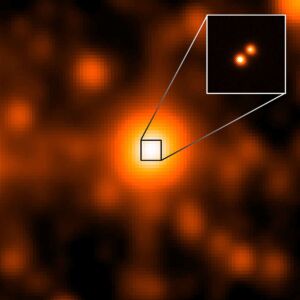
High resolution images have enabled scientists to identify both of these burning stars in the complicated target field.
Even after obtaining images of the light from both of these stars, it is still impossible for the scientists to verify whether the gas giant planet orbits the main star, the companion star, or the circumbinary orbit.
Revisiting the past gravitational microlensing discoveries from the space archives
The microlensing technique is used to detect planets using the gravitational effect of light amplification caused by stars passing through interstellar space in the galactic bulge.
In the year two thousand six, a small magnification signal was detected by a series of telescopes and indicated the existence of a planet.
Light curves were stored without detecting the photons from the lensed stars located in our galaxy.
The mass anomalies make direct imaging hard in all space exploration programs.
The optical resolution needed to image the lensing system could not be achieved by researchers at the time of the surveys.
Faint stellar flux isolation with advanced telescopes on the ground
Observatories fitted with adaptive optics were used to study the historic microlensing coordinates, capturing starlight from the lenses directly.
The adaptive optics technology fixed the problem of atmospheric distortion by altering the shape of mirrors several hundred times every second.
Photons detected showed two bright objects separated by an extremely small angle in the night sky.
Stellar flux data verified the separation parameters of the binary system.
Discovery of two individual stars debunked the earlier assumption about the involvement of a single host star system.
The confirmation of faint light detection ensures that this is actually a binary star system.
Orbital mechanics in binary star systems
Orbital mechanics theory describes the gravitational forces that exist between two stars in a binary star system.
Two stars revolve around their center of mass and exert huge gravitational forces outside.
The planetary orbit in multi-stellar systems is subjected to huge gravitational disruptions.
This makes it difficult to determine the orbit of the planets.
From the gravitational calculations, the planets can exist in a stable region in the two-star binary system.
Due to the geometrical complications, it is impossible to determine whether one of the stars is keeping the planets within the gravitational pull all the time.
There are tidal forces that affect the planets’ orbit frequently.

The process of finding planetary host stars using gravity
Astrophysics computer simulations were done in order to find the match between the light curve of the binary star and the magnification profile of the microlensing in history.
These equations were used to test whether the planet is orbiting around the primary star or the secondary star object.
Both models have resulted in the same magnification profile for the first transiting of the planet in space, according to arXiv.
The statistical models are unable to differentiate between the two degenerate orbit models based on current photometry light curves.
The clear results do not help us to identify which star the planet belongs to even after the direct imaging of the stars.
Degeneracy in parameters makes the situation more complicated, as reported by the University of Warsaw.
Discovering multiple star systems in future space telescope missions
Measuring astrometric wobble in order to detect orbit motion in the binary star system will be achieved in the future by means of the upcoming space telescopes.
Orbit motions can only be detected after some years of accurate position measurement using special instruments that measure orbit motions specifically in space.
Whether the planet moves around one of the stars or both stars needs to be determined through future measurements.
It is very important to know how the planets are formed in such a complex environment with many stars.
Future technology would reveal the dynamics of star nurseries in the Milky Way.
The new mission is underway.
Read the whole thing?
Get the week's signal, not the noise
Our sharpest reporting on energy, climate and nature — free, once a week.