For years, astronomers trained their telescopes on Sagittarius A* — the supermassive black hole at the Milky Way’s center, four million times the mass of the Sun — and waited. Several dusty objects were spiraling through its gravitational grip, and every theoretical model pointed to the same outcome: the black hole would stretch them apart and swallow the remains.
The vigil stretched on. The destruction never came.
A black hole that was supposed to be a cosmic shredder
Sagittarius A* sits at the galaxy’s center with a gravitational pull so extreme that anything venturing too close should, by most theoretical accounts, be torn apart. The process even has a name: spaghettification, where tidal forces stretch an object into a long, thin strand before it’s consumed. For nearby dusty objects, astronomers assumed it was only a matter of time.
Dr. Florian Peißker and his team at the University of Cologne spent years monitoring these objects, waiting to watch that process unfold. They used the Enhanced Resolution Imager and Spectrograph — ERIS — mounted on the Very Large Telescope in Chile, one of the most capable instruments available for observing the galactic center. Their findings were published in Astronomy & Astrophysics.
What they found contradicted the script entirely. The objects showed stable orbits. No spaghettification — just persistence. The core surprise wasn’t that one object survived, but that the pattern held across multiple targets, suggesting something fundamental about the galactic center had been misread all along.
G2: the ‘doomed’ gas cloud that refused to die
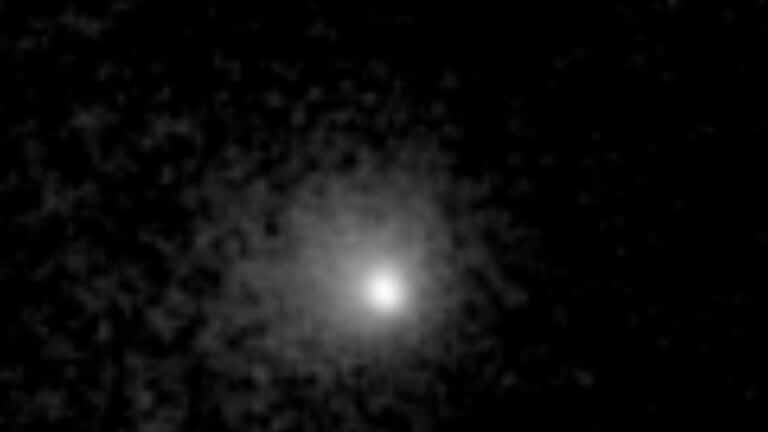
No object attracted more confident predictions of doom than G2. Astronomers widely classified it as a simple cloud of gas and dust, which made it a textbook candidate for destruction. As it approached Sagittarius A* on a close orbit, researchers expected the black hole’s tidal forces to do exactly what physics said they should: stretch G2 into a thin filament and eventually swallow it whole.
The anticipation was real. Scientists described what spaghettification would look like in observable terms — a brightening, a stretching, a dispersal of material. Models were specific. Confidence was high.
The new ERIS observations told a completely different story. G2 continues to follow a stable orbit with no visible signs of disruption. “The fact that these objects move in such a stable manner so close to a black hole is fascinating,” Peißker said, adding that the results suggest Sagittarius A* is less destructive than previously believed.
The emerging explanation centers on what G2 might actually be. The observations suggest the dusty cloud likely conceals a star at its core — a stellar interior that would give G2 far more structural integrity than a simple gas cloud, which would account for why tidal forces haven’t torn it apart. Physics didn’t fail here. The object was misidentified from the start.

Four survivors: D9, X3, and X7
G2’s survival alone could have been dismissed as an edge case. Peißker’s team didn’t stop there. Three additional objects — D9, X3, and X7 — showed the same pattern of unexpected stability, and each one adds weight to the conclusion that something systemic is happening near Sagittarius A*.
D9 is the most structurally remarkable. Discovered by Peißker and colleagues in 2024, it’s the first known binary star system ever observed this close to a supermassive black hole. Theory predicted that the intense tidal forces surrounding Sagittarius A* would merge D9’s two stars into a single, larger object. That merger hasn’t happened — the binary remains intact throughout the observation period.
X3 and X7 round out the picture, both continuing along stable orbits near the galactic center with no meaningful signs of disruption. Individually, each finding is interesting enough. Taken together — four objects, same environment, same unexpected outcome — the pattern becomes very hard to explain away as coincidence. This is no longer an isolated anomaly. It’s a systemic finding that challenges what astronomers thought they understood about the galactic center’s destructive capacity.
A more complex portrait of the galactic center
The standard model of supermassive black holes casts them primarily as destroyers — gravitational engines that shred, consume, and erase whatever falls within reach. These findings suggest that picture is incomplete, at least for Sagittarius A*.
Michal Zajaček of Masaryk University in Brno, Czech Republic, offered a broader interpretation. The supermassive black hole, he noted, “has not only the capability to destroy stars but it can also stimulate their formation or the formation of pretty exotic dusty objects, most likely via mergers of stellar binaries.” That’s a meaningful reframe: the same gravitational environment that was supposed to annihilate these objects may actually be responsible for creating them.
Peißker described the galactic center as “an ideal laboratory for studying the interactions between black holes and stars.” A laboratory is a place where conditions are extreme but legible — where careful observation yields insight rather than just spectacle. That framing matters more than it might seem.
Future observations with ERIS and the Extremely Large Telescope, currently under construction, are expected to keep tracking these objects as they evolve. Scientists hope those observations will clarify how stars and dusty stellar systems manage to survive in one of the most hostile environments in the galaxy.
What lingers after all of this is a quieter question. If astronomers were this confident about what would happen near Sagittarius A* — and were this thoroughly wrong — it’s worth asking what else the galactic center is doing that no one has thought to look for yet. The black hole didn’t behave as expected. That might be the most important data point of all.
Read the whole thing?
Get the week's signal, not the noise
Our sharpest reporting on energy, climate and nature — free, once a week.