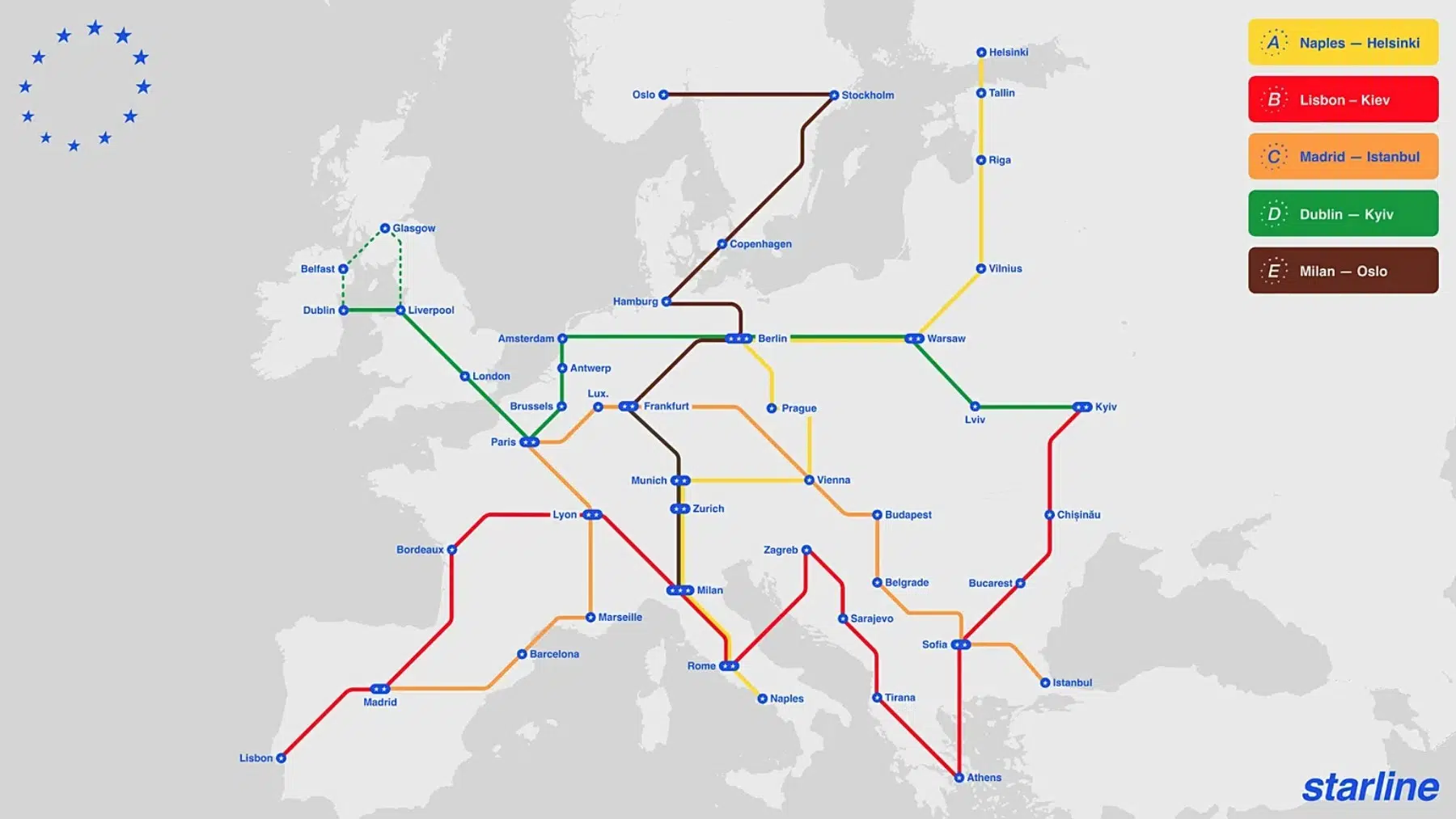
Can you imagine traveling from Lisbon to Helsinki in just 3 hours? Well, your wildest dreams are about to come true, as Europe will build the first “continental subway” in history. Travel times will be cut shorter, be more sustainable, and much more efficient in this revolutionary move proposed by a well-known Danish institute. Discover which major cities will be linked together by one of the world’s most futuristic metro concepts. Who knows, we could be witnesses to history in the making!
A call to revolutionary changes in travel
Millions of people travel across Europe every year for holidays and work alike. Whether visiting a loved one in the nearest city, or traveling abroad for some quality family time or a well-deserved vacation, one thing remains certain: Conventional travel, especially in Europe, may not be all it’s cracked up to be. There are several disadvantages linked to conventional travel, including, but not limited to:
- Environmental disadvantages
- Plane and car travel are significant contributors to overall carbon emissions
- Climate change becomes inevitable thanks to air pollution
- Traffic congestion
- Noise pollution
- Health Disadvantages
- Sitting still for extended periods, such as on international flights or traveling between states, is not healthy for your blood circulation
- Financial Disadvantages
- Some flights are expensive, especially during the in-season
Fortunately, an unconventional mode of travel could be within our grasp soon, as Europe plans to build a “continental subway,” the first of its kind. You may even be able to travel from Lisbon to Helsinki in just 3 hours! Find out more below.
Europe will build the first continental subway in history
2025 has been full of surprises, from a revolutionary billion-dollar cross-continental energy system in Africa to the first continental subway in Europe. Now, the latter has been in talks for a while, as the Danish institute, 21st Century Europe, has already conducted all the required research. The institute’s proposal entails the construction of a ‘fast European Metro’, which will link 39 cities across Europe — among them:
- Budapest
- Paris
- Berlin
- Rome
- Vienna
- Lisbon
- Warsaw
Advantages of the European Metro
- Trains will have the ability to travel at speeds of 300 to 400 km/h (186 mph to 249 mph)
- Shorter travel times
- More cost-effective means of travel
- Reduced traffic congestion on roads and airports
- Reduced carbon emissions (especially from planes)
The proposed continental subway will link 39 cities across Europe, with the main goal of replacing air travel on short to medium-range routes. The routes will altogether be a whopping 13,670 miles.
Routes include Lisbon to Helsinki in just 3 hours
Prospective European Metro users will be able to use the train travel service at five major corridors:
- Line E
- Milan to Oslo
- Stops in Copenhagen, Hamburg, Stockholm, Munich, and Zurich
- Line D
- Dublin to Kyiv
- Linking Liverpool, London, Paris, Warsaw, and Berlin
- Line C
- Madrid to Istanbul
- Passing Paris, Barcelona, Frankfurt, Sofia, and Belgrade
- Line B
- Lisbon to Kyiv
- Connecting Lyon, Madrid, Zagreb, Milan, Bucharest, and Athens
- Line A
- Naples to Helsinki
- Linking Milan, Rome, Zurich, Vienna, Munich, Berlin, and Prague
Whether you are traveling for business or pleasure, this experience will not only be efficient but also extremely convenient. In an even more unconventional approach, the trains will be like ‘moving hotels’, featuring everything from family cabins to workstations and communal areas.
Only time will tell how soon we will witness history in the making, as this innovative proposal still faces several challenges, including the synchronization of Europe’s various national rail systems. Significant upgrades will also be required, which means it may still be a while before the proposal becomes a reality. Nonetheless, the adventurous prospect remains exciting! In other sustainable travel and train news, the U.S.’s first-ever solar train is on track with its impressive budget of $100 billion.
Disclaimer: Our coverage of events affecting companies is purely informative and descriptive. Under no circumstances does it seek to promote an opinion or create a trend, nor can it be taken as investment advice or a recommendation of any kind.
Read the whole thing?
Get the week's signal, not the noise
Our sharpest reporting on energy, climate and nature — free, once a week.