
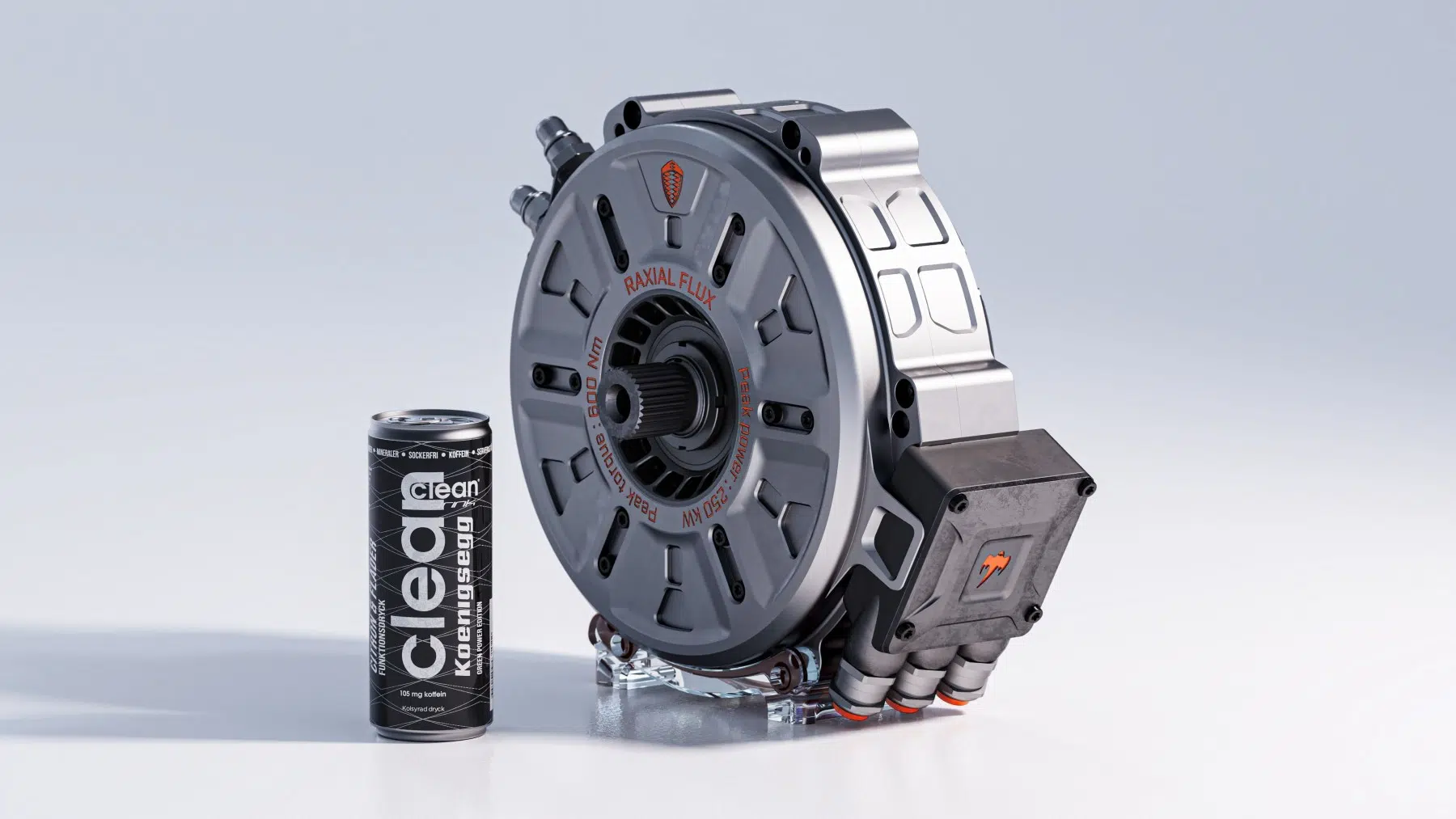
Swedish manufacturer created a new e-motor called Quark. As the automotive world is undergoing a dramatic shift as manufacturers race to redefine performance in the age of electric mobility, traditional engines, with their visceral noise and long the heart of high-powered vehicles, are giving way to innovative electric drivetrains less noisy. More autonomy per kilometer than the regular combustion engine. Designers and engineers are exploring new ways to balance efficiency, torque, and power, pushing the boundaries of what electric propulsion can achieve.
Electric vs combustion: which one performs better?
Interest in cutting-edge electric motors is growing rapidly, driven not only by the global push for sustainability but also by the demand for extreme performance. Enthusiasts and engineers alike are watching developments closely, knowing that the next breakthrough could redefine how speed, acceleration, and energy efficiency are measured in high-performance vehicles.
Amid this evolving landscape, a Swedish engineering team has unveiled a completely new type of electric motor. Its unusual form factor, unique design principles, and focus on maximizing power density have already caught the attention of automotive innovators and tech observers. What comes next promises to challenge conventional assumptions about how electric motors can be built and deployed.
Koenigsegg’s new engine: next generation could be like Quark
Introduced in 2022, the Quark engine merges radial and axial flux motor designs, hitting a sweet spot between torque and power. Without diving into the complex physics, the takeaway is simple: it gives Koenigsegg an industry-leading combination of performance and weight. Peak numbers hold for around 20 seconds — standard for high-performance electric motors — before dropping to 134 horsepower and 184 pound-feet.
That’s ideal for the Gemera model, which pairs three electric motors with a 600-horsepower three-cylinder engine. The Quark also uses advanced materials like aerospace-grade steel and hollow carbon fiber rotors, part of Koenigsegg’s Air core technology. It’s built with aerospace and marine applications in mind, making it as versatile as it is powerful.
Efficiency drives performance: power-to-weight numbers through the roof
Koenigsegg’s CEO highlights the Quark’s efficiency, noting how it balances torque, power, and weight. Because it spins at optimal speeds, the Quark engine can often bypass a traditional transmission in vehicles like boats, planes, or VTOL crafts — saving weight, reducing complexity, and cutting energy losses. Smaller motors might hit higher peak power-to-weight numbers, but they often require a transmission to deliver usable torque, adding weight and parts.
Koenigsegg also offers the Terrier EV drive unit, which pairs two Quarks with a compact inverter and planetary gear sets. The Terrier produces 670 horsepower and 811 pound-feet of torque, weighs just 187 pounds, and includes axle torque vectoring. It’s designed to bolt directly to a car’s chassis for a clean, high-performance setup.
Other major companies like Lamborghini and Ferrari are also trying to create cars powerful enough to maintain the brand status, but also follow the market trends in the pursuit of new, renewable sources of fuel. So far, they were only able to replicate the power – or close – with hybrid systems.
Third-party assisting on the project: meet Donut Lab
Across the Channel, Donut Lab has focused on shrinking motors while keeping output high. According to IEEE Spectrum, their largest supercar-level motor is 53 centimeters (21 inches) in diameter and weighs only 40 kilograms (88 pounds). That delivers an impressive power-to-weight ratio of roughly 9.6 horsepower per pound, or 15.75 kW per kilogram.
Donut Lab claims their motor produces nearly six times the output of Lordstown’s motor at the same weight. For comparison, Koenigsegg’s Gemera “Dark Matter” motor weighs 40 kilograms, uses a six-phase radial-flux layout, and delivers up to 597 kW (800 horsepower) with 1,250 Nm of torque. That gives it a power-to-weight ratio of 14.9 kW/kg — a performance benchmark that clearly puts it at the top of the field.
Our coverage of events affecting companies is purely informative and descriptive. Under no circumstances does it seek to promote an opinion or create a trend, nor can it be taken as investment advice or a recommendation of any kind
Read the whole thing?
Get the week's signal, not the noise
Our sharpest reporting on energy, climate and nature — free, once a week.


