
A rotary engine, often referred to as “Wankel”, owes its name to German inventor Felix Wankel, who first developed the concept. Though he initiated the design, it was the Japanese automaker Mazda that brought the technology to life, refining it into a cult icon. The RX-7, in particular, became synonymous with the spinning-triangle piece under the hood and won fans worldwide with its compact build and smooth, high-revving performance. Nowadays, it is still around, but in a new format.
Mazda’s iconic engine
Rotary motors have long fascinated car enthusiasts with their compact design and smooth power delivery. Yet despite their appeal, they’ve struggled with efficiency and emissions—keeping them from widespread adoption. For decades, the Wankel remained a niche technology, with Mazda nearly alone in refining and popularizing it. Now, an American company is revisiting that concept with a bold new twist.
This new “self-rotating” power plant breaks from tradition by eliminating the crankshaft and using innovative internal mechanics to generate motion—promising a lighter, simpler power source. It challenges long-held assumptions about combustion and opens the door to a reimagined future for engine design across industries.
The rise of the self-rotating engine
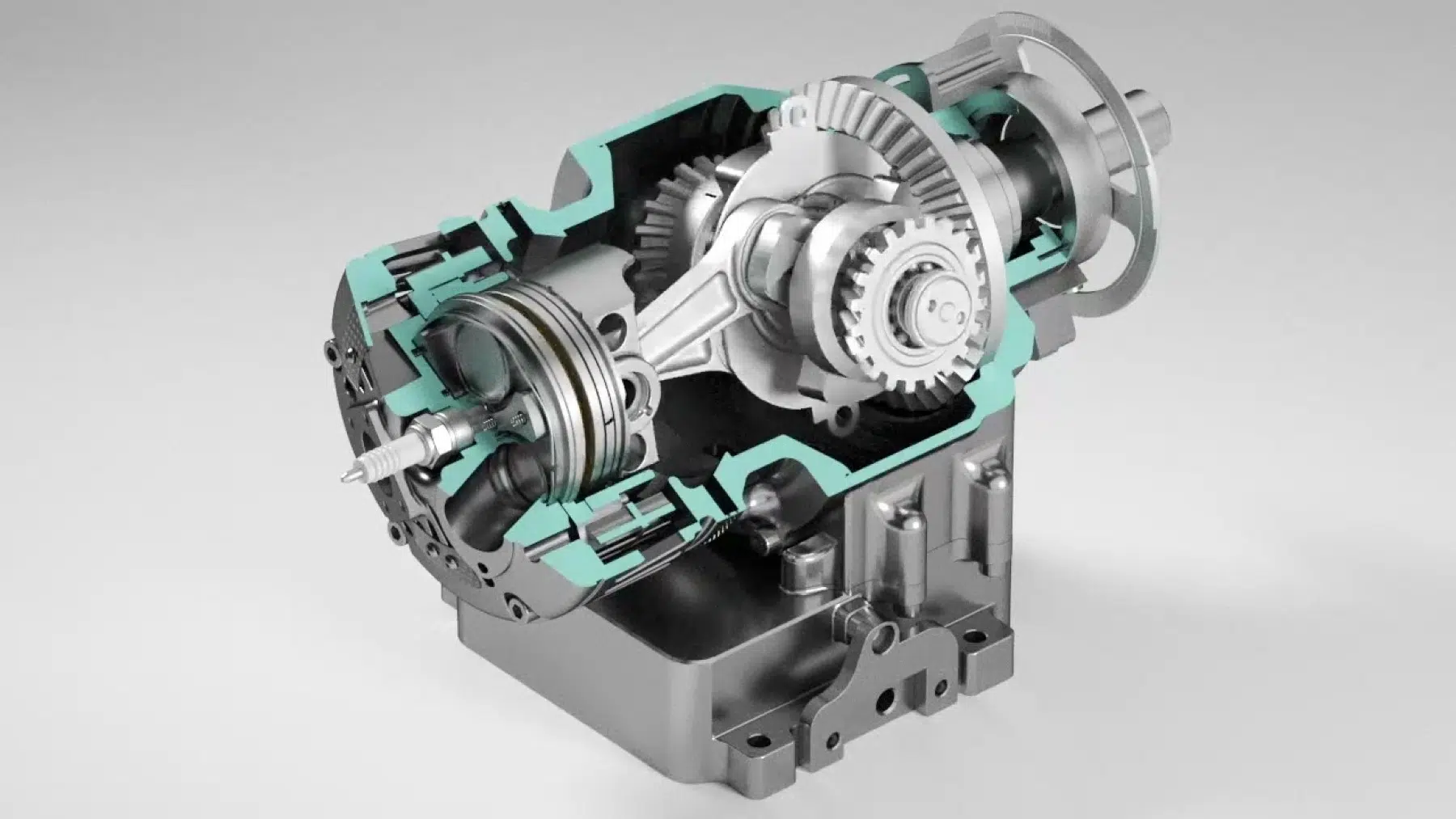
An American company named Avadi is challenging traditional engine design with a radical concept: an internally rotating combustion engine. Instead of the classic Wankel “spinning triangle,” Avadi’s prototype features a single rotating piston driven by two scissor-like connecting rods that engage with pinion gears, translating up-and-down piston motion into rotational output.
Everything inside the crankcase rotates on a fixed ring gear connected directly to the output shaft. The result is an ultra-compact power unit—just 23.6 pounds in total—that can generate nearly 16 horsepower. It’s not designed to power full-size vehicles on its own, but rather to support electric vehicles as an onboard generator, extending range without relying on large battery packs.
A new role for rotary: supporting, not replacing
Avadi’s vision isn’t to compete with traditional engines, but to complement electric power systems. Their rotating piston engine could be used in everything from EV range extenders and motorcycles to ATVs, drones, and even lawnmowers. It represents a rethinking of internal combustion—not as the main driver, but as an efficient assistant.
This approach mirrors trends already forming in the industry. Mazda’s hybrid crossover uses a small rotary motor as a battery recharger. Ram’s hybrid pickup uses a standard gasoline engine for the same purpose. The idea is gaining ground: combustion isn’t disappearing—it’s evolving.
Though Avadi’s motor is still in prototype form, progress is steady. The company is working on a redesigned rotary valve after the original valve design showed deficiencies in airflow, and anticipates run tests in the near future. These upgrades hint at the potential for commercial use.
That said, there’s still some mystery surrounding the motor’s inner mechanics—especially how the rotating piston’s motion translates into usable torque. The company hasn’t revealed all technical details yet, but interest is building. A partnership with an established automaker could be the next key milestone in bringing this innovation to market.
Mazda’s rotary plans going forward
Mazda has unveiled its new “Lean Asset Strategy” aimed at increasing flexibility in its electrification roadmap, cutting R&D spending, and improving production efficiency through strategic partnerships. As part of this shift, the company is scaling back its planned EV investment to around $13.3 billion.
A key component of the plan is the upcoming SkyActiv-Z power plant. Mazda is also staying committed to its “Multi-Solution” approach — offering internal combustion, hybrid, and fully electric vehicles based on regional market needs.
Our coverage of events affecting companies is purely informative and descriptive. Under no circumstances does it seek to promote an opinion or create a trend, nor can it be taken as investment advice or a recommendation of any kind.
Read the whole thing?
Get the week's signal, not the noise
Our sharpest reporting on energy, climate and nature — free, once a week.


