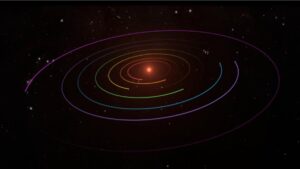
James Webb finds no atmosphere on TRAPPIST-1d, dimming hopes for life on the nearby exoplanet
Earth is still the only planet we know to have life in the universe, but other planets could be capable of holding life. This is why…
Explore the Technology section of The Pulse for insights into innovation, artificial intelligence and technologies shaping the future.
Earth is still the only planet we know to have life in the universe, but other planets could be capable of holding life. This is why…
Aliens have always been a central theme in the imaginations of science fiction lovers and scientists alike, but NASA may have actually found evidence of life…
There are more creatures living in the deep seas than those found “close” to the surface. Some are so old that they survived hundreds of years,…
The universe often hides many things from us. Not on purpose, but due to the distance light travels and our current limitations, sometimes the most amazing…
The current understanding of our three-dimensional universe can change with new research published by the University of Alaska Fairbanks that challenges the concept of time having…
NASA saw a black hole collision, and the consequences of the impact were felt through spacetime at a very high speed – but none of them…
The continuum space-time is not being held together because the universe is made this way. There are invisible forces that scientists from NASA and other space…
The ocean is the most unexplored part of the planet. Not even 10% has been explored to date, and it hides many secrets that humanity may…
In a place where there’s barely any light, scientists discovered something from outer space: a neutrino. For this to travel all the way to Earth, a…
Over the billions of years that the Earth has been around in the solar system, it “survived” multiple extinction events. As the dominant force in our…
A new creature was found in the Grand Canyon, and it belongs to an era when the tourism spot was a big ocean. When the first…
NASA has been searching for any evidence of living organisms that lived or are currently living on Mars for decades. The Red Planet is the only…
NASA has always thrived on rare glimpses into the violent life cycles of stars. For more than a century, telescopes have tracked novas, supernovas, and other…
NASA says that galaxies were formed billions of years after the Big Bang, after the period of ionization, and even though some studies show otherwise, ours…
Albert Einstein’s general theory of relativity has been one of the cornerstones of modern physics. The German scientist achieved it without any of the technology that…
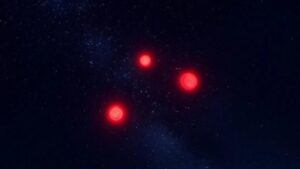
NASA’s James Webb Space Telescope has spotted three ‘red monsters’ that are challenging our understanding of physics. The JWST is one of the most advanced instruments…
In order to go to space, first the ships need to be 100% clean – especially if it’s landing on another planet, like rovers on Mars.…
NASA has spotted something big in the Milky Way. Even though our galaxy may seem one of the most “boring” ones because it’s the one we…
Negative mass was something physicists never thought they would find – let alone create. For more than a century, physics has operated on the foundation that…
The ocean, covering 70% of Earth’s surface, remains one of the least explored frontiers. Despite its vastness, scientists estimate that only about 10% of marine life…
NASA’s planetary defense efforts have intensified in recent years, as the agency has ramped up monitoring of near-Earth objects (NEOs) to better predict and look out…
Astronomers have long grappled with understanding how the earliest black holes formed in the infancy of the universe. Prevailing theories held that these cosmic behemoths emerged…
Venus has not been extensively studied by NASA or any other space agency due to its atmosphere. In contrast, rovers were able to land and start…
NASA found something, not looking for new discoveries, but rather data from 1978. Space exploration has a long history of collecting more data than scientists can…
NASA found something remarkable deep in the heart of the Milky Way. The heart of our galaxy has long been regarded as a quiet, inscrutable void—a…
For centuries, astronomers have studied the final acts of dying stars with a mix of fascination and restraint. Planetary nebulae—once mistaken for cloudy planets—offered a glimpse…
Looking into the cosmos is like taking a peek into the past of the universe. Everything that NASA and other space agencies observe, which is thousands,…
What we previously thought snow looks like is changing with the pink snow that turned red and pink in America. Ever since the formation of planet…
In the far reaches of our solar system, Neptune has long been a gravitational powerhouse. As the eighth and most distant known planet from the Sun,…
NASA has spotted something coming to our solar system using the planetary defensive system, Atlas. Our solar system came into existence around 4.5 billion years ago,…
For most of human history, the question of life beyond Earth had no real evidence to support it — only speculation. But with tools like the…
NASA’s James Webb Space Telescope found three ‘red monsters’ and they are challenging long-held notions about galaxy formation. JWST is one of the most powerful tools…
Some evidence of life from outside our planet is hard to ignore, and after the Asteroid Terrestrial-impact Last Alert System (ATLAS) detected an interstellar object that…
NASA’s exploration of Mars is far from over, but its interest in water now extends well beyond the Red Planet. Across the solar system, ice has…
Astronomers have spotted a structure so massive and oddly shaped that it’s testing the very limits of what we think we know about the universe. It’s…
Scientists looked deeper into the cosmos and, while still standing on Earth, managed to capture galaxies scientists have never seen because light has been traveling for…
A Silicon Valley startup is developing a new type of EUV light source that could challenge Europe’s ASML in semiconductor lithography. The race for developing new…
Antarctica is one of the least explored pieces of land on Earth. Due to its mysterious nature, many theories about the icy continent have come up…
Cosmic fluctuations are the new big bang. Dark matter has long been seen as the invisible glue holding the galaxy together, stopping galaxies and clusters from…
The Earth is in the perfect position relative to the sun. It cannot burn everything down or make the planet hot enough to not support life,…
Saturn is one of the most interesting planets in the solar system. The rings formed by billions of asteroids and comets, which ended up locked in…
NASA has spotted something sending cosmic morse signals. The universe is always reaching out to us. Strange pulses, flickers of light — they come from every…
The Earth is the only planet in the solar system capable of having life inside. Due to the distance to the sun, our planet is in…
NASA is not just exploring Mars and the moons of Jupiter – it is also searching for life in other corners of the universe. The Voyager…
Our solar system was one of many that scientists know of, but NASA found something remarkable recently. Our planet is relatively new to the Universe, as…
The Big Bang is widely considered to be the beginning of the universe, but scientists are not sure about this. According to the theory, the universe…
The universe conceals many mysteries, and one of the most intriguing is how stars are powered. A star is born when clouds of gas collapse and…
Yellowstone isn’t just famous for its beautiful forests, geysers, or mountains. Beneath all that beauty lies one of the world’s most closely watched super volcanoes —…
Scientists’ quest to understand the universe has led them from the vastness of galaxies down to the tiniest quarks. Yet, one of the most puzzling questions…
Dark matter is considered the invisible force that holds everything together in the universe, preventing materials from drifting apart, but what if this could be explained…
The Pulse Newsletter
Once a week we send our best reporting on energy, climate and nature. No spam, unsubscribe anytime.